
Finding senior remote roles is not the same as browsing entry-level work from home jobs. A good remote tech jobs board should help you separate Staff Engineer openings from junior developer listings, fully remote roles from hybrid ones, and serious employers from vague posts.
Disclosure: landremotework.com may earn a commission if you use our affiliate link to visit Remoterocketship. That does not change the criteria below: the goal is to help senior developers, engineers, designers, product managers, DevOps specialists, data professionals, and other tech candidates choose the most efficient places to search.
Listings, filters, and job board features can change over time, so always confirm role details on the employer’s own career page before applying.
Official website · Latest pricing & offers
Why senior remote tech candidates need a different job board strategy
Senior candidates usually have less room for noisy job search tactics. If you are already operating at senior, lead, staff, principal, manager, or head-of-function level, your search depends on signal quality more than raw listing count.
A general job site may have thousands of remote tech jobs, but many will be mismatched by level, location, salary, or remote policy. The best remote tech jobs board for senior candidates is the one that helps you identify the right opportunities quickly.
The gap between general remote boards and senior-level tech roles
General remote boards are useful for market scanning, but they often mix customer support, marketing, sales, design, engineering, and operations roles into the same discovery flow. That is fine for broad browsing, but it can waste time if your target is “Staff Backend Engineer,” “Principal Product Designer,” or “Head of Data.”
Senior tech roles also tend to have more specific requirements. Employers may care about system design, architecture ownership, team leadership, distributed systems, cloud infrastructure, AI/ML experience, security, or product strategy.
That is why a strong remote tech jobs board should let you narrow by function, seniority language, company type, location rules, and sometimes compensation. Without those signals, you spend too much time opening roles that were never a fit.
What senior candidates care about: scope, comp, level, and team quality
At senior levels, job title alone is not enough. A “Senior Software Engineer” role at one company might mean independent feature delivery, while another might expect architecture leadership, mentorship, incident ownership, and cross-functional planning.
The same is true for product, design, DevOps, data, and security roles. A strong job description should clarify scope, reporting lines, collaboration expectations, and business context.
For senior candidates, the most useful remote tech jobs board experience is not just “remote or not.” It is whether the board helps you answer these questions:
| Senior Search Question | Why It Matters |
|---|---|
| Is the role fully remote, hybrid, or location-restricted? | Avoids wasted applications to roles that are not truly remote |
| Is the level clear? | Helps distinguish senior, lead, staff, principal, and head roles |
| Is compensation visible? | Saves time and improves negotiation leverage |
| Is the employer credible? | Reduces risk of low-quality or outdated postings |
| Is the role fresh? | Improves application timing and response odds |
How to evaluate a board before investing application time
Before you commit to a board, run a practical test. Search for your actual target title, such as “Staff Frontend Engineer,” “Senior Product Manager,” “Lead DevOps Engineer,” or “Principal Data Scientist.”
Then check the first page of results. Are the jobs relevant? Are they recent? Are the remote rules clear? Are salary ranges visible? Do the listings lead to real employer application paths?
This five-minute audit is often more useful than reading generic remote tech jobs board reviews. Your role, seniority, and geography determine whether a board is a good match.
Quick picks: best remote tech jobs boards for senior-level searches
If you want the short version, use a small stack instead of relying on one source. Start with a focused remote tech jobs board for discovery, add a known remote-first board for breadth, and use company pages to validate details.
Here is a practical quick-pick framework for senior remote tech candidates in 2026.
| Best For | Board To Consider | Why It Fits Senior Searches |
|---|---|---|
| Broad remote tech discovery | Remoterocketship | Useful as a starting destination for remote tech job exploration |
| Curated remote-first roles | We Work Remotely | Known remote job board with category-based browsing |
| Company transparency and volume | Built In Remote | Useful for tech company research and filterable remote role discovery |
| Tech-focused remote roles | Arc.dev | Remote-focused tech talent context |
| Extra market scanning | TrueUp, NoDesk, Remote.co, Remote.com/jobs | Helpful as supplementary sources |
Best overall for broad remote tech discovery
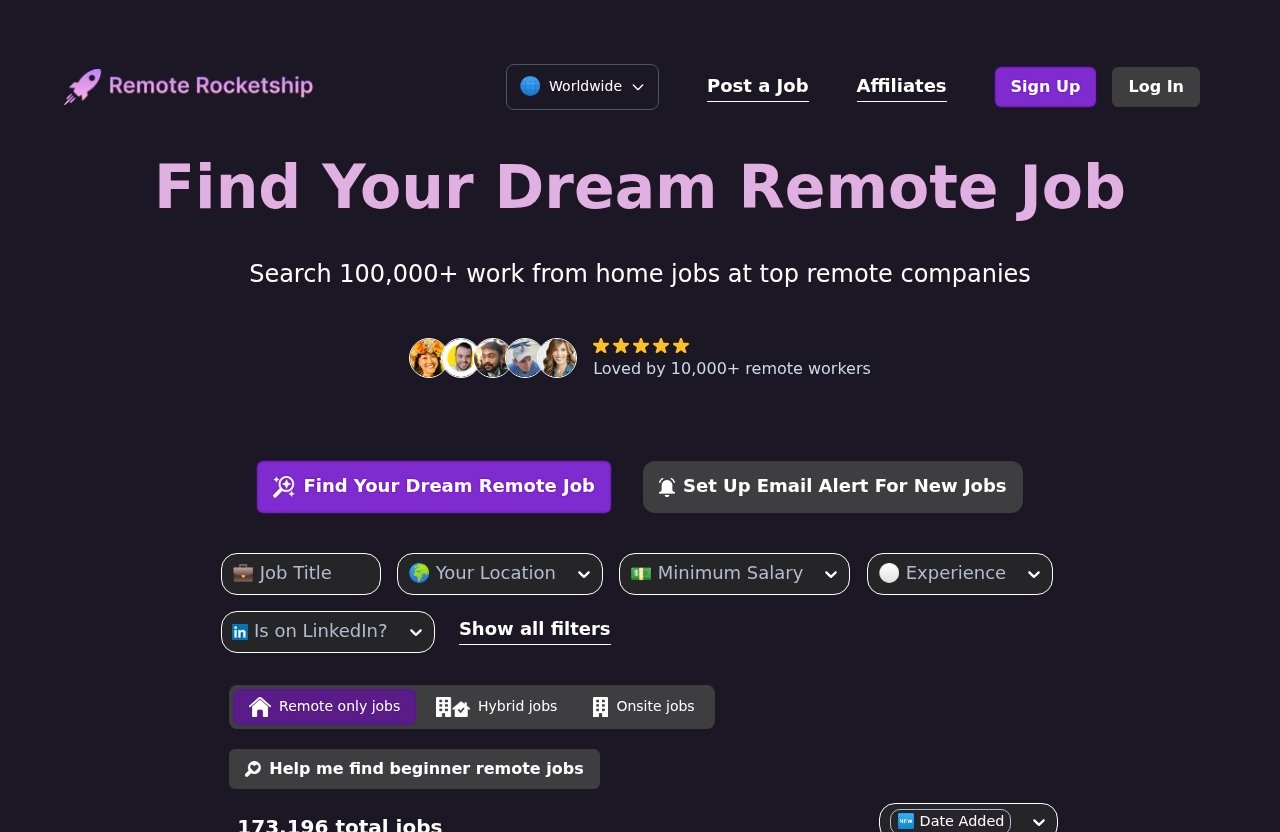
For a senior candidate who wants a focused place to begin, Remoterocketship belongs near the top of the shortlist. Because official Remoterocketship pricing and feature pages were not accessible from the provided source context, I will not make specific claims about pricing, plans, filters, or paid functionality.
What I can say is that it is a relevant affiliate destination for people actively exploring remote tech jobs. If you want to evaluate it directly, you can visit Remoterocketship and compare the live listings against your target titles.
Use it as your first screening layer: search your role family, test seniority terms, and check whether the visible results match your level. A remote tech jobs board earns a place in your workflow only if it reduces irrelevant applications.
Best for curated high-quality remote roles
We Work Remotely is one of the most recognizable names in remote hiring. Its visible structure around remote job categories makes it useful when you want to browse remote-first openings without starting from a massive general-purpose job platform.
For senior tech candidates, the advantage is simplicity. You can scan engineering, programming, product, design, and related categories, then apply your own seniority keywords.
The limitation is that category depth does not automatically mean every listing is senior-level. You still need to search for senior, lead, staff, principal, manager, director, or head terms to make the board work for your level.
Best for company transparency and job volume
Built In Remote can be useful when your search depends on company context. Senior candidates often want to know more than the title: company size, tech market category, culture signals, benefits, and whether the employer has multiple open technical roles.
Visible SERP context suggests Built In is often associated with filterable job search and company-oriented discovery. That can be helpful if you are comparing employers, not just roles.
For senior candidates, this makes Built In Remote a good complement to a dedicated remote tech jobs board. Use it to validate employers, compare open roles, and understand whether a company is hiring across several senior functions.
Best for niche filtering by function or seniority
For tech-specific searches, Arc.dev is worth reviewing because it sits closer to the remote tech talent market than a general job board. It can be especially relevant for developers and engineers who want remote roles across tech companies.
TrueUp and NoDesk can also help in specific situations. TrueUp is useful for market scanning across tech jobs, while NoDesk is a known remote work destination that can surface global work from home jobs and distributed-company opportunities.
The best niche board is the one that matches your function. A senior infrastructure engineer, principal product designer, and head of product may each need a slightly different remote tech jobs board stack.
What to look for in a remote tech jobs board for seniority
The difference between a decent board and a great board is not just the number of listings. For senior candidates, the key question is whether the board helps you make faster, better decisions.
A strong remote tech jobs board should reduce ambiguity around level, compensation, remote rules, and employer quality. If it cannot do that, it may still be useful for volume, but it should not be your only source.
Seniority filters and title matching
Seniority filtering is the first thing I look for. Even if a board does not have a dedicated seniority filter, it should at least support title matching well enough to search for “senior,” “lead,” “staff,” “principal,” “director,” or “head.”
This is where many boards fall short. A search for “senior engineer” might return every engineering listing with “senior” buried somewhere in the description, not necessarily in the title.
A good remote tech jobs board helps you distinguish between:
- Senior Software Engineer
- Lead Frontend Engineer
- Staff Platform Engineer
- Principal Security Engineer
- Engineering Manager
- Head of Product
- Senior Product Designer
- Lead Data Scientist
For senior searches, title accuracy matters because it usually correlates with scope, compensation, and interview expectations.
Salary visibility and comp ranges
Salary visibility is one of the most important filters for senior remote candidates. At higher levels, compensation gaps can be large, and location-based pay rules can change the actual offer.
Some listings show salary ranges; others do not. Some boards make compensation easier to scan, while others leave it entirely to each employer post.
When evaluating remote tech jobs board salary usefulness, look for visible compensation, currency, location assumptions, equity notes, and whether the range appears tied to a specific geography. If a listing says “competitive salary” with no range, treat it as lower signal.
Role freshness and update frequency
Freshness matters because senior roles can attract strong applicants quickly. An older listing may still be open, but your odds are usually better when you apply early and tailor your outreach while the search is active.
Look for visible posting dates, recently added sections, or other signs that jobs are current. If a board repeatedly sends you to expired roles, downgrade it in your workflow.
This is especially important when comparing free sites for remote jobs worldwide. Free access can be useful, but freshness and employer verification still matter.
Remote policy clarity: anywhere, country-specific, hybrid vs fully remote
Not every “remote” job is truly remote. Some are remote within the United States only. Others require overlap with European time zones, legal work authorization in a specific country, or occasional office visits.
For senior candidates, vague remote rules are costly. You may invest time in interviews only to learn that the role is hybrid, region-locked, or incompatible with your working hours.
A good remote tech jobs board should make it easy to understand:
| Remote Policy Signal | What To Check |
|---|---|
| Truly remote | Can you work from anywhere, or only in specific countries? |
| Country-specific | Does the employer require legal residency or payroll eligibility? |
| Time-zone restricted | Is overlap with a team or customer region required? |
| Hybrid | Are office visits mandatory? |
| Travel | Are retreats, customer visits, or quarterly onsites expected? |
If remote policy clarity is weak, confirm directly on the employer’s career page before applying.
Signal quality: company profile depth, skills required, and role descriptions
Signal quality is the overall usefulness of a listing. A high-signal role explains the company, team, tech stack, responsibilities, success measures, interview process, location rules, and compensation where available.
Low-signal posts rely on vague phrases like “rockstar developer,” “fast-paced environment,” or “wear many hats” without explaining the real scope. Senior candidates should be cautious with these listings.
A strong remote tech jobs board does not need to make every decision for you, but it should help you identify promising roles faster. The best boards give you enough context to decide whether an application is worth a tailored resume and thoughtful cover note.
Best board picks, reviewed for senior remote tech job seekers
No single board is perfect for every senior tech candidate. The best choice depends on your function, level, geography, compensation expectations, and whether you prioritize volume or curation.
Below are practical remote tech jobs board reviews based on observable market positioning and visible SERP context, without inventing unverified pricing or proprietary feature claims.
Remoterocketship: why it belongs on a senior remote tech shortlist
Remoterocketship is the primary recommendation to test first if your goal is efficient remote tech discovery. Since the official homepage and pricing page were not accessible in the provided source context due to security verification, I am deliberately avoiding claims about specific plans, prices, trials, or proprietary features.
The reason it belongs on a senior shortlist is straightforward: it is positioned as a destination for remote job search, and senior candidates need focused discovery before they branch out into broader boards. If the live results match your role family and seniority, it can become your primary remote tech jobs board starting point.
Use it practically. Search for your title, apply seniority terms, open several relevant roles, and check whether the postings are current and clear. If you want to evaluate it for your own search, start with Remoterocketship and compare it against the other boards below.
Best for:
- Senior candidates who want a dedicated remote job search destination
- Developers, engineers, product people, designers, DevOps, and data professionals testing remote roles
- Searchers who want a focused first stop before checking broad boards
Watch-outs:
- Confirm all live role details on employer career pages
- Do not assume pricing, alerts, filters, or other features unless you verify them directly
- Compare results with at least one other board before committing your application time
We Work Remotely: category depth and remote-first reputation
We Work Remotely is a strong remote-first board to include in your stack. It is especially useful when you want to browse by broad categories such as programming, design, product, customer support, and related remote functions.
For senior tech candidates, its strength is recognizability and remote-focused structure. You can use it to find companies that are comfortable hiring distributed workers, then narrow manually by title.
The tradeoff is that “remote-first board” does not automatically mean “senior-only board.” You still need to search carefully. Use combinations like “staff engineer,” “lead designer,” “senior product manager,” or “principal architect” to reduce noise.
We Work Remotely is a good supplement to a primary remote tech jobs board because it gives you another lens into remote-first hiring demand.
Built In Remote: strong for senior tech roles with filterable search
Built In Remote is useful for senior job seekers who care about company context. It is often associated with tech company profiles and filterable job discovery, which can help when you want to compare employers as well as listings.
For example, a senior engineer may want to know whether a company is hiring across backend, DevOps, data, and product. A product leader may want signs of company growth, department maturity, and hiring breadth.
Built In Remote can also be useful for compensation research when listings include salary ranges. Not every listing will show pay, but boards with more structured job data can make compensation comparison easier.
Use Built In Remote when your search is partly about employer research. It is not just a remote tech jobs board substitute; it can also help you validate whether a company looks serious, active, and aligned with your target market.
Arc.dev: useful for remote roles across tech companies
Arc.dev is relevant for technical candidates because of its remote tech talent positioning. It can be particularly useful for software engineers and developers who want to search across remote technology roles rather than unrelated remote categories.
For senior engineers, the value is in checking whether the role mix includes your specialty: frontend, backend, full-stack, mobile, DevOps, AI/ML, data engineering, or platform engineering. Search quality matters more than brand recognition.
Arc.dev can be a strong secondary board if your primary remote tech jobs board is producing good results but you want more technical coverage. It may also help you identify companies hiring remote developers across multiple stacks.
As always, verify job details before applying. A role may appear remote in one context but have region, time-zone, or employment-status constraints in the original employer post.
TrueUp and NoDesk: when they help and when they do not
TrueUp and NoDesk are useful additions for certain searches, but I would not make them the only boards in a senior tech workflow.
TrueUp can help with tech job market scanning, especially if you want to understand which companies are hiring and how roles cluster across the market. It may be more useful for breadth than for highly specific senior remote filtering.
NoDesk is relevant for remote work discovery and can surface remote opportunities across functions. It is helpful when you want to browse distributed-company roles or compare remote opportunities beyond one niche.
They help when:
- You want more market coverage
- You are open to adjacent senior tech roles
- You are researching companies, not just applying
- You want to compare remote job board legit signals across sources
They may not help as much when:
- You need tight seniority filters
- You only want fully remote roles in one function
- You require visible salary ranges on most listings
- You have limited time and need a high-signal remote tech jobs board first
Official website · Latest pricing & offers
How to search smarter for senior remote tech jobs
Even the best board will underperform if your search terms are too broad. Senior candidates should build repeatable searches around level, function, stack, and compensation.
Think of a remote tech jobs board as a database, not a magic recommendation engine. The better your query, the better your results.
Search by seniority in the title: senior, lead, staff, principal, head
Start with seniority words in the job title. These terms are the fastest way to separate advanced roles from general listings.
Useful title terms include:
- Senior
- Lead
- Staff
- Principal
- Architect
- Manager
- Director
- Head
- VP
Example searches:
| Target Role | Search Examples |
|---|---|
| Engineering | Senior Backend Engineer, Staff Software Engineer, Principal Platform Engineer |
| Product | Senior Product Manager, Lead Product Manager, Head of Product |
| Design | Senior Product Designer, Lead UX Designer, Principal Designer |
| DevOps/SRE | Senior DevOps Engineer, Staff SRE, Principal Cloud Engineer |
| Data | Senior Data Engineer, Lead Data Scientist, Head of Analytics |
If a remote tech jobs board supports title search well, these queries should quickly improve relevance.
Pair role titles with stack or function keywords
Once seniority is clear, add function or stack keywords. This is especially important for engineering, DevOps, data, and security roles.
Examples:
- “Staff Backend Engineer Go”
- “Senior React Engineer remote”
- “Principal Kubernetes Engineer”
- “Lead Product Designer B2B SaaS”
- “Senior Data Engineer Python Spark”
- “Head of Security remote”
This approach reduces false positives. A “Senior Engineer” search can return too much; “Staff Platform Engineer Kubernetes” is more precise.
For product and design roles, pair seniority with domain terms such as SaaS, fintech, marketplace, developer tools, AI, mobile, or enterprise.
Use salary bands as a screening tool
Compensation is not the only factor, but it is a practical screen. If your target range is above what a listing suggests, it is better to know before spending time on a tailored application.
When a board or listing shows salary ranges, check whether the range is realistic for your location and level. Some remote roles use local-market pay, while others use broad bands across countries or regions.
Use compensation data to prioritize applications, not to eliminate every unclear role. A listing without salary can still be excellent, but senior candidates should ask compensation questions earlier in the process.
Save time with board filters and alerts
Where available, use filters for role category, location, seniority terms, full-time status, and salary. If alerts are available, set them narrowly enough to be useful.
A practical alert might be:
- “Staff Software Engineer” + remote
- “Senior Product Manager” + B2B SaaS
- “Principal DevOps Engineer” + Kubernetes
- “Lead Product Designer” + remote
- “Head of Data” + remote
Do not create too many broad alerts. If your inbox fills with irrelevant listings, you will stop trusting the system.
A good remote tech jobs board workflow should save attention, not create another feed to ignore.
Cross-check roles on company career pages
Before applying, open the employer’s own career page. Confirm the job is still live, remote policy is accurate, salary details match, and the application path is legitimate.
This step protects you from stale listings, reposted jobs, scraper errors, and unclear remote restrictions. It also lets you see other open roles at the same company.
For senior candidates, company-page validation is especially important. If the company has multiple senior openings, that may signal growth, team expansion, or a broader transformation effort worth investigating.
When a broad job board is better than a niche board
Niche boards reduce noise, but broad boards still have a place. The best search strategy often combines both.
A focused remote tech jobs board helps you discover relevant openings, while broader boards help you understand market volume, compensation patterns, and employer activity across categories.
You want more volume across companies
If your search is too narrow, a niche board may not produce enough opportunities. This is common for principal-level, director-level, AI infrastructure, security leadership, and specialized data roles.
Broad boards can reveal companies that do not always post on niche remote sites. They may also show multiple listings from the same employer, which helps you understand hiring priorities.
Use broad boards for volume, then apply seniority and remote filters aggressively.
You are open to multiple senior tech functions
Many senior candidates are flexible across adjacent roles. A Staff Engineer may consider Engineering Manager roles. A Senior Product Manager may consider Group PM or Head of Product roles. A Principal Designer may consider design systems leadership.
In that case, a broader board can help you map adjacent opportunities. Search by function clusters rather than a single title.
For example:
- Platform, infrastructure, SRE, DevOps
- Product management, product strategy, growth product
- UX, product design, design systems, research
- Data engineering, analytics engineering, machine learning
This is where a remote tech jobs board work from home search may be too broad by itself. Add seniority and function terms to keep results useful.
You need faster market scanning
Sometimes the goal is not to apply immediately. You may want to understand who is hiring, what titles are common, what compensation bands look like, or whether your target role is in demand.
Broad boards are useful for that. Search across We Work Remotely, Built In Remote, Remote.co, Remote.com/jobs, Remote OK, NoDesk, and TrueUp to see patterns.
Then use your preferred focused board for daily applications.
You are comparing compensation across board types
Salary visibility varies by board and employer. To understand your market value, compare listings across multiple sources instead of relying on one platform.
Look for repeated compensation patterns by title and geography. If several senior backend roles cluster around similar ranges, that gives you a rough benchmark.
But be careful: salary ranges can reflect location, company stage, equity mix, and role scope. A remote tech jobs board salary comparison is useful, but it is not the same as a final offer.
Signs a remote tech job board is legit
Searchers often ask whether a remote tech jobs board legit claim can be trusted. The better question is: what evidence does the board provide?
Legitimate boards usually make it easy to identify the employer, understand the role, and reach a real application path. Low-quality boards hide too much, scrape stale listings, or redirect through confusing pages.
Transparent company/job details
A credible listing should include the company name, role title, team or department, employment type, and location rules. It should also explain responsibilities and qualifications in concrete terms.
For senior roles, vague descriptions are a warning sign. If a company wants a Staff Engineer or Head of Product, it should be able to explain scope clearly.
Strong listings usually mention team context, technical environment, product area, or business goals.
Recent job freshness and active listings
Look for posting dates or other freshness indicators. Recent listings are not automatically better, but stale listings create wasted effort.
If you keep seeing jobs that are closed on the employer’s career page, reduce your reliance on that board. Freshness is one of the clearest quality signals in remote tech jobs board reviews.
Clear job titles and location rules
A legitimate remote listing should not hide whether the role is fully remote, hybrid, country-specific, or time-zone restricted. “Remote” without detail can mean many things.
For senior candidates, unclear location rules are especially frustrating because interview processes can be long. Always check whether the role is truly remote before investing heavily.
Real company profiles and application paths
A quality board should lead you to a real application process, either through the board itself or through the company’s official careers page. Be cautious with listings that obscure the employer or ask for unusual personal information too early.
You should never need to pay an employer to apply for a normal salaried tech job. Be careful with suspicious messages, unofficial email domains, or requests for sensitive documents before a legitimate hiring process begins.
Community reputation and brand presence
Brand recognition is not everything, but it helps. Boards like We Work Remotely, Built In Remote, Arc.dev, NoDesk, Remote.co, Remote.com/jobs, TrueUp, and Remote OK have visible market presence in remote or tech job search.
That does not mean every listing is perfect. It means you can evaluate them with a clearer baseline than an unknown site with no company information, no fresh postings, and no transparent application path.
A legitimate remote tech jobs board should make your search safer, clearer, and faster.
Recommended board stack for senior remote tech candidates
The best workflow is usually a three-layer stack: primary discovery, secondary validation, and employer-level confirmation. This keeps your search efficient without making you dependent on one source.
For senior candidates, I recommend reviewing your stack weekly. If a board is not producing relevant roles, replace it.
Primary board for discovery
Use Remoterocketship as your primary discovery layer if its live results match your target roles. Start with seniority searches, then add stack, function, or domain terms.
This is where you should test whether a remote tech jobs board deserves daily attention. If you can find relevant senior roles in a few minutes, it is doing its job.
Example primary searches:
- Senior Software Engineer remote
- Staff Platform Engineer
- Principal Product Designer
- Lead DevOps Engineer
- Senior Data Engineer
- Head of Product
Secondary board for high-signal tech roles
Add one or two secondary boards based on your function. We Work Remotely is useful for remote-first category browsing. Built In Remote is useful for company context and broader tech-market visibility. Arc.dev is useful for tech-focused remote searches, especially for engineering roles.
Your secondary layer should catch roles your primary board misses. It should not duplicate the same low-signal listings.
A practical stack might look like this:
| Candidate Type | Suggested Stack |
|---|---|
| Senior Software Engineer | Remoterocketship + We Work Remotely + Arc.dev |
| Staff/Principal Engineer | Remoterocketship + Built In Remote + TrueUp |
| Senior Product Manager | Remoterocketship + Built In Remote + We Work Remotely |
| Senior Product Designer | Remoterocketship + Built In Remote + NoDesk |
| DevOps/SRE | Remoterocketship + Arc.dev + We Work Remotely |
| Data/ML | Remoterocketship + Built In Remote + TrueUp |
Tertiary board for company research and validation
Use tertiary sources for validation. This includes company career pages, LinkedIn company pages, engineering blogs, funding/news pages where relevant, and additional boards like Remote.co, Remote.com/jobs, Remote OK, NoDesk, and TrueUp.
The goal is not to apply everywhere. The goal is to confirm whether a company is real, actively hiring, and aligned with your seniority.
Before applying, check:
- Is the role still live on the employer site?
- Does the remote policy match the board listing?
- Is the title clearly senior, lead, staff, principal, manager, director, or head level?
- Is the compensation range visible or discoverable?
- Are there multiple related openings?
- Does the company describe the team and product clearly?
This workflow turns a remote tech jobs board from a passive browsing site into an active sourcing system.
Final verdict: which board is best for senior remote tech jobs?
The best board is the one that gives you the strongest match between seniority, role relevance, remote clarity, and application efficiency. For most senior candidates, that means using one focused discovery board plus one or two comparison sources.
If you want a practical starting point, begin with Remoterocketship, then compare results against We Work Remotely, Built In Remote, Arc.dev, TrueUp, and NoDesk depending on your function.
Best overall pick
Best overall starting point: Remoterocketship.
It is the board I would test first for focused remote tech discovery, with the important caveat that you should verify live features, listings, and any commercial details directly because official product facts were not accessible in the provided source context.
For senior candidates, the value of any remote tech jobs board comes down to whether it helps you find relevant roles faster. If Remoterocketship surfaces the right senior, lead, staff, principal, or head-level openings for your field, keep it as your primary discovery layer.
Best for role volume
Best for role volume: Built In Remote and We Work Remotely, depending on your target function.
Built In Remote can be strong when you want tech-company context and broader hiring visibility. We Work Remotely is useful when you want remote-first category browsing and recognizable remote-market coverage.
Use volume boards carefully. More listings only help if you filter them well.
Best for salary visibility
Best for salary visibility: the board or listing that actually shows compensation for your target role.
This may vary by employer and board. Some remote job listings include salary ranges; others do not. Senior candidates should prioritize transparent compensation where possible, but also verify details during recruiter conversations.
A remote tech jobs board salary search is useful for benchmarking, but compensation depends on scope, geography, equity, and company stage.
Best for remote-first companies
Best for remote-first discovery: We Work Remotely, Remoterocketship, NoDesk, Remote.co, and similar remote-focused boards.
If your priority is truly remote work, do not rely on the word “remote” alone. Confirm whether the job is anywhere remote, country-specific, time-zone restricted, or hybrid.
Final recommendation: start with a focused remote tech jobs board, use seniority keywords aggressively, compare across one or two established remote boards, and validate every promising role on the employer’s own career page. That gives you the best balance of speed, quality, and confidence in a senior remote tech search.
Official website · Latest pricing & offers
FAQ
What is the best remote tech jobs board for senior roles?
The best remote tech jobs board for senior roles depends on filtering quality, seniority matching, salary visibility, and remote policy clarity. For a practical starting point, test Remoterocketship first, then compare results with We Work Remotely, Built In Remote, Arc.dev, TrueUp, or NoDesk based on your function.
Senior candidates should judge a board by the relevance of the first page of results. If it quickly surfaces senior, lead, staff, principal, or head-level openings, it is worth keeping in your workflow.
How do I find senior remote tech jobs faster?
Search for seniority terms in the job title: senior, lead, staff, principal, manager, director, or head. Then combine those terms with stack or function keywords such as React, Python, Kubernetes, platform, security, data, product, or design.
Use salary ranges as a screening tool when available. Also save narrow searches or alerts where the board supports them, and cross-check promising roles on employer career pages.
Are remote tech job boards legit?
Many remote tech job boards are legitimate, but quality varies by listing and source. Look for recent postings, real company names, clear job descriptions, transparent remote rules, and direct application paths.
To evaluate whether a remote tech jobs board legit signal is strong, open several listings and verify them on the employer’s own career page. Avoid roles with vague employers, suspicious application steps, or unclear location requirements.
Should I use a niche board or a broad job board?
Use both if you have time. Niche boards often reduce noise and help you focus on remote tech jobs, while broad boards can help with volume, market scanning, and compensation comparison.
For senior candidates, the best setup is usually one focused discovery board plus one or two broader sources. That gives you relevance without missing too much of the market.
Do remote job boards show salary ranges?
Some remote job boards and listings show salary ranges, but not all do. Salary visibility depends on the employer, jurisdiction, board structure, and how the job post is written.
When possible, prioritize listings with visible compensation, currency, and location assumptions. If a role looks strong but has no range, ask about compensation early before investing too much interview time.
