
Finding the most legit site for remote jobs is less about locating the board with the biggest headline number of listings and more about understanding where those listings originate, how they are reviewed, and how easily you can verify the employer yourself. In 2026, job seekers have more options than ever—but broad access also means more duplicated listings, low-effort posts, and scams.
This guide compares the best remote job sites using a trust-first framework: employer sourcing, listing verification, scam exposure, freshness, filters, and realistic job quality. No board can guarantee that every employer or role is right for you, but some platforms make it easier to find credible opportunities and avoid obvious junk.
Official website · Latest pricing & offers
Best Legit Remote Job Sites in 2026: Quick Verdict
The most legit site for remote jobs depends on what “legit” means for your search. Some people want the earliest possible access to openings posted directly by employers. Others want an established remote-only board, curated listings, or the widest possible search database.
Who this guide is for
This comparison is for remote job seekers who want a safer, more efficient search process, including:
- Beginners worried about fake work-from-home offers
- Experienced professionals seeking remote-first employers
- Career switchers looking for entry-level or junior remote roles
- International applicants who need to check location eligibility carefully
- People tired of seeing the same old remote jobs not on LinkedIn
The goal is not to declare one site perfect for everyone. It is to identify the strongest option for each search style while being realistic about tradeoffs.
What makes a remote job site truly legit
A legitimate board is not simply a recognizable brand. The most useful legit remote job boards tend to show several trust signals:
- Clear sourcing: Listings come directly from employers, company career pages, or identifiable recruiting channels.
- Meaningful review: The site has some stated approach to checking listings or keeping junk off the platform.
- Employer transparency: Job posts identify the employer, role, location rules, and responsibilities.
- Fresh listings: New openings are available before they become overcrowded or expire.
- Practical filters: Searchers can narrow jobs by country, seniority, contract type, or job category.
- Reasonable scam exposure: The board avoids or reduces anonymous, vague, payment-based, and misleading offers.
A platform can be legitimate while still requiring caution. The most legit site for remote jobs should be your starting point, not a reason to skip employer checks.
Best overall picks by job seeker type
| Job seeker need | Strong option | Why it may fit |
|---|---|---|
| Verified, early-stage applications | Remote Rocketship | It says jobs are pulled from company career pages, checked, and added minutes after posting |
| Large remote-only audience and broad reach | We Work Remotely | Positions itself as a long-running remote job board with a large remote-focused audience |
| Curated search experience | FlexJobs | Emphasizes no ads, scams, or junk in its public positioning |
| Straightforward remote jobs and company browsing | Remote.co | Offers remote jobs alongside company listings |
| Free, lightweight browsing | NoDesk | Says it is free, requires no account, and is updated daily |
| Maximum volume across many industries | Indeed | Has a massive database and familiar search tools, but requires more filtering |
For most people, the best approach is to use two or three trusted remote job boards rather than rely on one source. That gives you reach without making your search dependent on a single platform’s selection.
How We Evaluated Legitimacy, Scam Risk, and Job Quality
To identify the most legit site for remote jobs, I focused on how a board reduces uncertainty before you invest time in an application. A polished website alone is not evidence that listings are high quality. What matters is the path between an employer’s actual opening and the job seeker seeing it.
Verification model: direct employer sourcing vs aggregated postings
There are three broad types of remote job sites:
- Remote-only boards: These focus specifically on distributed and remote-friendly roles. We Work Remotely and Remote.co fit this general category.
- Curated boards: These present themselves as reviewing or screening listings to reduce scams and low-value posts. FlexJobs is commonly associated with this approach.
- General job boards and aggregators: These offer enormous reach, but may include varied sources, duplicate listings, staffing posts, and less consistent quality. Indeed is the clearest example in this comparison.
Direct employer sourcing is a particularly useful trust signal. If a role can be matched to the employer’s official careers page, it is easier to confirm that the opening exists. That does not automatically make the job a good fit, but it reduces the chance that you are responding to an invented listing.
This is why the most legit site for remote jobs is often one that makes the listing source easier to evaluate instead of simply displaying the largest quantity of posts.
Signals of employer quality
Before treating any listing as credible, look for evidence that the employer is a real operating business. Strong signals include:
- A company website with a current product, service, team information, or customer presence
- An active LinkedIn company page with employees connected to it
- A job description that matches the company’s industry and business model
- A professional email domain rather than a free email account
- A matching opening on the employer’s own careers page
- Clear information about responsibilities, qualifications, pay structure where applicable, and work location eligibility
This review process matters even on remote job sites with no scams in their marketing language. Screening can lower risk, but it cannot replace judgment about the employer, manager, workload, or hiring process.
For a deeper checklist, read [How Can I Tell If a Remote Job Is Legit? Best Ways to Spot Remote Job Scams in 2026](/how-can-i-tell-if-a-remote-job-is-legit).
Red flags that indicate junk or scams
The biggest warning signs are usually visible before you apply. Be skeptical when a role has no clear company identity, makes unusually high income claims, or uses vague language such as “online assistant needed immediately” without explaining the work.
Common red flags include:
- Requests for payment, training fees, software purchases, or “refundable” deposits
- Pressure to communicate only through Telegram, WhatsApp, or personal messaging apps
- An interview conducted only by text with no verifiable company contact
- A recruiter email that does not match the employer’s web domain
- A request for banking information, ID documents, or Social Security details before an offer and onboarding
- Poorly written job descriptions that do not align with the company’s actual business
- A job that is unavailable on the company website despite supposedly urgent hiring
The most legit site for remote jobs can help reduce exposure to these issues, but scam awareness remains your responsibility.
The Most Legit Remote Job Sites Compared
The following comparison places the major platforms in context. Each can be useful, but they serve different search styles and offer different levels of confidence around sourcing, volume, and curation.
| Site | Board type | Best for | Main trust signal | Main tradeoff |
|---|---|---|---|---|
| We Work Remotely | Remote-only board | Broad remote-focused search | Long-standing remote-job focus | You still need to assess employers individually |
| FlexJobs | Curated board | Searchers who value curation | Publicly emphasizes no ads, scams, or junk | Not the same open-access experience as free boards |
| Remote.co | Remote-only board | Jobs plus employer research | Includes remote jobs and company listings | Listing selection may not suit every niche |
| Remote Rocketship | Direct-career-page focused platform | Fresh, verified remote opportunities | Says it scans company career pages and checks jobs | Still verify every employer and role |
| NoDesk | Remote job board | Simple free browsing | Says no account is required and it is updated daily | Less breadth than massive aggregators |
| Indeed | General job board | High-volume searching | Massive database and easy search | More noise, duplicates, and filtering work |
We Work Remotely
We Work Remotely positions itself as the largest job board for remote jobs and says it has been the number-one remote job site for over a decade. It also reports 6 million monthly visitors, which indicates substantial visibility among remote employers and job seekers.
For a job seeker, its main advantage is clear: it is built around remote work rather than treating remote as one filter among thousands of job types. That makes it a strong option for people who want a familiar remote-only board with broad exposure.
The tradeoff is competition. High-visibility boards can attract a large applicant pool, especially for attractive marketing, support, design, engineering, and operations roles. It can still be part of your most legit site for remote jobs shortlist, but apply early and independently verify the employer.
FlexJobs
FlexJobs presents itself in search results as “The #1 Job Site to Find Work From Home Jobs” and emphasizes “No Ads, Scams, or Junk.” That positioning makes it relevant for applicants who prioritize a curated environment over raw listing volume.
FlexJobs is often a sensible choice for someone who would rather work through a more selective catalog than sort through a general aggregator. Its stated scam-reduction focus can be especially appealing for beginners and career changers who are unsure how to evaluate remote listings.
Still, curation is not a substitute for fit. Confirm that the role’s location, schedule, employment classification, and company expectations work for you. The most legit site for remote jobs should save you time, not encourage blind applications.
Remote.co
Remote.co offers remote jobs and company listings. That combination can be useful because researching the employer is one of the fastest ways to separate a plausible opportunity from a questionable one.
The site is a strong option for people who want to browse remote roles while also looking for companies that publicly support distributed work. It is particularly helpful when you are building a target-employer list rather than applying only to individual jobs.
Remote.co may not replace a wider search routine, but it is a credible addition to a collection of best remote job sites. Use company information as a starting point, then check the employer’s own website and LinkedIn presence.
Remote OK
Remote OK is another recognizable name in the remote job board space and can be useful for discovering opportunities across digital, technical, and online-first roles. As with any job platform, evaluate each listing based on the employer’s identity and whether the opening appears on an official company careers page.
Its practical value is discovery. If you work in an internet-native field, checking more than one remote-only board can uncover different employers and job-post timing. Keep your search organized so you do not submit duplicate applications through multiple sources.
A most legit site for remote jobs search should prioritize quality over tab overload. Track where you found each role, when it was posted, and whether you confirmed it independently.
NoDesk
NoDesk says it offers free access, requires no account or sign-up, and is updated daily. These are useful characteristics for job seekers who want a simple place to browse without committing to a registration process before they know whether the listings match their field.
NoDesk can work well as a low-friction supplement to larger sites. Check it during a daily search routine, especially if you prefer a clean browse-first experience.
Free access does not inherently mean lower quality, just as paid curation does not eliminate the need for diligence. NoDesk is one of the best websites to find remote jobs for free when you want to explore without creating another account.
Indeed and other large aggregators
Indeed is described in search results as having a massive job database and easy-to-use search functionality. That size is valuable for people in specialized industries, regulated professions, local-to-remote transitions, or roles that may not appear on remote-only boards.
The downside is that general boards demand stronger filtering. You may see jobs labeled “remote” that are actually hybrid, location-restricted, temporary, outdated, or posted by third-party agencies. Use date filters, location terms, company research, and title variations to reduce noise.
Indeed can be part of the most legit site for remote jobs strategy when you need breadth, but it should not be the only source you use. Pair it with a remote-specific board where the signal-to-noise ratio may be better.
Why Remote Rocketship Stands Out for Legit Remote Jobs
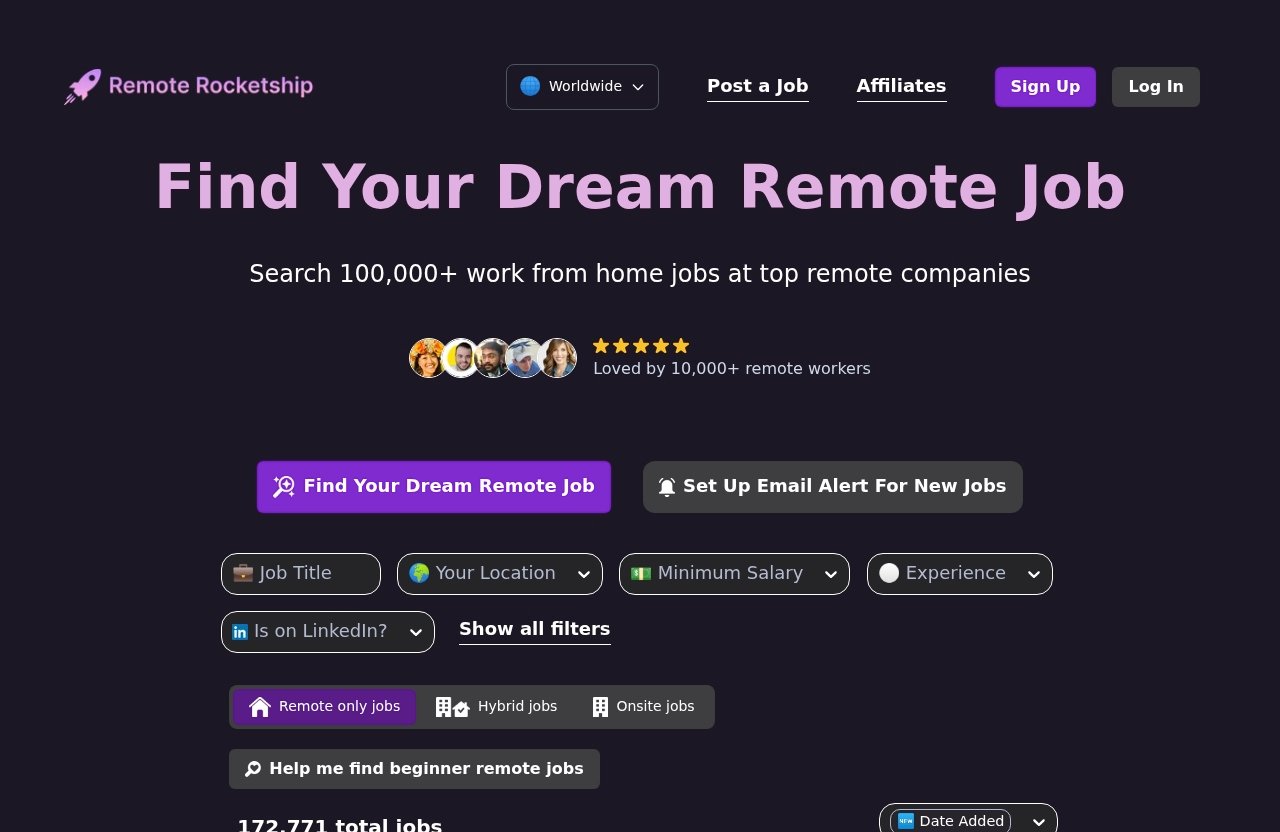
Remote Rocketship stands out because its stated model addresses two common problems in remote hiring: questionable sourcing and delayed discovery. Rather than positioning itself around sheer volume alone, it says it scans thousands of company career pages around the clock and finds new remote jobs minutes after companies post them.
That makes it a compelling option for job seekers who want verified remote jobs while trying to get ahead of the typical application rush. The platform says it is loved by 10,000+ remote workers and describes its listings as “100% remote,” “Verified jobs only,” and “No scams, no junk.”
Jobs pulled from company career pages
Remote Rocketship says jobs are pulled straight from company career pages. That is a meaningful sourcing detail because it gives applicants a more direct path back to the employer’s original listing.
In practice, you should still open the employer’s career page before applying. Confirm the job title, location rules, application destination, and posting status match. This extra step takes minutes and strengthens your remote jobs scam protection process.
If that sourcing approach suits your search, explore Remote Rocketship as one of your job-search sources. The affiliate relationship does not change the basic advice here: verify each employer independently before sending personal information or accepting an interview.
Listings verified before they spread
Remote Rocketship says new jobs land on the site minutes later and that each one is checked and verified. For applicants who are wary of scraped, stale, or anonymous posts, that stated review process is an important differentiator.
No screening model can guarantee a perfect employer, a healthy team, or a successful application. But a platform that emphasizes direct career-page sourcing and verification appears better aligned with job seekers who value traceability over endless unfiltered volume.
For a role-by-role review process, use this [Verify Remote Rocketship Jobs: A 2026 Safety Checklist Before You Apply](/verify-remote-rocketship-jobs).
Why fast application timing matters
Many remote jobs receive heavy interest quickly because applicants can apply from multiple locations. Being early does not guarantee an interview, but it can improve your odds of having your application reviewed before a role becomes saturated.
Remote Rocketship says it helps users apply before the competition by surfacing roles shortly after employers publish them. This makes it particularly relevant if your priority is finding the most legit site for remote jobs with fresh opportunities rather than waiting for listings to be copied across several aggregators.
The official site also displays browse options for remote jobs by country, city, title, entry level, junior and senior levels, tech stack, contract type, internships, and part-time work. Those navigation paths can help job seekers narrow a large remote market into something more relevant.
Official website · Latest pricing & offers
Which Remote Job Site Is Best for Each Type of Job Seeker?
The best platform is the one that matches your level of experience, risk tolerance, and application speed. Here is the practical version of the comparison.
Best for verified, fast-moving roles
Remote Rocketship is a strong option for applicants who want to find jobs early and prefer listings that the platform says are pulled from company career pages and checked before appearing. Its focus on speed may be especially useful for competitive roles where a delayed application can matter.
For someone looking for the most legit site for remote jobs with an emphasis on direct sourcing, it is worth including in a daily routine. Just do not treat any board’s verification language as permission to skip your own research.
Best for curated, paid filtering
FlexJobs is a practical choice for people who prefer a curated environment and are comfortable with a membership-style job-search model. Its public messaging emphasizes no ads, scams, or junk, which may appeal to applicants who want less clutter.
This option is best for job seekers who value screening and organization more than a fully open-access browsing experience. Before committing, review the current terms on the official site rather than relying on old third-party descriptions.
Best for free browsing
We Work Remotely, Remote.co, and NoDesk are useful options for free browsing, each with a different angle. We Work Remotely brings a large remote-focused audience, Remote.co combines jobs with company information, and NoDesk offers a no-account browsing experience.
Use these boards to identify employers and patterns in your field. If you keep seeing the same companies, go directly to their career pages and set up a target list.
Best for broad-volume search
Indeed is the broadest option in this group when your role is niche, location-sensitive, or not commonly advertised on remote-only boards. It can uncover opportunities from large employers that do not actively market themselves as remote-first.
However, volume is not the same as trust. The most legit site for remote jobs for a high-volume searcher is often a combination: use Indeed for reach, then validate the listing through the employer’s official channels.
How to Spot a Legit Remote Job Before You Apply
Even the most careful trusted remote job boards cannot fully assess what happens after you enter an employer’s hiring funnel. You should use a repeatable safety process for every role, especially when the job involves financial data, customer information, or contractor payments.
Check the company website and career page
Start with the employer’s official website. A real company should generally have a coherent online presence that explains what it does, who it serves, and how it can be contacted.
Next, search the company website for the exact role. If the job appears on a third-party board but nowhere on the employer’s site, that does not automatically prove it is fake—but it should trigger additional checks. Look at the posting date and contact the company through its official channels if necessary.
Cross-check the employer on LinkedIn and search results
Search for the company name on LinkedIn and look for a credible employee base, leadership profiles, recent activity, and people whose roles make sense for the business. Then search the company name plus terms such as “scam,” “reviews,” “careers,” and the exact job title.
A legitimate employer can be small, quiet, or new. What matters is consistency: the website, LinkedIn page, employee profiles, email domain, and job description should all point to the same organization.
For more ways to find employers beyond mainstream platforms, see [Remote Jobs You Won’t Find on LinkedIn: A Practical 2026 Search Guide](/remote-jobs-you-wont-find-on-linkedin).
Watch for common scam signals
Never pay to get hired. Legitimate employers may require you to have equipment or meet licensing requirements, but they should not demand money through gift cards, crypto, wire transfers, or a personal payment app before you begin work.
Also avoid giving out sensitive information too early. Your bank account details, government ID, tax information, and full address generally belong in a verified onboarding process after you have confirmed an actual offer from a real company.
The most legit site for remote jobs can reduce initial risk, but your safest habit is to pause whenever a recruiter creates urgency, avoids video or phone contact, or refuses to use a company email address.
Best Search Filters and Tactics for Faster Remote Hiring
Good search habits matter as much as the board you choose. A focused process will usually outperform spending hours scrolling broad “remote” results.
Use location and contract filters wisely
“Remote” does not always mean “work from anywhere.” Many jobs are remote only within a country, state, province, time zone, or legal hiring region.
Filter by:
- Country or city eligibility
- Full-time, part-time, contract, internship, or freelance status
- Entry-level, junior, mid-level, or seniority requirements
- Specific job title variations
- Industry or technical skill keywords
- Date posted
A role that looks ideal can become irrelevant if it requires local work authorization or specific time-zone overlap. Read those details before customizing an application.
Target newly posted jobs first
Prioritize jobs posted recently, particularly within the last few days. New listings are more likely to be active and less likely to have already attracted hundreds of applications.
This is where the most legit site for remote jobs may be one that surfaces jobs close to their original publication time. Remote Rocketship’s stated focus on finding new roles minutes after companies post them is useful for this approach, but you should also check official company career pages directly.
Build a repeatable daily search routine
A sustainable routine is better than sporadic marathon sessions. Try a simple schedule:
- Check fresh postings on one direct-sourcing or verified-focused source.
- Browse one established remote-only board.
- Run saved searches on a broad job board for your niche.
- Verify the employer before applying.
- Track applications, dates, contacts, and follow-up deadlines.
This process helps you avoid duplicate applications and gives you a record if a recruiter contacts you later. For alternative search channels, read [Remote Jobs Better Than LinkedIn: Where to Find Stronger Remote Opportunities in 2026](/remote-jobs-better-than-linkedin).
Final Recommendation: The Most Legit Site for Remote Jobs in 2026
There is no single universal answer to the most legit site for remote jobs because job seekers define value differently. Some prioritize employer verification, others want established brands, and others need the biggest possible pool of opportunities.
Best overall
For a trust-first job seeker who wants fresh roles connected to official employer career pages, Remote Rocketship is a compelling overall pick. It says it scans thousands of career pages, checks listings, and surfaces remote jobs minutes after companies post them.
That combination of stated verification and speed makes it especially useful when you want to apply before a listing spreads widely. Still, confirm every employer and opening yourself before applying.
Best free option
For free browsing, We Work Remotely, Remote.co, and NoDesk are worthwhile options. We Work Remotely is a strong remote-only destination with a large audience, Remote.co supports job and company discovery, and NoDesk provides low-friction daily browsing without requiring an account.
Use more than one source if you can. The best free strategy is often a remote-only board plus direct employer career pages.
Best paid/curated option
FlexJobs is the clearest choice for people who want a curated search environment and value its stated no-ads, no-scams, no-junk positioning. It may be a better fit for cautious applicants who want less filtering work than they would face on broad aggregators.
Always review current access terms on the official platform. This comparison does not assume any particular price, plan, or feature availability.
Best for stealthy early applications
For early applications, Remote Rocketship stands out based on its claim that it finds and verifies newly posted remote jobs soon after they appear on company career pages. It is not a guarantee of employment, but it can be a practical edge in competitive remote hiring.
The smartest conclusion is not to rely blindly on any most legit site for remote jobs claim. Use reputable boards, verify employers through official channels, apply promptly to fresh roles, and keep your personal information protected until you have confirmed a legitimate hiring process.
Official website · Latest pricing & offers
FAQ
What is the best website to find legit remote jobs?
The best website depends on whether you want the strongest screening signals, the most listings, or the earliest access to new opportunities. FlexJobs, Remote.co, and We Work Remotely are established options, while Remote Rocketship is notable for saying it pulls verified jobs from company career pages and surfaces them quickly.
For many applicants, the best approach is to use two or three sources. Choose one remote-only board, one broad search platform, and one source focused on newly posted roles.
How to find out if a remote job is legitimate?
Verify the employer’s website, official career page, LinkedIn profile, professional email domain, and overall online footprint. The company name, recruiter identity, job description, and contact information should be consistent across those sources.
Avoid jobs that ask for money, gift cards, crypto payments, banking details, or identity documents too early. Be equally cautious when an employer insists on messaging-only interviews or cannot provide a verifiable company email address.
What are the best sites for remote work?
Strong options include We Work Remotely, FlexJobs, Remote.co, Remote Rocketship, NoDesk, and Indeed. Each serves a different search style: remote-only browsing, curation, employer research, early career-page discovery, free access, or high-volume searching.
The best remote job sites are usually the ones you can use consistently while still taking time to verify every employer. A good board lowers risk; it does not eliminate the need for judgment.
Will Amazon really pay you to work from home?
Some Amazon customer service and support roles can be legitimate paid remote positions. However, applicants should only trust listings that can be confirmed through Amazon’s official career channels.
Do not respond to social-media messages or unofficial recruiters claiming to offer Amazon work-from-home jobs without verification. Check the role on Amazon’s own careers site and confirm that recruiter emails use an official company domain.
