
If you are applying from outside the United States, remote job boards for international applicants can save time—or waste it fast. The frustrating part is that many “remote” jobs are only remote inside one country, require a US work authorization, or expect hours that do not work from your timezone.
This guide looks at whether Remote Rocketship is useful for non-US candidates and how it compares with NoDesk, Working Nomads, We Work Remotely, Remote.co, and Truly Remote. This page may contain an affiliate link to Remote Rocketship, which means Land Remote Work may earn a commission at no extra cost to you. The recommendation below stays practical and usefulness-first.
Short verdict: Remote Rocketship can be useful as a discovery tool for global remote openings, especially if you want another source to scan regularly. But non-US applicants should pair it with boards that explicitly surface worldwide, anywhere-in-the-world, or region-specific roles, and should always verify country eligibility before applying.
Official website · Latest pricing & offers
What Non-US Applicants Need From Remote Job Boards For International Applicants
The best remote job boards for international applicants do more than collect remote listings. They help you separate truly global roles from jobs that are remote only within the US, Canada, the UK, the EU, or another specific hiring region.
For international candidates, the real question is not “Is this job remote?” It is “Can the company legally hire, pay, and manage someone in my country?”
Global Hiring Signals To Look For
When I review remote listings for non-US candidates, I look for language that clearly confirms eligibility. Strong signals include phrases such as “worldwide,” “anywhere in the world,” “global,” “work from anywhere,” “open to candidates in EMEA,” or “remote within Europe.”
Weak signals are more vague. A listing that says “remote” but mentions “US-based employees,” “must be authorized to work in the United States,” or “available during Pacific Time business hours” may not be a real option for many international applicants.
Here are the signals worth checking before you invest time in an application:
| Signal | What It Usually Means | What To Verify |
|---|---|---|
| Worldwide / anywhere | Potentially open globally | Timezone, contractor status, salary currency |
| Remote – US only | Remote inside the US | Usually not suitable for non-US applicants |
| EMEA / APAC / LATAM | Region-specific hiring | Country list and timezone expectations |
| Contractor accepted | May support international hiring | Payment method, tax responsibility, contract terms |
| Employer of Record mentioned | Company may hire across borders | Which countries are supported |
Good remote job boards for international applicants make these signals easier to find. Poor boards force you to open dozens of job descriptions just to discover that most roles are country-restricted.
Why Location Filters Matter More Than Job Volume
A huge board with thousands of roles is not automatically better. For non-US candidates, a smaller board with reliable location filtering can outperform a larger site full of US-only remote jobs.
This is why location filters matter more than raw job volume. If you can filter for “worldwide,” “Europe,” “Latin America,” “Asia,” “Africa,” or “timezone overlap,” you can spend more time applying and less time decoding vague job posts.
This is also where many lists of the best remote job boards for international applicants fall short. They name popular websites, but they do not explain whether those boards help you avoid roles that are legally or operationally unavailable from your country.
Common Mistakes International Applicants Make
The biggest mistake is assuming “remote” means “globally remote.” It often does not. Companies may advertise remote roles while limiting applicants to countries where they already have payroll, tax compliance, or legal entities.
Another common mistake is ignoring timezone overlap. A company hiring “remote worldwide” may still expect four to six hours of overlap with US Eastern Time, Central European Time, or another core team timezone.
Non-US applicants should also avoid applying before checking salary and payment details. A role may be open internationally but offered as a contractor arrangement, paid in USD, EUR, or local currency, with different tax responsibilities depending on your country.
For deeper research, this is a good place to create internal resources such as:
- Related guide: remote job alerts for international applicants
- Related guide: how to use remote job board filters
- Related guide: remote job board vs LinkedIn for global candidates
Does Remote Rocketship Work For International Applicants?
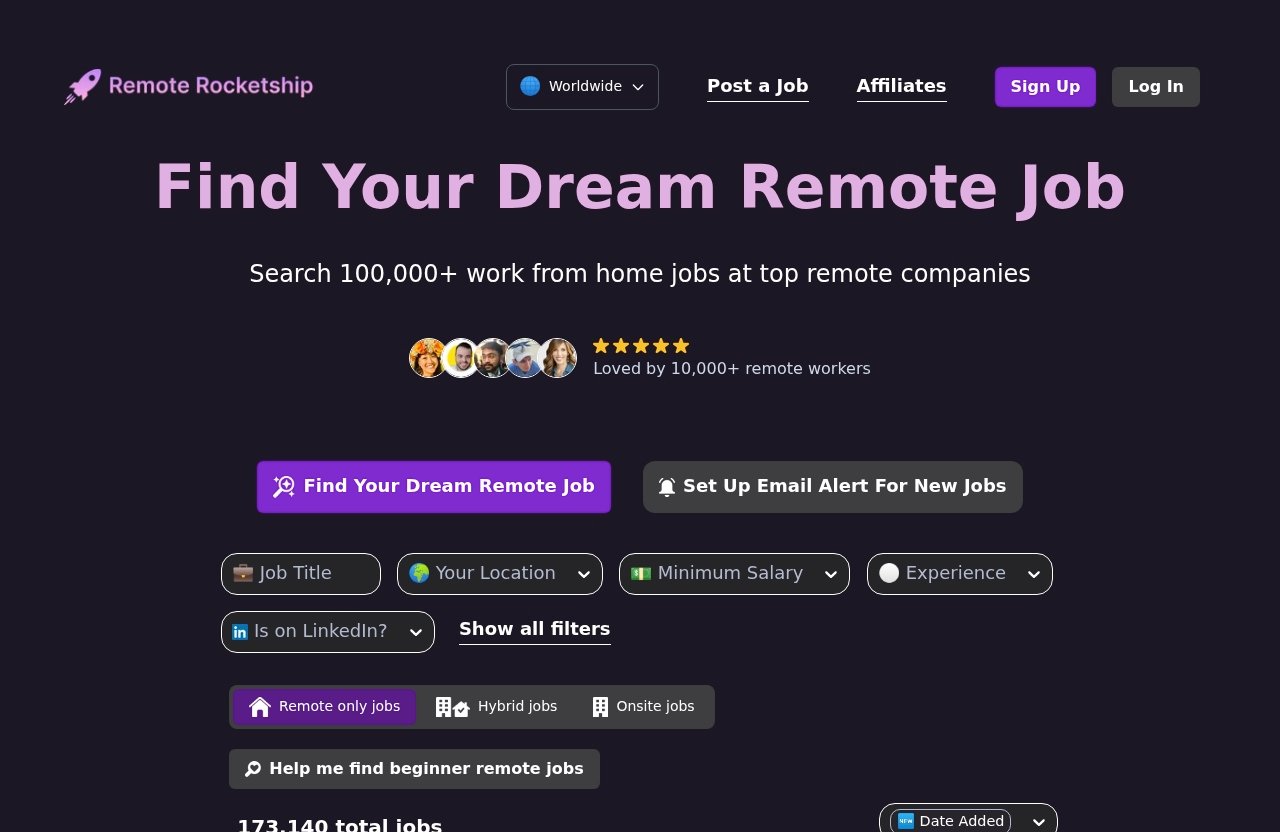
Remote Rocketship is worth considering if you are building a search stack of remote job boards for international applicants, but it should not be your only source. Based on the verified context available, it is best evaluated as a remote job board for discovery rather than a guaranteed shortcut to global hiring.
Because access to the official homepage and pricing page was blocked by security verification during the provided fetch, I cannot verify pricing, subscription tiers, trials, or specific feature bundles from official pages. That matters: international applicants should be careful with any tool where key operational details cannot be independently confirmed from accessible official pages.
You can still review Remote Rocketship directly through its official site: Remote Rocketship. Just make sure you evaluate each listing with the same country-eligibility checklist you would use on any board.
Who It Is Best For
Remote Rocketship is likely most useful for candidates who want another place to discover remote openings and compare opportunities across role types. If you are in software, product, marketing, operations, customer support, design, or other remote-friendly fields, it may help you broaden your search beyond the most obvious boards.
It can also be useful if you already have a workflow. For example, you might scan Remote Rocketship, then verify interesting jobs on the company career page before applying.
For non-US users, the value depends on whether the specific listings you find are open to your country, region, or timezone. That is the practical standard every remote job boards for international applicants should be judged against.
Where It May Fall Short For Non-US Users
The main limitation is verification. Since pricing and detailed official product information could not be verified from the blocked official pages in the provided context, I will not claim specific plans, costs, trials, or proprietary filtering features.
That does not mean Remote Rocketship is not useful. It means you should treat it as one source in your job search, not as proof that every listing is globally available.
Non-US applicants should be especially cautious with jobs that only say “remote” without mentioning country eligibility. If the description does not clearly say worldwide, region-specific, or open to your country, confirm before spending time on a tailored application.
How To Judge If The Listings Match Your Country
Use a simple three-step test. First, check the job title and location field for terms like “Worldwide,” “Remote – EMEA,” “Remote – LATAM,” or “Remote – Europe.” Second, read the job description for legal hiring language, work authorization requirements, and timezone expectations.
Third, cross-check the same role on the company’s own career page. Company pages often include more precise details about countries, employment type, salary range, and whether the role is employee-based or contractor-based.
If the company says “remote” on one board but “US only” on its own site, trust the company site. This rule applies to all remote job boards for international applicants, not just Remote Rocketship.
PRODUCT FACTS: Remote Rocketship
- Official website: Remote Rocketship
- Affiliate URL: https://remoterocketship.com/?ref=the
- Verified official page access: the homepage and pricing page were blocked by security verification / 403 on the provided fetch.
- Pricing could not be verified from official pages.
- This article does not state any price, subscription tier, free trial, guarantee, or detailed feature bundle for Remote Rocketship.
- Remote Rocketship is discussed only at a high level as a remote job board being evaluated for international applicants.
- Any specific operational detail not visible in the provided context should be treated as unverified until confirmed directly on the official site.
How Remote Rocketship Compares To Top Remote Job Boards For International Applicants
The most useful comparison is not “which board has the most jobs?” It is “which board helps non-US applicants find roles they can actually accept?”
Below is a practical comparison of Remote Rocketship against other well-known options positioned around remote, worldwide, international, or work-from-anywhere roles.
| Job Board | Best Fit | International Applicant Watch-Out |
|---|---|---|
| Remote Rocketship | Extra remote job discovery source | Verify country eligibility on each listing |
| NoDesk | Broad remote discovery and location browsing | Confirm whether “remote” is worldwide or region-limited |
| Working Nomads | Digital nomad and worldwide remote job discovery | Check timezone and contract details |
| We Work Remotely | Large remote job inventory and category depth | Many roles may still include location limits |
| Remote.co | Remote-focused roles with international appeal | Read each listing for country restrictions |
| Truly Remote | Work-from-anywhere and international positioning | Confirm legal hiring and payment setup |
NoDesk: Broad Remote Discovery And Location Browsing
NoDesk is often useful for candidates who want broad remote discovery and the ability to browse by location-oriented terms. For international applicants, that positioning matters because location browsing can reduce the number of irrelevant applications.
Compared with Remote Rocketship, NoDesk may be a better first stop if your priority is finding jobs that clearly signal location flexibility. However, you should still read each description carefully because “remote” can still mean country-restricted.
NoDesk fits well into a search stack of remote job boards for international applicants when you want to compare listings across multiple regions.
Working Nomads: Worldwide Digital Nomad Jobs
Working Nomads is strongly associated with digital nomad-style remote work and worldwide opportunities. That makes it relevant for candidates searching for remote jobs anywhere in the world or flexible jobs that can be performed outside traditional office hubs.
Its value for international applicants is the positioning around remote and nomad-friendly work. Still, “nomad-friendly” does not automatically mean open to every country, every timezone, or every legal employment setup.
If you are searching for work from anywhere jobs, Working Nomads is worth checking alongside Remote Rocketship, especially when you want roles that are more explicitly aligned with international remote work.
We Work Remotely: Large Volume, Strong Category Depth
We Work Remotely is one of the better-known remote job boards and is useful when you want a large inventory across categories. For candidates in development, design, marketing, support, and product, the depth can be valuable.
The trade-off is that large volume often requires more filtering discipline. Non-US applicants may still encounter roles with US-only, North America-only, or timezone-specific requirements.
If you want more listings to review, We Work Remotely can be stronger than a smaller board. If you want only globally open roles, you need to be more selective and verify every promising job before applying.
Remote.co And Truly Remote: International And Work-From-Anywhere Focus
Remote.co is a remote-focused board that can be useful for discovering companies comfortable with distributed work. It belongs in the same search routine as Remote Rocketship, especially for candidates comparing multiple sources.
Truly Remote is especially relevant because of its international and work-from-anywhere positioning. For non-US applicants, that focus can be helpful when searching for global remote jobs rather than remote jobs limited to one country.
Between Remote.co, Truly Remote, and Remote Rocketship, the best choice depends on your workflow. If you want a broader discovery layer, use multiple boards. If you want worldwide-first roles, prioritize boards that explicitly surface anywhere-in-the-world opportunities.
Official website · Latest pricing & offers
What Actually Works When Searching Remote Jobs Internationally
The candidates who get the best results from remote job boards for international applicants usually do not apply randomly. They build a repeatable system: filter hard, verify eligibility, track companies, and apply quickly to roles that genuinely fit.
This matters even more for international remote jobs hiring immediately, where speed helps but only if you are applying to roles you can legally and practically accept.
Search By Region, Not Just ‘Remote’
Searching only for “remote” creates too much noise. Search by your region, timezone, or hiring eligibility instead.
Useful search phrases include:
- Remote worldwide
- Remote EMEA
- Remote APAC
- Remote LATAM
- Remote Europe
- Remote Canada
- Remote UK
- Remote anywhere
- Work from anywhere
- Contractor worldwide
If you are using Google, you can combine boards and terms. For example, search for “site:companycareers.com remote EMEA product manager” or “remote worldwide customer support SaaS.”
This approach works better than relying on generic lists of free sites for remote jobs worldwide because it helps you uncover exact hiring language.
Use Job-Board Filters For Country, Timezone, Or Region
When a board offers location filters, use them aggressively. Start with your country or region, then broaden to worldwide roles if the board supports that language.
If filters are weak, use the board’s search bar with terms such as “worldwide,” “anywhere,” “EMEA,” “LATAM,” “APAC,” “contractor,” and “async.” These terms often reveal whether the company is serious about distributed hiring.
This is also why free remote job boards for international applicants can still be effective. A free board with good filtering and fresh listings can outperform a paid or popular source that buries country restrictions.
Cross-Check Company Career Pages And Job Descriptions
Never rely only on the job board snippet. Open the full job description and then open the company’s career page.
Look for:
- Country eligibility
- Work authorization language
- Timezone overlap requirements
- Employment type: employee, contractor, freelance, EOR
- Salary range and currency
- Benefits eligibility by country
- Application deadline or urgency
- Whether the role is still active
This cross-checking step prevents wasted effort. It also protects you from applying to reposted, expired, or location-restricted roles.
If you regularly compare listings, consider an internal resource such as a “remote job board filters checklist” for Land Remote Work readers.
Track Repeat Posters And Role Patterns
Some companies hire internationally again and again. Others post remote roles but restrict them to one country every time.
Create a simple spreadsheet with columns for company, board, role, location eligibility, timezone, salary, employment type, and application status. After two weeks, patterns become obvious.
This method is especially useful when comparing remote job boards for international applicants reddit discussions with actual board results. Reddit can surface helpful anecdotes, but your own tracking shows which boards produce suitable roles for your country and skill set.
Best Use Cases For Remote Rocketship
Remote Rocketship makes the most sense as part of a broader search stack. It should not replace all other remote job boards for international applicants, but it can be worth checking when you want another source of remote openings.
Think of it as a discovery layer. You scan it, shortlist roles, then verify the details on company sites before applying.
Fast Scanning For Remote Openings
Remote job searching can become slow if you spend too much time on boards that do not match your location. Remote Rocketship may be useful when you want to quickly scan remote openings and identify companies or categories worth deeper research.
For non-US candidates, the key is not to apply directly to everything that looks remote. Save the role, check eligibility, and then decide whether it deserves a tailored application.
This keeps Remote Rocketship useful without letting it become another source of low-fit applications.
Finding Role Categories That Fit Your Background
Remote Rocketship may also help you spot which job categories are active in your field. If you repeatedly see product marketing, backend engineering, customer success, design, or operations roles, that tells you where demand may be appearing.
This is useful even if some listings are not open to your country. You can use the patterns to search the same role titles on NoDesk, Working Nomads, We Work Remotely, Remote.co, Truly Remote, LinkedIn, and company career pages.
For startup-focused candidates, this naturally connects to an internal guide such as “best remote job boards for startups.”
Using It Alongside Broader Boards
The strongest workflow is not Remote Rocketship versus every other board. It is Remote Rocketship plus boards that explicitly position around worldwide or international hiring.
A practical weekly workflow could look like this:
| Day | Board Type | Goal |
|---|---|---|
| Monday | Remote Rocketship | Discover fresh remote openings |
| Tuesday | NoDesk / Working Nomads | Find worldwide and nomad-friendly roles |
| Wednesday | We Work Remotely | Review high-volume categories |
| Thursday | Remote.co / Truly Remote | Search international and work-from-anywhere roles |
| Friday | Company career pages | Verify and apply to best-fit jobs |
This kind of system is more reliable than browsing randomly. It helps you use the best remote job boards for international applicants without depending on any single source.
When A Different Board Is The Better Choice
Remote Rocketship is not always the best first choice. Sometimes another board will save more time, especially if your main requirement is worldwide eligibility.
The right board depends on your constraint: country, timezone, role type, salary, or hiring model.
If You Need Worldwide-Only Roles
If you only want jobs that clearly say worldwide, anywhere, or work from anywhere, prioritize boards that explicitly surface that type of listing. Truly Remote and Working Nomads may be better starting points when your search is focused on remote jobs anywhere in the world.
Remote Rocketship can still be useful in the background. But if every application must be open globally, worldwide-first boards should come first.
This is especially important for applicants in countries that are often excluded by US-only or Europe-only remote hiring policies.
If You Want The Largest Job Inventory
If your priority is volume, We Work Remotely may be a better starting point because of its broad remote job inventory and category depth. Larger boards can reveal more openings, more companies, and more repeated hiring patterns.
The downside is more filtering work. A high-volume board can produce many irrelevant listings if you do not check country restrictions carefully.
Use larger boards when you have time to filter. Use narrower boards when you need higher relevance.
If You Want Stronger Filtering By Country Or Region
If you need country or region precision, choose boards that make location browsing easier. NoDesk is relevant here because of its broad remote discovery and location browsing angle.
For international candidates, region filters are not a convenience feature. They are a core requirement.
This is where many free remote job boards for international applicants can still be worth using. If they let you quickly identify EMEA, APAC, LATAM, Europe, or worldwide roles, they can be more efficient than a larger general board.
Final Verdict: Is Remote Rocketship Worth It For Non-US Applicants?
Remote Rocketship is worth considering as one of several remote job boards for international applicants, especially if you want an additional discovery source for remote openings. It is not something I would use alone if my goal were strictly worldwide or country-flexible roles.
The safest recommendation is balanced: use Remote Rocketship for discovery, then pair it with boards that more explicitly surface worldwide, international, or work-from-anywhere jobs. Always verify each role on the company career page before applying.
Best-Fit Summary
Remote Rocketship is best for candidates who already understand how to filter remote listings and want another board to scan. It may be especially useful if you are comparing role categories, tracking companies, and building a wider pipeline.
It is less ideal for applicants who need every listing to be clearly open worldwide from the start. In that case, start with boards positioned more directly around global hiring.
Verdict box: Use Remote Rocketship if you want broader remote job discovery and are willing to verify eligibility yourself. Prefer NoDesk, Working Nomads, Remote.co, Truly Remote, or We Work Remotely when you need stronger worldwide positioning, larger inventory, or clearer regional browsing.
Main Limitations
The biggest limitation is that “remote” does not always mean international. This applies across the market, but it is especially important when using any board where country eligibility is not obvious from the listing preview.
Also, because the provided official Remote Rocketship homepage and pricing page access was blocked by security verification, pricing and detailed product claims could not be verified for this article. You should confirm any current product details directly on the official website.
For non-US applicants, the board is only as useful as the listings that match your country, timezone, salary needs, and legal hiring setup.
Recommended Workflow For Global Candidates
Start with a focused weekly routine. Use Remote Rocketship for discovery, then search NoDesk, Working Nomads, We Work Remotely, Remote.co, and Truly Remote for worldwide or region-specific roles.
Before applying, check the company career page and confirm:
- Your country is eligible
- The timezone overlap is realistic
- The company can hire or contract with you
- Salary currency and payment terms make sense
- Benefits and tax responsibilities are clear
- The role is still active
That workflow will help you get more value from remote job boards for international applicants and avoid wasting time on remote jobs that are not truly available to you.
Official website · Latest pricing & offers
FAQ
What Remote Job Boards Work Best For International Applicants?
The best boards explicitly list worldwide, anywhere-in-the-world, international, or region-specific roles. NoDesk, Working Nomads, We Work Remotely, Remote.co, Truly Remote, and Remote Rocketship can all be useful, but each listing still needs verification.
For non-US candidates, the strongest remote job boards for international applicants are the ones with clear location signals, fresh listings, and practical filters for country, region, or timezone.
How Do I Know If A Remote Job Is Open To Non-US Applicants?
Look for wording such as “worldwide,” “anywhere in the world,” “global,” “EMEA,” “APAC,” “LATAM,” or “open to candidates in [your region].” Then check the full job description for work authorization, timezone overlap, payment method, salary currency, and employment type.
If the company career page says “US only” or “must be authorized to work in the United States,” assume the role is not open to most non-US applicants.
Is Remote Rocketship Good For Global Candidates?
Remote Rocketship can be useful for global candidates as a remote job discovery tool. However, non-US applicants should verify location eligibility on every listing before applying.
It is best used alongside boards that more clearly emphasize worldwide, international, or work-from-anywhere roles.
Are Free Remote Job Boards Enough For International Applicants?
Free boards can be enough if they have strong filters, active listings, and clear location information. Many candidates can build a good pipeline using free remote job boards for international applicants plus company career pages.
That said, combining multiple sources usually improves results because no single board captures every legitimate global remote opening.
What Should Non-US Applicants Avoid When Using Remote Job Boards?
Avoid assuming “remote” means globally open. Also avoid ignoring timezone requirements, applying without checking hiring-country restrictions, or skipping salary and payment details.
The goal is not to apply to the most jobs. The goal is to apply to the right global remote jobs where your country, schedule, and hiring setup actually fit.
