
Official website · Latest pricing & offers
Introduction: Why finding remote jobs feels slower in 2026
Finding remote work should feel easier than ever, yet many job seekers are spending more time scrolling and less time applying to roles that actually fit. If you are wondering how to find remote jobs fast, the answer is not “apply everywhere.” It is to reduce noise, verify listings, and use a repeatable search system.
The biggest time-wasters in 2026 are stale posts, vague “remote” labels, duplicate listings, scammy offers, and huge job sites that mix hybrid, location-restricted, and fully remote roles together. This guide shows you how to find better remote opportunities faster without relying on random browsing.
The remote job market is crowded but still efficient if you use the right system
Remote jobs are competitive because one opening can attract applicants from many regions. That does not mean the search is hopeless. It means your process needs to be sharper than someone who casually checks job boards when they feel motivated.
In my experience reviewing remote job listings, the fastest searches usually have three things in common: clear filters, a prepared application kit, and a short daily routine. The goal is not to spend all day searching; it is to find suitable roles quickly and apply before fatigue sets in.
Who this guide is for: beginners, career switchers, and experienced remote candidates
This guide is for anyone trying to find remote jobs faster in 2026, including entry-level applicants, career switchers, freelancers, and experienced professionals. The tactics also apply if you are searching from home, relocating, or looking for free remote jobs across different platforms.
You will learn where a focused remote job board like Remote Rocketship may fit into the workflow, how to compare it with manual browsing, and how to avoid wasting time on low-quality listings.
What actually makes remote job searches faster
Speed in a remote job search is not just about looking at more listings. It is about seeing fewer irrelevant ones. If you want to understand how to find remote jobs fast, you need to focus on filtering, alerts, reduced friction, and better signal-to-noise.
A fast search helps you answer four questions quickly: Is this role truly remote? Am I eligible based on location? Do I match the experience level? Is the job still active?
Speed comes from filtering, alerts, and lower browsing friction
The fastest remote job searches use filters before motivation. Start by narrowing your role, seniority, location eligibility, salary range if visible, employment type, and required skills.
Alerts also reduce repeat work. Instead of manually searching the same phrase every day, you can review fresh matches at fixed times. This is one of the most practical remote job search tips 2026 applicants can use because it protects your attention.
Why broad browsing on huge job sites wastes time
Large job boards have volume, but volume can slow you down. A search for “remote customer support” may include hybrid roles, jobs restricted to one city, reposted listings, staffing agency duplicates, and roles that require unrelated experience.
Manual browsing is still useful, but it often creates decision fatigue. You spend 20 minutes opening tabs, only to discover that half the roles are not fully remote or are no longer listed on the employer’s career page.
Why niche remote job boards can improve signal-to-noise
Niche remote work job boards can improve signal-to-noise because the starting pool is narrower. Instead of filtering a massive general database, you begin with listings that are more likely to be relevant to remote seekers.
That does not mean every niche board is perfect. You still need to verify listings, read location requirements, and check official employer pages. But if your goal is how to find remote jobs fast, starting with a focused source can reduce the time spent removing obvious mismatches.
The fastest way to find remote jobs in 2026: a 5-step system for how to find remote jobs fast
The fastest way to find remote jobs in 2026 is to treat the search like a short workflow, not an open-ended internet session. The system below works because it separates planning, searching, and applying.
Use it for one week before changing tools. Most job seekers switch platforms too quickly, which makes it harder to tell what is actually working.
Step 1: Define role, seniority, and location constraints
Before opening any job board, write down your target role and constraints. This saves time because you will stop clicking listings that were never realistic matches.
Use this quick filter checklist:
| Filter | Example |
|---|---|
| Role target | Customer support, SDR, virtual assistant, data analyst |
| Seniority | Entry-level, mid-level, senior, manager |
| Remote type | Fully remote, remote within country, hybrid excluded |
| Location eligibility | US-only, Canada, UK, worldwide, specific time zones |
| Employment type | Full-time, part-time, contract, freelance |
| Must-have skills | Excel, Salesforce, writing, Python, Zendesk |
| Deal-breakers | Phone-heavy work, night shifts, commission-only pay |
If you are searching globally, pay close attention to location restrictions. “Remote” often means remote within a country, state, or time zone.
Step 2: Build a remote-ready resume and profile
A remote-ready resume should make it easy for a recruiter to see that you can work independently. Add proof of communication, ownership, documentation, async collaboration, and tool fluency.
For example, instead of writing “Handled customer emails,” write “Resolved 45+ customer support tickets per day using Zendesk while documenting repeat issues for the team.” This is stronger because it shows output, tools, and remote-friendly work habits.
Your LinkedIn profile should match your resume. Use a clear headline such as “Remote Customer Support Specialist | SaaS | Zendesk | Email & Chat Support” instead of a vague title like “Looking for opportunities.”
Step 3: Use curated remote job boards first
If you are trying to learn how to find remote jobs fast from home, begin with curated remote job boards before opening broad job sites. This helps you start with listings that are more aligned with remote work.
Websites for remote jobs can include niche boards, company career pages, LinkedIn, and major job aggregators. The best websites to find remote jobs for free are the ones that let you filter quickly, verify employers, and avoid repeated irrelevant results.
A practical order is:
- Focused remote job boards
- Company career pages
- LinkedIn alerts
- Major job boards
- Networking and referrals
This order keeps your first search pass cleaner while still giving you broad coverage later.
Step 4: Set alerts and check listings at fixed times
Alerts are useful only if you control when you check them. Otherwise, they become another distraction.
Set alerts for specific combinations like:
- “remote customer support SaaS”
- “remote junior data analyst”
- “remote virtual assistant”
- “remote SDR entry level”
- “remote content editor”
- “worldwide remote support”
Then check alerts at fixed times, such as morning and evening. The point is to stop refreshing job boards throughout the day.
Step 5: Apply in batches with tailored templates
Batching applications saves time because you reuse structure while still tailoring the important parts. Create three resume versions and three cover letter templates for your top role categories.
A fast application batch might look like this:
| Time | Task |
|---|---|
| 5 minutes | Review shortlisted roles |
| 10 minutes | Customize resume bullets |
| 10 minutes | Write tailored opening paragraph |
| 5 minutes | Submit and log application |
Avoid sending generic applications. Fast does not mean careless. A slightly tailored application usually beats a rushed one that ignores the job description.
Manual browsing vs Remote Rocketship: which saves more time?
When people ask how to find remote jobs fast, they often want to know whether a dedicated remote job board is worth using. The honest answer is that it depends on your role, location constraints, and how disciplined your search process is.
Manual browsing gives you reach. A focused board like Remote Rocketship may reduce browsing friction by helping you stay inside a remote-focused search environment. The best approach is usually to combine both.
Manual browsing: pros, cons, and hidden time costs
Manual browsing across Google, LinkedIn, Indeed, company pages, and Reddit can uncover roles that may not appear everywhere else. It is also useful for researching companies and finding direct employer listings.
The downside is time leakage. You may spend an hour sorting through duplicate posts, hybrid roles, expired listings, or jobs that say remote but require a specific city. This is where many applicants lose momentum.
Manual browsing works best when you use it intentionally, not endlessly. Set a timer, search specific terms, and stop when you have enough quality leads for the day.
Remote Rocketship: how a focused board can reduce search friction
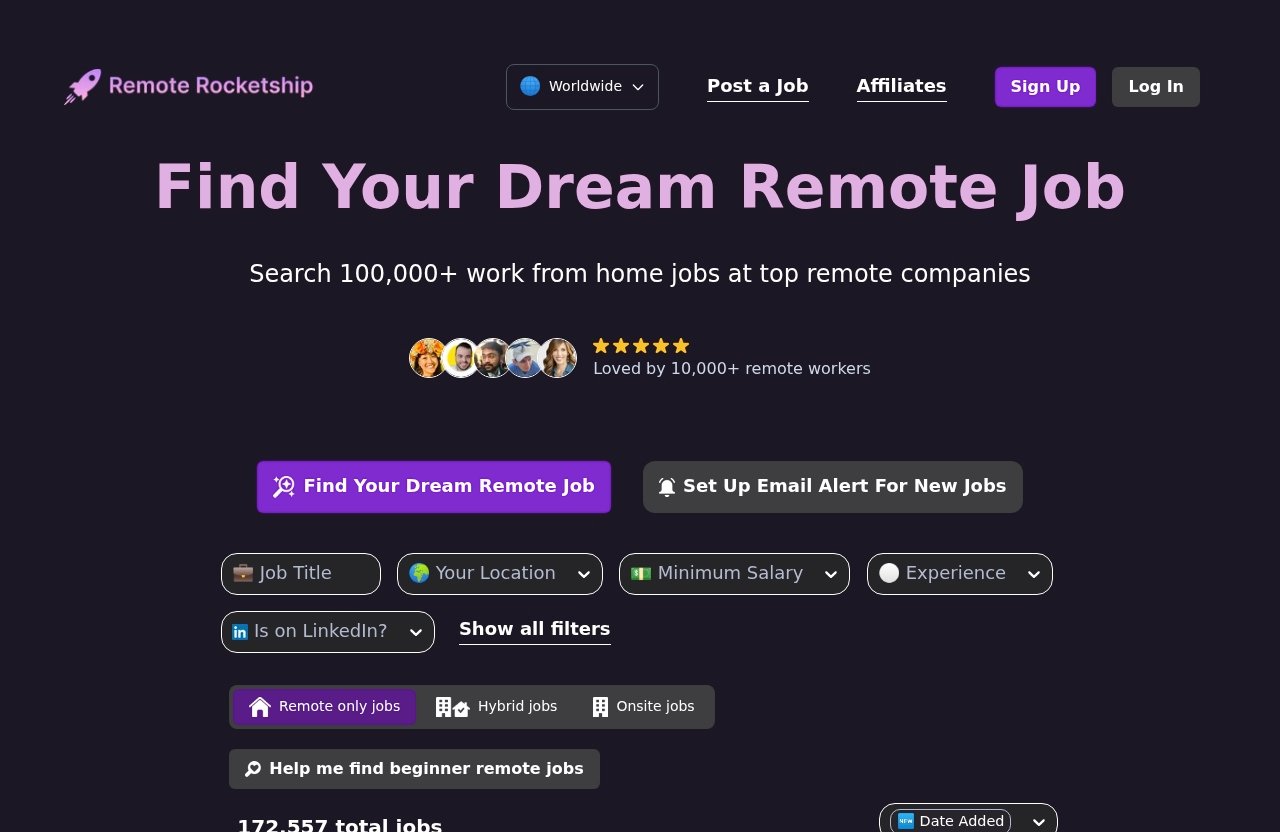
Remote Rocketship fits into this workflow as a focused remote job board option. Based on general navigation context and search result snippets, it is positioned around remote job discovery, which can make it useful for applicants who want to spend less time jumping between unrelated platforms.
Because the official homepage and pricing page were not accessible due to Cloudflare verification during source review, I cannot verify official pricing, plans, or specific product features. For that reason, treat it as a tool to evaluate directly rather than something to rely on blindly.
The practical value is workflow-based: if a board helps you scan relevant remote roles faster, avoid broad-site clutter, and build a shortlist more efficiently, it can save mental energy.
When manual browsing still helps
Manual browsing still matters because no single job board contains every remote opening. Some companies post first on their own career pages. Others prioritize LinkedIn, referrals, or niche communities.
Manual research is especially useful for:
- Checking whether a role is still active
- Finding the original employer listing
- Researching hiring managers
- Comparing job descriptions across platforms
- Identifying similar companies hiring for the same role
If you want remote jobs fast, do not abandon manual browsing entirely. Just stop making it the center of your day.
Best use case: combining both without wasting hours
The best workflow is to use a focused board for discovery, then verify strong matches on official employer pages. After that, use broader platforms for backup searches and networking.
Here is a simple comparison:
| Approach | Best For | Main Risk |
|---|---|---|
| Manual browsing | Maximum coverage and employer research | Slow, repetitive, high fatigue |
| Focused remote board | Faster scanning and remote-first discovery | May not include every role |
| Company career pages | Verification and direct applications | Time-consuming if used first |
| LinkedIn alerts | Networking and recruiter visibility | Noisy alerts and broad matches |
This balanced system gives you speed without depending on one source.
How to use Remote Rocketship to search faster
If your goal is how to find remote jobs fast, use Remote Rocketship as part of a structured search routine rather than as a place to browse casually. The tool should help you create a shortlist, not become another endless tab.
Since official product details were not verified from the inaccessible homepage and pricing page, the safest approach is to evaluate the platform directly and confirm whether its current listings, navigation, and any available search controls match your needs.
Start with job filters that match your target role
Begin with your role target, not a vague keyword. Search for specific titles such as “customer support specialist,” “account executive,” “product designer,” “data analyst,” or “virtual assistant.”
Then narrow by seniority and location eligibility wherever the platform allows. If you are looking for free remote jobs or free sites for remote jobs worldwide, always confirm whether the employer accepts applicants from your country before applying.
Use the board to surface higher-fit jobs quickly
A focused remote board can be useful because it keeps your attention on remote opportunities. Instead of sorting through unrelated office jobs, you can move faster from search to shortlist.
When reviewing listings, scan in this order:
- Job title
- Remote location rules
- Required experience
- Core tools or skills
- Employment type
- Application destination
- Date posted, if visible
This order helps you reject poor fits quickly. The faster you eliminate mismatches, the more energy you keep for strong applications.
Save time with search habits and alert checks
Do not check remote job boards all day. Use Remote Rocketship during a fixed search block, then move into verification and applications.
A good habit is to shortlist three to five jobs, verify each one on the company site, and apply to the best matches first. If a listing is duplicated elsewhere, prioritize the official employer page when possible.
Affiliate note: how readers can try the platform
If you want to test whether a focused remote board improves your workflow, you can try Remote Rocketship here. I recommend using it alongside company career pages and LinkedIn rather than treating it as your only source.
That approach keeps the search efficient while still giving you enough coverage to avoid missing good opportunities.
Official website · Latest pricing & offers
How to avoid wasting time on low-quality remote listings
A big part of how to find remote jobs fast is learning what not to apply for. Low-quality listings waste time, lower confidence, and can expose you to scams.
Even legitimate job sources can contain outdated posts or duplicated listings. Always verify details before sharing sensitive information or spending time on a long application.
Red flags for scams and vague job posts
Be cautious with remote jobs that promise unusually high pay for simple tasks, require upfront fees, or ask you to buy equipment from a specific vendor. Legitimate employers do not need your banking details before a formal hiring process.
Common red flags include:
- “No interview required”
- “Guaranteed income”
- Poor grammar from a supposed established company
- Personal email addresses instead of company domains
- Requests for payment, crypto transfers, or gift cards
- Vague job duties with high compensation
- Pressure to act immediately
If something feels off, pause and verify. A fast search should still be a careful search.
How to spot outdated or duplicated listings
Outdated listings often remain live on aggregators after the company has closed the role. Duplicates may appear under staffing agencies, scraped job sites, or reposted feeds.
Before applying, check:
- Is the role listed on the company’s official careers page?
- Does the job title match exactly?
- Is the location requirement the same?
- Does the application link go to the employer or a trusted ATS?
- Is the posting date recent?
- Are there multiple versions with conflicting details?
If the company page no longer lists the role, move on unless you can confirm it through a recruiter or official contact.
Ways to verify company legitimacy before applying
Search the company name plus “careers,” “LinkedIn,” and “reviews.” Look for a real website, active employee profiles, a company domain, and consistent job details.
For smaller companies, check whether leadership profiles, funding announcements, product pages, or customer references exist. For large employers, apply through official career portals whenever possible.
Do not upload identification documents, tax forms, or banking details until you have confirmed the employer and received a legitimate offer process.
Best remote job search tactics by candidate type
The best strategy depends on your background. Someone searching for how to find a remote job with no experience needs a different plan than a senior engineer or experienced project manager.
Use the tactics below to shorten the search based on where you are starting.
How to find remote jobs fast with no experience
If you are trying to learn how to find remote jobs fast with no direct experience, target roles where transferable skills matter. Good starting categories include customer support, appointment setting, data entry, virtual assistant work, moderation, tutoring, transcription, and basic sales support.
Focus your resume on proof of reliability, writing ability, organization, and tool comfort. If you lack paid experience, use projects, volunteer work, coursework, or personal systems as evidence.
For example:
| Weak Resume Line | Stronger Remote-Ready Version |
|---|---|
| Good communicator | Responded to 30+ customer messages per shift with clear written updates |
| Organized | Managed shared calendar, task list, and weekly reports for a volunteer team |
| Fast learner | Completed CRM training project and documented workflow steps |
Search terms like “entry-level remote,” “remote assistant,” “remote customer support,” and “no experience remote” can help, but be extra careful because scam listings often target beginners.
How to move faster if you are a career switcher
Career switchers should avoid applying as if they are starting from zero. Your advantage is transferable experience.
If you are moving from retail to remote customer success, emphasize conflict resolution, sales targets, scheduling, and customer communication. If you are moving from teaching to instructional design or tutoring, emphasize lesson planning, feedback, documentation, and online tools.
Your fastest path is usually an adjacent role, not a total leap. Build a bridge resume that connects your current experience to the remote role’s outcomes.
How experienced candidates can shorten the hunt
Experienced applicants should narrow aggressively. Applying to every remote job below your level usually wastes time and may make your profile look unfocused.
Use targeted searches by title, industry, tech stack, and company stage. For example, “remote senior product manager B2B SaaS” is stronger than “remote manager.”
Experienced candidates should also use networking more heavily. A referral can reduce the time between application and recruiter review, especially for competitive remote roles.
A daily remote job search routine that takes under 30 minutes
If you want how to find remote jobs fast without burning out, use a short daily routine. Thirty focused minutes is usually better than two scattered hours.
The goal is to search, verify, apply, and track without getting pulled into endless browsing.
Morning scan
Spend 7 minutes scanning your focused sources. This can include Remote Rocketship, saved job board searches, and email alerts.
Your goal is not to apply yet. Only shortlist roles that clearly match your title, seniority, location eligibility, and core skills.
Midday shortlist
Spend 5 minutes reviewing the best matches. Open the official company page for each role and confirm that the listing is active.
Remove anything vague, outdated, duplicated, or outside your location. Keep only the jobs worth a tailored application.
Evening application batch
Spend 15 minutes applying to one or two high-fit jobs. Customize your resume summary, top bullets, and first cover letter paragraph.
Use a simple template, but make the first few lines specific to the company and role. Mention the exact skills or outcomes they ask for.
Weekly review and optimization
Once a week, spend 20 minutes reviewing your tracker. Look at which roles got responses, which searches produced quality leads, and which keywords wasted time.
Track at least:
| Field | Why It Matters |
|---|---|
| Company | Avoid duplicate applications |
| Role title | Spot patterns in fit |
| Source | See which websites for remote jobs perform best |
| Date applied | Follow up at the right time |
| Status | Stay organized |
| Notes | Record salary, location, and concerns |
This routine is simple, but it compounds. Consistency is what makes remote job searches faster.
Recommended tools and sources to combine with Remote Rocketship
No single platform is the complete answer to how to find remote jobs fast. The best setup combines focused remote job discovery, employer verification, networking, and tracking.
Think of your tool stack as a funnel. Use remote work job boards to discover roles, company pages to verify them, LinkedIn to increase visibility, and a tracker to stay organized.
Major job boards
Major job boards can still be useful because they have large volumes of listings. Use them with strict filters and exact search phrases.
Try combinations such as:
- “remote account coordinator”
- “fully remote customer support”
- “remote junior analyst”
- “remote content specialist”
- “remote sales development representative”
If you search “how to find remote jobs fast reddit,” you will often see people recommend a mix of job boards, networking, and direct applications. That advice is useful, but Reddit comments can be outdated, anecdotal, or region-specific, so verify everything.
Company career pages
Company career pages are the best place to confirm whether a job is real and active. They also show other openings that may not appear on every board.
Create a list of 20 target companies that hire remotely in your field. Check their pages once or twice per week instead of manually searching them every day.
LinkedIn alerts and networking
LinkedIn alerts can help you spot new listings and connect with recruiters. Use specific titles and location filters to reduce noise.
Networking does not need to be awkward. Send short messages to people in roles you admire, comment thoughtfully on company posts, and keep your profile updated with remote-friendly keywords.
A simple message might be:
“Hi, I noticed you work in customer success at a remote-first company. I’m researching remote CS roles and appreciated your post about onboarding. If you have one tip for candidates applying remotely, I’d be grateful.”
Resume and application tracking tools
Use a spreadsheet, Notion, Airtable, Trello, or any simple tracker. The tool matters less than the habit.
Track every application, source, follow-up date, and outcome. This helps you identify the best websites to find remote jobs for free based on your actual results, not internet opinions.
Conclusion: the fastest remote job search is a system, not a site
If you want to know how to find remote jobs fast, remember this: speed comes from a system. Define your target, prepare a remote-ready resume, use focused sources first, verify listings, and apply in consistent batches.
A remote job board can help, but it should not replace judgment. The fastest applicants are not just searching more; they are filtering better and applying with more precision.
Summary of the best approach
Start narrow, then expand. Use focused remote job boards for discovery, company pages for verification, LinkedIn for visibility, and a tracker for follow-through.
Avoid low-quality listings, protect yourself from scams, and do not waste time on roles that ignore your location, seniority, or skill fit.
When to use Remote Rocketship versus broader platforms
Use Remote Rocketship when you want a more focused remote job discovery workflow. Use broader platforms when you need maximum coverage, company research, or networking opportunities.
Because official pricing and product feature details were not verified from the inaccessible official pages, evaluate the platform yourself and compare it with your current process.
Final CTA
The practical answer to how to find remote jobs fast is to reduce noise and repeat the same focused routine daily. If you want to add a remote-focused board to that routine, you can try Remote Rocketship here and see whether it helps you build a better shortlist faster.
Official website · Latest pricing & offers
FAQ
How to make $1000 a week remotely?
Making $1000 a week remotely depends on your role, hours, skill level, location, and pay structure. Common paths include customer support, sales, tutoring, transcription, virtual assistance, freelance writing, design, bookkeeping, and technical roles.
Always verify pay terms before applying. Check whether compensation is hourly, salaried, commission-based, contract-based, or dependent on completed tasks.
What is the 70 30 rule in hiring?
The 70 30 rule in hiring often refers to the idea that recruiters may spend much of their time sourcing and screening candidates before interviews happen. For applicants, this means being easy to find and easy to evaluate matters.
Use clear job titles, relevant keywords, measurable resume bullets, and a complete LinkedIn profile. The easier you make the recruiter’s first review, the better your chances of moving forward.
Why is it so hard to find a remote job right now?
Remote jobs are hard to find because competition is high, many roles require previous remote experience, and some listings are stale, duplicated, or misleading. Entry-level applicants also face scams and vague postings more often.
To improve your odds, narrow your target role, apply quickly to verified listings, tailor your resume, and use a mix of remote job boards, company pages, LinkedIn alerts, and referrals.
Will Amazon really pay you to work from home?
Amazon does offer work-from-home roles, but availability, pay, benefits, and eligibility vary by position and location. Some roles may be seasonal, customer-service focused, or restricted to specific regions.
Always apply through Amazon’s official jobs site and read the listing carefully. Confirm equipment requirements, schedule expectations, location rules, and compensation before sharing personal information.
