
If you are comparing the best remote job boards 2026, the real question is not “Which site has the most jobs?” It is “Which board helps me find relevant, legitimate remote roles without wasting hours on stale listings, location traps, or duplicate posts?”
I’ve evaluated remote job sites from the perspective of a practical job seeker: how quickly you can find suitable roles, how clear the listings are, whether the board fits your function, and whether it helps you avoid low-quality applications. Remote Rocketship is included as one useful option among stronger alternatives, but this guide is intentionally balanced so you can build the right job-search stack for your situation.
Official website · Latest pricing & offers
Best remote job boards in 2026: quick verdict
The best remote job boards 2026 are the ones that match your role, seniority, location, and search habits. A senior software engineer needs a different mix than an entry-level customer support applicant or a marketer looking for global remote work.
My practical recommendation: use three to five boards at once. Pair one broad remote board, one role-specific board, one alert-based discovery source, LinkedIn, and one backup board for fresh leads.
Who this list is for
This guide is for people who want to compare the best remote job sites before committing time to applications. It is especially useful if you are tired of vague “remote” roles that turn out to be hybrid, U.S.-only, or already filled.
It is also for candidates who want to know which remote job boards legit job seekers actually use in 2026. That includes software engineers, designers, marketers, customer support professionals, operations candidates, product managers, salespeople, and international applicants.
How we evaluated each board
I ranked the best remote job boards 2026 using practical job-search criteria rather than hype. The main factors were listing relevance, freshness signals, role coverage, ease of filtering, remote-policy clarity, and usefulness for different applicant types.
For Remote Rocketship specifically, I’m being cautious. Its official homepage and pricing pages were not readable during verification because of security verification/CAPTCHA, so I am not stating unverified pricing, plan names, or proprietary feature claims.
At-a-glance shortlist by use case
| Use case | Best-fit boards to start with | Why |
|---|---|---|
| Best overall remote search stack | We Work Remotely, LinkedIn, Remote Rocketship, FlexJobs | Good mix of breadth, discovery, and verification habits |
| Best for breadth | LinkedIn, Remote OK, We Work Remotely | Large pools and frequent listings |
| Best for curated listings | FlexJobs, NoDesk, Remotive | More structured browsing and less random noise |
| Best for tech roles | Remote OK, We Work Remotely, Wellfound | Stronger startup and technical role coverage |
| Best for international applicants | Remote OK, NoDesk, Remote Rocketship, LinkedIn | Better for checking global access and location filters |
| Best for speed and filtering | LinkedIn, DailyRemote, Remote Rocketship | Useful for quick scanning and repeated searches |
| Best for budget-conscious users | Remote OK, We Work Remotely, NoDesk, LinkedIn | Useful if you prefer best free remote job sites first |
The short version: there is no single winner for everyone. The best remote job boards 2026 depend on whether you need volume, curation, global access, niche roles, or fast daily discovery.
What makes a remote job board actually worth using in 2026
A remote job board is only valuable if it improves your odds of finding suitable roles faster. Bigger is not always better, especially if half the listings are duplicated, location-restricted, or poorly described.
The best remote job boards 2026 reduce friction. They help you identify legitimate roles, understand remote requirements, and apply before the listing is saturated.
Freshness and listing quality
Freshness matters because remote jobs often receive high application volume quickly. A role posted 30 days ago may still be open, but your odds are usually better when you find a relevant listing early.
Good boards make it easy to sort or identify recent postings. Better boards also help you avoid low-effort listings with unclear responsibilities, missing company details, or vague remote policies.
Legitimacy and scam filtering
Legitimate remote boards usually show clear company information, role details, application paths, and remote expectations. They also make it easier to spot whether a role is fully remote, hybrid, region-restricted, or temporarily remote.
No job board can remove every bad listing, so your own vetting still matters. If a role asks for payment, personal financial information, or crypto-related onboarding, treat it as a red flag.
Search filters, alerts, and saved searches
The best remote job boards 2026 help you repeat searches quickly. Saved searches, email alerts, function filters, seniority filters, salary filters, and location filters all reduce wasted time.
If you apply manually, alerts can give you a timing advantage. For a deeper workflow, see this guide to [Remote Rocketship job alerts](/remote-rocketship-job-alerts/) and compare it with alerts from LinkedIn, Remote OK, and other remote work websites.
Role focus: tech, non-tech, freelance, contract, full-time
Remote job boards differ sharply by role type. Some lean toward software, DevOps, product, and design, while others are better for customer support, marketing, writing, sales, or operations.
You should also separate full-time boards from freelance marketplaces. A site that is excellent for contract projects may be inefficient if you want a salaried remote job with benefits.
Global access and location restrictions
“Remote” does not always mean “work from anywhere.” Many listings are remote within the U.S., remote within Europe, remote within specific time zones, or remote only for candidates with work authorization in a particular country.
The best remote job boards 2026 make these restrictions visible before you apply. International applicants should prioritize boards that surface region requirements clearly and combine them with company career pages for confirmation.
The 10 best remote job boards in 2026
Below is a practical comparison of the best remote job boards 2026, including where each one fits, who should use it, and where it may fall short. I would not use all 10 daily; instead, pick the three to five that match your role and location.
| # | Board | Best for | Main tradeoff |
|---|---|---|---|
| 1 | We Work Remotely | Established remote roles | Can be competitive |
| 2 | Remote OK | Tech-heavy remote discovery | Listings vary in clarity |
| 3 | NoDesk | Simple curated browsing | Smaller than major boards |
| 4 | Remote Rocketship | Practical job discovery workflow | Official pricing/features not verified |
| 5 | FlexJobs | Screened flexible/remote roles | May not fit users seeking only free boards |
| 6 | Working Nomads | Email-based discovery | Less ideal for deep filtering |
| 7 | Remotive | Community-style remote listings | Smaller selection than broad platforms |
| 8 | Broadest professional network | Requires careful filtering | |
| 9 | DailyRemote | Fast remote-job scanning | Quality can vary by listing |
| 10 | Wellfound | Startup and tech roles | Startup-specific fit |
We Work Remotely
We Work Remotely is one of the most recognizable remote job boards and is often a good first stop for software, design, marketing, product, and customer support roles. It is especially useful if you want established companies that are intentionally hiring remote workers.
Its strength is focus: it is not a general job site with remote filters bolted on. The tradeoff is competition, because many experienced remote job seekers check it regularly.
Use We Work Remotely if you want a reliable anchor board in your weekly search. If you want a deeper comparison, read [Remote Rocketship vs We Work Remotely](/remote-rocketship-vs-we-work-remotely/).
Remote OK
Remote OK is a strong option for tech candidates, startup-oriented applicants, and people who want a broad view of remote roles across categories. It often appeals to developers, product candidates, designers, and growth marketers.
Its strength is discovery volume and remote-first positioning. The tradeoff is that you still need to check each listing carefully for region restrictions, salary clarity, and recency.
Remote OK belongs in a stack of the best remote job sites 2026 if you want frequent scanning and do not mind doing your own vetting.
NoDesk
NoDesk is useful for candidates who prefer a cleaner, more editorial-feeling remote job browsing experience. It often works well for people who want curated remote work resources rather than an overwhelming feed.
Its strength is simplicity. The tradeoff is that it may not offer the same volume as larger remote job boards USA candidates might use, especially if you are searching across many functions at once.
NoDesk is a good fit if you want a calmer browsing workflow and are willing to pair it with higher-volume sources.
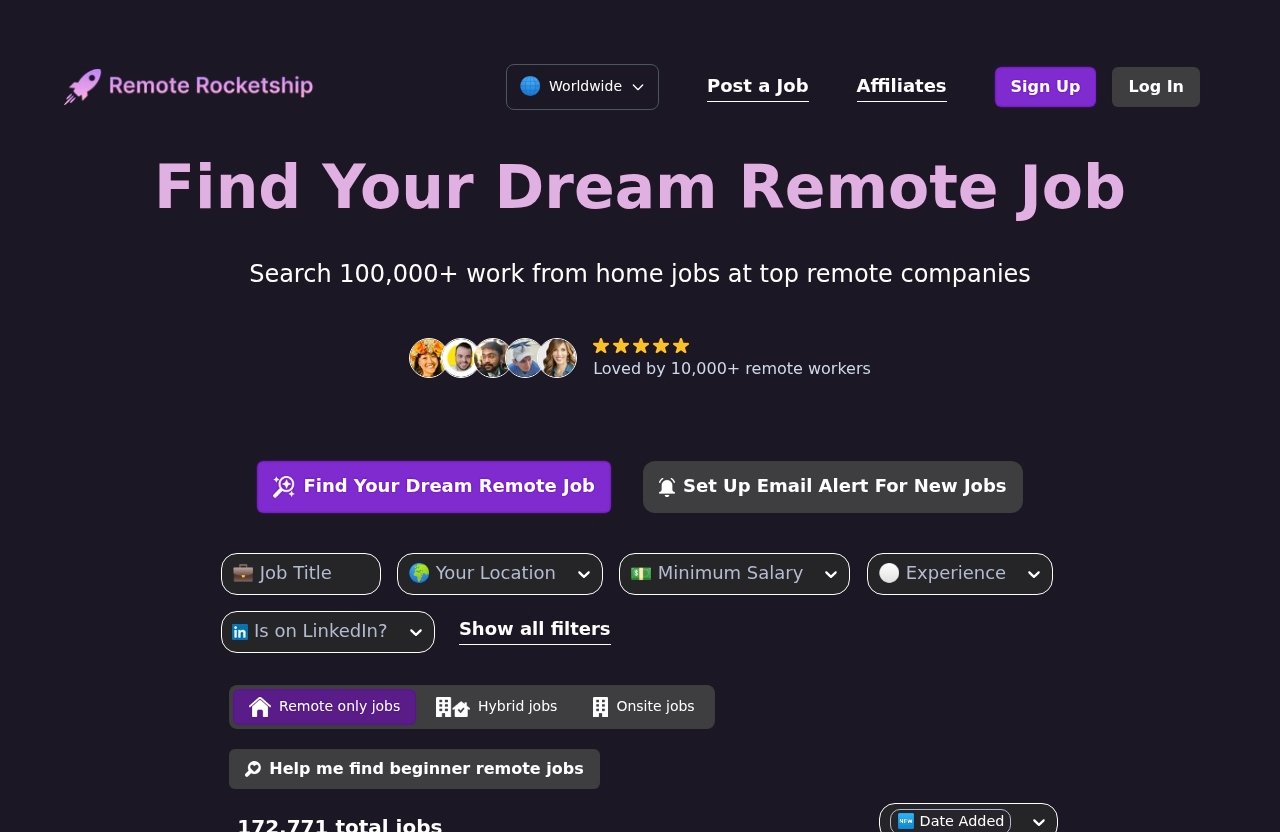
Remote Rocketship
Remote Rocketship is worth considering as part of a practical remote job search workflow, especially if you are comparing several boards and want another discovery source. You can review Remote Rocketship directly and decide whether it fits your search habits.
I cannot verify official pricing, plans, or feature details from the official pages because those pages were inaccessible during review due to bot protection/security verification. For that reason, I recommend treating it as one option to evaluate alongside established boards rather than relying on unsupported claims.
Remote Rocketship fits best for readers who want to test another remote-job discovery path and compare relevance against their current stack. For more context, see our [Remote Rocketship review 2026](/remote-rocketship-review-2026/).
FlexJobs
FlexJobs is often considered by candidates who want a more screened environment for remote, hybrid, part-time, freelance, and flexible roles. It can be especially appealing if your top concern is avoiding scams and low-quality listings.
Its strength is trust-oriented browsing. The tradeoff is that it may not be the first choice if you are only looking for free remote job boards or want the highest possible volume.
FlexJobs is a strong option for non-tech candidates, career changers, and people who value screening over raw listing count.
Working Nomads
Working Nomads is useful for candidates who like email-based job discovery and want remote roles delivered in a digest-style format. It covers categories such as development, marketing, management, sales, design, and customer support.
Its strength is convenience. The tradeoff is that it may not be as powerful for deep search filtering as platforms designed around advanced job search workflows.
Use Working Nomads if you want passive discovery while still checking more active boards two or three times per week.
Remotive
Remotive combines remote job listings with a community-oriented feel. It is a good option for candidates who want a curated remote-work environment rather than a massive database.
Its strength is clarity and remote-work focus. The tradeoff is that the total number of listings may be lower than larger sites, so it should be part of a broader stack.
Remotive is a sensible choice for remote-first job seekers who value relevance and browsing quality over sheer volume.
LinkedIn is not a remote-only board, but it remains one of the most important job search tools in 2026. Its advantages are company coverage, recruiter activity, networking, and the ability to verify hiring managers or employees.
Its weakness is noise. Many “remote” listings are hybrid, location-restricted, outdated, or posted by staffing firms with limited detail.
LinkedIn works best when you use tight filters, saved searches, company follow lists, and direct networking. It is not always the cleanest option, but it is too broad to ignore.
DailyRemote
DailyRemote is useful for fast scanning across remote roles, especially if you want to check new opportunities frequently. It can be a helpful supplement when you are building a daily application routine.
Its strength is speed and straightforward browsing. The tradeoff is that, as with many remote work websites, listing quality and detail can vary.
DailyRemote works best for candidates who already know their target titles and can quickly reject poor-fit posts.
Wellfound or JustRemote
For the tenth slot, I would choose Wellfound if you are interested in startups, tech companies, and early-stage teams. It is especially relevant for software engineers, product managers, designers, sales candidates, and growth marketers who like startup environments.
The strength of Wellfound is startup relevance. The tradeoff is that not every role is remote, and startup hiring can be more variable than larger-company hiring.
If you are less startup-focused, JustRemote can be a reasonable alternative to test. Either way, this category is best used as a niche supplement, not your only job board.
Official website · Latest pricing & offers
Best remote job boards by job seeker type
The best remote job boards 2026 change depending on who you are. A senior backend engineer, an entry-level support candidate, and a global marketing applicant should not use the same search strategy.
The smartest approach is to choose boards by role fit first, then by location access, then by speed. That keeps you from wasting time on sites that look impressive but do not match your actual market.
Best for software engineers and designers
Software engineers should start with We Work Remotely, Remote OK, LinkedIn, and Wellfound. These boards tend to surface more technical and startup roles than general flexible-work sites.
Designers can use the same stack but should add Remotive and NoDesk for curated browsing. For both groups, the best strategy is to create saved searches for exact titles, such as “frontend engineer,” “product designer,” or “UX researcher.”
Best for marketers, support, ops, and non-tech roles
For non-tech roles, I would prioritize FlexJobs, We Work Remotely, LinkedIn, Remotive, and NoDesk. These are often more useful than tech-heavy boards if you are searching for customer support, marketing, operations, recruiting, or admin roles.
The best remote job boards 2026 for non-tech candidates are usually the ones that help you avoid applying to generic “assistant” or “marketing” posts with unclear responsibilities. Look for listings with specific tools, KPIs, team structure, and remote policy details.
Best for international applicants
International applicants should be especially careful with location restrictions. Start with Remote OK, NoDesk, LinkedIn, and Remote Rocketship, then verify each role on the company’s careers page before applying.
A listing that says “remote” may still require U.S. work authorization, a European time zone, or residency in a specific country. If you are applying globally, this guide to [Remote Rocketship for international applicants](/remote-rocketship-for-international-applicants/) may help you think through location filters and application fit.
Best for entry-level candidates
Entry-level remote jobs are competitive because many applicants want flexible work without years of experience. The best boards for entry-level candidates are usually LinkedIn, FlexJobs, We Work Remotely, DailyRemote, and company career pages.
Search for titles like “customer support specialist,” “sales development representative,” “marketing coordinator,” “operations assistant,” and “junior QA tester.” Be cautious with vague “no experience remote job” posts, because that phrase is commonly used in low-quality listings.
Best for contract and freelance remote work
For contract and freelance work, FlexJobs, LinkedIn, Wellfound, and niche freelance platforms can all be useful depending on your field. Designers, writers, marketers, developers, and consultants should also search company career pages for “contract,” “part-time,” and “freelance” filters.
The best free remote job sites can still surface contract roles, but you need to check payment terms, scope, timezone expectations, and whether the company treats the role as ongoing work or a one-off project.
How Remote Rocketship compares with the top alternatives
Remote Rocketship should be evaluated as one part of a broader remote job search, not as a magic replacement for every board. Since official pricing and feature details were inaccessible during verification, the most responsible comparison is based on workflow fit and how it complements other sources.
If you are comparing the best remote job boards 2026, think of Remote Rocketship as a board to test for relevance against your target roles. Then compare the quality of the opportunities you find with We Work Remotely, Remote OK, LinkedIn, and curated boards.
Where Remote Rocketship is strongest
Remote Rocketship is strongest when you treat it as an additional discovery channel. If it surfaces roles that your other boards miss or helps you organize your search more efficiently, it can earn a place in your weekly workflow.
Because I could not verify official feature or pricing details from accessible official pages, I would avoid making assumptions about what it includes. The practical move is to test Remote Rocketship yourself and compare the relevance of listings to your target role.
Where bigger boards may be better
Bigger boards may be better when you need maximum coverage. LinkedIn, We Work Remotely, and Remote OK are strong choices when your priority is volume, company discovery, and broad role availability.
They may also be better if you rely heavily on public company pages, recruiter visibility, or networking signals. LinkedIn in particular gives you context that many standalone remote boards cannot provide, such as mutual connections and employee profiles.
When to use Remote Rocketship alongside other boards
Use Remote Rocketship alongside other boards when you want to widen your search without losing focus. A reasonable stack could be Remote Rocketship, We Work Remotely, LinkedIn, and one niche board for your role.
The key is to measure output, not impressions. If a board regularly gives you relevant, current roles that match your location and seniority, keep it; if it mostly creates duplicates or poor-fit applications, reduce your time there.
How to choose the right board for your remote job search
The best remote job boards 2026 are the ones you can use consistently without burning out. A scattered search across 15 sites usually produces worse results than a disciplined system across four or five sources.
Think like a recruiter pipeline: source roles, qualify them, apply quickly, track outcomes, and improve based on response rates. For a more tactical process, read [How to find remote jobs fast in 2026](/how-to-find-remote-jobs-fast-in-2026/).
Use multiple boards, not one
Use one broad platform, one remote-first board, one curated board, one niche board, and one alert source. For example, a marketer might use LinkedIn, We Work Remotely, FlexJobs, Remotive, and Remote Rocketship.
This gives you enough coverage without creating chaos. It also helps you compare which boards produce interviews rather than just applications.
Match the board to your seniority level
Senior candidates should prioritize boards with specific, high-signal listings. Look for detailed role descriptions, clear team context, salary information where available, and company maturity.
Entry-level candidates should prioritize volume but still filter aggressively. Avoid listings that promise unusually high pay for minimal work, especially if the company identity is unclear.
Track alerts and application sources
Create a simple spreadsheet with columns for company, role, board, date found, date applied, location restriction, and status. After three weeks, you will know which boards are actually producing quality opportunities.
Alerts are useful only if they are specific. Set alerts for exact titles, core tools, industries, and locations rather than broad phrases like “remote job.”
Avoid duplicates and wasted applications
Duplicate listings are common across remote boards. Before applying, check whether you already applied through another source or whether the listing appears on the company’s careers page.
A good weekly workflow looks like this:
| Day | Task | Time |
|---|---|---|
| Monday | Check alerts and new listings | 30–45 minutes |
| Tuesday | Apply to best-fit roles | 60–90 minutes |
| Wednesday | Network with hiring teams | 30 minutes |
| Thursday | Review niche boards | 30–45 minutes |
| Friday | Follow up and clean tracker | 30 minutes |
This system works better than refreshing free sites for remote jobs worldwide all day with no tracking.
Red flags to avoid when using remote job boards
Even the best remote job boards 2026 can contain roles that are outdated, vague, or not truly remote. Your job is to separate real opportunities from time-wasters before you invest in a tailored application.
A legitimate remote role should clearly explain the company, responsibilities, hiring process, location rules, and required experience. If those basics are missing, proceed carefully.
Fake remote jobs
Fake remote jobs often use generic titles, unusually high pay, poor grammar, and urgent hiring language. They may also push you to communicate only through messaging apps or ask for sensitive personal information too early.
Never pay to apply for a job. Legitimate employers do not require candidates to buy equipment, pay onboarding fees, or send banking details before a formal hiring process.
Location-bait listings
Location bait happens when a job is labeled remote but later reveals a strict city, state, country, or hybrid requirement. This is one of the biggest frustrations on remote job boards USA applicants and international candidates both encounter.
Always scan for phrases like “must be based in,” “remote within,” “hybrid,” “occasional office presence,” and “authorized to work in.” If the listing is unclear, check the company careers page before applying.
Outdated postings
Outdated postings waste time because the role may already be filled, paused, or duplicated from another source. Listings without a recent date, active company page, or clear application path deserve extra scrutiny.
When possible, prioritize roles posted in the last week. For older listings, apply only if the role is highly relevant and still appears on the employer’s official careers page.
Too-good-to-be-true salary claims
Unrealistic salary promises are a common bait tactic in remote hiring. Be skeptical of entry-level roles promising executive-level compensation with vague responsibilities.
Salary transparency is helpful, but it should match the role, market, and required experience. If the compensation looks unusually high, verify the company, recruiter, and application process before sharing personal information.
Official website · Latest pricing & offers
FAQ
Is remote work dying in 2026?
No, remote work is not dying in 2026, but remote hiring is more selective than it was during the early remote-work boom. Many companies still hire remotely, especially for specialized roles, distributed teams, and global talent. The best remote job boards 2026 can help you find those roles faster, but you still need targeted applications.
What remote job boards are legit?
Legit remote job boards usually show clear company names, updated listings, specific job descriptions, and transparent remote-location requirements. We Work Remotely, Remote OK, FlexJobs, NoDesk, Remotive, LinkedIn, DailyRemote, Wellfound, and Remote Rocketship are all worth evaluating, depending on your role and search style. Always verify listings on company career pages when something looks vague.
What remote jobs are in demand in 2026?
Common remote jobs in demand 2026 include software engineering, product management, customer support, sales, design, marketing, operations, data, and recruiting roles. Demand depends on industry, seniority, and location restrictions. Specialized candidates with strong portfolios, measurable results, and remote collaboration experience usually have an advantage.
What are the best sites for looking for jobs in 2026?
The best sites for looking for jobs in 2026 depend on your role, location, and experience level. For remote work, a strong mix includes LinkedIn, We Work Remotely, Remote OK, FlexJobs, NoDesk, Remotive, DailyRemote, Wellfound, and Remote Rocketship. The smartest approach is to combine broad job sites, niche remote boards, and company career pages rather than relying on one source.
Conclusion: choosing the best remote job boards 2026 for your search
The best remote job boards 2026 are not the same for every candidate. We Work Remotely and Remote OK are strong for remote-first discovery, LinkedIn is essential for breadth and networking, FlexJobs is useful for screened flexible roles, and NoDesk or Remotive can make browsing feel more curated.
Remote Rocketship is worth considering as part of that mix, especially if you want another practical way to discover remote roles. Because official pricing and feature details were not accessible during verification, evaluate it directly and compare the relevance of results against your current boards.
If you want the most efficient setup, choose three to five boards, create focused alerts, track every application source, and review your results weekly. That disciplined approach will outperform randomly browsing even the best remote job boards.
