
Disclosure: This page may contain affiliate links. That does not change our editorial approach: this Remote Rocketship review 2026 objective guide separates official product facts from our practical judgment for remote job seekers.
Official website · Latest pricing & offers
Quick Verdict: Is Remote Rocketship Worth It in 2026?
One-sentence verdict: Remote Rocketship appears to be a legitimate paid remote-job search tool that can be worth the cost for active applicants who value early listings and organized alerts, but it is probably unnecessary for casual browsers willing to search free sources manually.
This Remote Rocketship review 2026 objective assessment comes down to urgency. The platform’s official pitch is not that it guarantees a job; it is that it helps users discover verified, 100% remote jobs shortly after companies post them. For someone applying consistently during a focused search, earlier visibility can be useful. For someone checking listings once a week, free boards may be enough.
The paid plans are straightforward: $29 per month, $59 billed every three months, or $99 billed once a year. You can browse remote jobs for free, and paid subscriptions come with a 14-day money-back guarantee and cancellation options.
Who it is best for
Remote Rocketship is best suited to people treating their job search like an active project. That includes applicants who are sending tailored applications regularly, monitoring a specific field, or trying to find roles before they become heavily saturated.
It may also appeal to job seekers who want filters for salary, visa sponsorship, and seniority. These details can reduce time spent opening listings that are clearly not a fit.
Who should probably skip it
Casual browsers, early-stage career explorers, and applicants with no clear target role may not get enough value from a Remote Rocketship subscription. Paying for faster alerts is less useful if you are not prepared to review and apply quickly.
The service may also be a poor fit if your budget is tight and you already have a disciplined routine using company career pages, professional networks, and free remote job boards.
One-paragraph bottom line
In this Remote Rocketship review 2026 objective guide, our view is measured: it looks like a credible tool, not a shortcut to employment. Its strongest potential value is speed—finding remote opportunities from company career pages soon after posting—combined with search filters and alerts. Whether that is worth paying for depends on your application volume, urgency, and ability to act on leads quickly.
What Remote Rocketship Is and How It Works
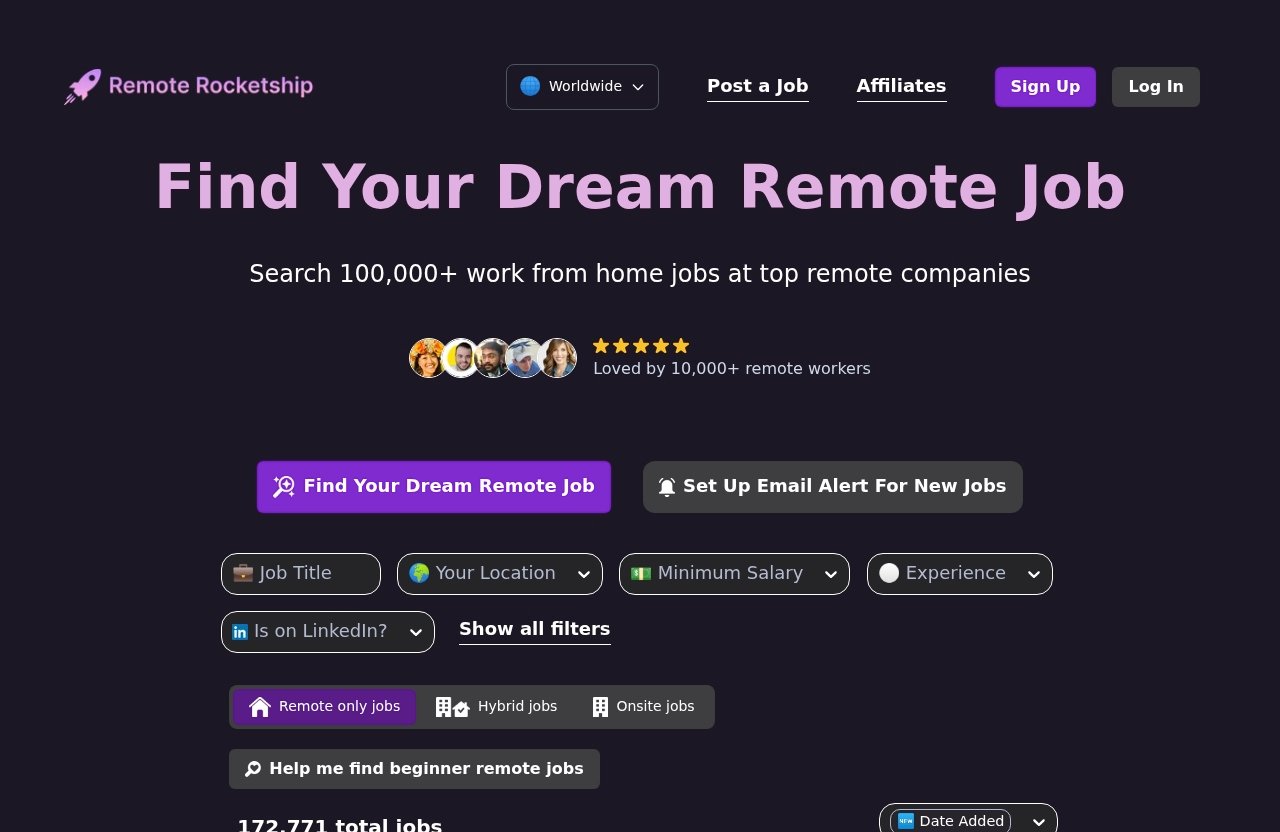
Remote Rocketship is a remote job search engine with paid access to its full feature set. It is not presented as a traditional general-purpose job board where employers simply post listings for broad public browsing.
The service focuses on remote roles and says it gathers listings directly from company career pages. The practical idea is to centralize job discovery rather than make applicants visit hundreds of individual employer sites.
What the platform does
According to its official site, Remote Rocketship scans thousands of company career pages around the clock and identifies newly posted remote jobs. It says new jobs can appear on its platform minutes after a company posts them.
For an active applicant, that workflow can save repetitive research time. Instead of separately checking employers, users can use one place to review remote openings and narrow results by relevant criteria.
How jobs are sourced
The official homepage says jobs are pulled straight from company career pages, checked and verified, and limited to 100% remote opportunities. It also says the service aims to avoid scams and junk listings.
That sourcing model is meaningful because it places emphasis on employer-originated job pages rather than only on reposts. Still, a sensible applicant should treat any aggregator as a discovery layer, then confirm the job on the employer’s official careers page before sharing personal information.
Why its listings may appear earlier than on larger boards
The core claim behind this Remote Rocketship review 2026 objective analysis is speed. If a tool monitors company career pages continuously, it may surface a new role before that opening spreads across larger public boards, social networks, and reposting sites.
Early access is helpful, but it is not a guaranteed advantage in every case. A fast application with a generic résumé is often less competitive than a slightly later application that is carefully matched to the employer’s needs.
Remote Rocketship Legitimacy Check
A careful Remote Rocketship review 2026 objective evaluation should distinguish between “legitimate platform” and “guaranteed results.” The available official information supports the first point more than the second: Remote Rocketship presents a real paid product, publishes plan terms, accepts payment through Stripe, and offers a refund window.
Those are useful trust signals. They do not eliminate the need for users to inspect individual opportunities or decide whether the subscription offers enough value for their own search.
Business legitimacy signals
Several visible policies support the view that Remote Rocketship is a genuine commercial service:
| Signal | What it indicates | What it does not prove |
|---|---|---|
| Public pricing page | The product’s costs and billing options are disclosed | That it will be valuable for every job seeker |
| Stripe checkout | Payment is handled through a widely used payment processor | That every listing is right for you |
| 14-day money-back guarantee | There is a stated opportunity to assess the service | A guarantee of job-search outcomes |
| Cancel anytime policy | The service states there is no long-term commitment | That you should subscribe without comparing options |
| Company-career-page sourcing claims | Listings are intended to originate from employer sources | That every role remains open at the moment you view it |
The official site also says users can browse remote jobs for free. That is a positive practical detail because it allows some initial evaluation before deciding whether paid tools are necessary.
What the official site says about the founder
Remote Rocketship’s official legitimacy page includes a founder-led explanation of the project and how it is presented to job seekers. That degree of direct explanation is better than an entirely anonymous product page, although readers should still assess the claims on their merits.
When researching any paid job-search service, look for clear ownership information, understandable support and billing terms, and a consistent public presence. Those factors are more useful than relying on one glowing testimonial or one negative comment.
Trust signals and what still deserves scrutiny
Searches for remote rocketship legit and remote rocketship reviews often reflect a reasonable concern: job seekers are exposed to scams often enough that skepticism is healthy. You can review public discussion, including Trustpilot and other independent feedback sources, but do not treat any single review platform as definitive evidence.
In this Remote Rocketship review 2026 objective guide, the sensible conclusion is that the service shows normal legitimacy markers for a subscription product. However, users should independently verify each opening, confirm the application link leads to the real employer, and avoid assuming a “verified” label replaces basic safety checks.
Pricing in 2026: Plans, Costs, and Refund Terms
Remote Rocketship pricing is published clearly on the official pricing page. Every paid plan includes the same listed features, so the decision is mostly about billing preference and how long you expect your active job search to last.
Monthly plan
The monthly plan is $29 per month, billed every month. This option is the simplest choice for applicants who want to test a structured search process without choosing a longer billing cycle.
A monthly Remote Rocketship subscription may suit someone entering an intensive application period, such as a person recently laid off or preparing a focused career move.
Quarterly plan
The quarterly plan is $59 billed every 3 months. The official pricing page says this option saves 32% versus monthly.
This plan could fit a search expected to take more than a few weeks. Before choosing it, be realistic about whether you will actually use alerts, filters, and application tools consistently.
Annual plan
The annual plan is $99 billed once a year. The official page states that it saves 72% versus monthly.
The annual option has the lowest stated long-term cost, but it is not automatically the best-value choice. If your search is short, uncertain, or exploratory, a lower-commitment approach may be more practical even when the annual rate appears more economical.
14-day money-back guarantee
Every paid plan includes a 14-day money-back guarantee according to the official checkout information. The service also states that there is no commitment and that users can cancel anytime.
That is helpful, but treat the refund period as a chance to test real usefulness. During those 14 days, search for your target titles, evaluate listing relevance, set alerts, and decide whether the platform is producing leads you would not otherwise find.
How to choose the best plan
| Your situation | More sensible starting point |
|---|---|
| You are testing whether the database fits your field | Monthly plan |
| You expect a sustained, active search | Quarterly plan |
| You regularly look for remote work or expect long-term use | Annual plan |
| You only want to browse occasionally | Start with free browsing and free sources |
A balanced Remote Rocketship review 2026 objective recommendation is to choose based on likely use, not just the advertised savings percentage.
Official website · Latest pricing & offers
Features and Benefits: What You Get With Every Plan
All paid plans include the same official feature package. The platform says users can discover hidden jobs, get a head start against competition, see every job it finds, receive alerts, use résumé tools, access a job-search MasterClass, and use developer access options.
Hidden jobs not on LinkedIn
The phrase “hidden jobs” should be understood carefully. It does not necessarily mean secret jobs unavailable elsewhere; it more likely refers to roles that have not yet become widely visible on major public job sites.
For people looking for remote jobs you won’t find on LinkedIn during the earliest hours of posting, direct company-career-page monitoring may offer a useful discovery advantage. It is still wise to verify that the position remains active on the employer’s site.
Head start on applications
Remote Rocketship says it helps users get a head start against the competition and find more interviews faster. Those are product claims, not promises of an interview or offer.
The practical benefit is straightforward: an alert that reaches you early can give you more time to research the company and submit a strong application. The benefit disappears if you apply indiscriminately or use an uncustomized résumé.
Email alerts and saved searches
The platform includes email alerts available hourly or daily. This is useful for applicants targeting a narrow combination of job function, seniority, location eligibility, salary, or visa sponsorship.
In a Remote Rocketship review 2026 objective framework, alerts are one of the more compelling features for urgent searchers. Passive users may find them unnecessary or may simply ignore the notifications.
Resume tools and cover-letter help
Paid access includes résumé tools: a customized résumé and cover letter, plus résumé match insight. These tools can support application preparation by helping users consider how their materials align with a listing.
They should not replace judgment. Review every generated or suggested document for accuracy, specific evidence of your work, and an authentic voice before submitting it to an employer.
MasterClass and developer access
Every plan also includes the full Remote Job Search MasterClass. For less experienced applicants, structured guidance may be useful alongside job discovery tools.
The official feature list additionally includes API, CLI, and MCP access via an API key. These options are most relevant to technically inclined users who want to incorporate job data into their own workflows. They are unlikely to influence the decision for most casual applicants.
Realistic Pros and Cons for Job Seekers
This section of our Remote Rocketship review 2026 objective assessment weighs the practical upside against limitations that apply to nearly all job-search databases.
Strengths
- Remote-only focus: The official site says listings are 100% remote, reducing the need to filter out hybrid or office-based roles.
- Company-career-page sourcing: The platform says it pulls jobs straight from employer career pages.
- Fast discovery: It claims to find new positions minutes after companies post them.
- Useful search fields: Salary, visa sponsorship, and seniority filters can make searching more efficient.
- Flexible alerts: Hourly and daily email alerts support different search routines.
- Transparent subscription terms: Pricing, cancellation language, secure Stripe payment, and a 14-day money-back guarantee are stated publicly.
Limitations
- It costs money for full access: Free job boards and direct company career pages remain viable alternatives.
- Early access does not equal a better application: Your experience, portfolio, and targeting still matter more than speed alone.
- Not every job will fit: Even a well-filtered remote database can include roles outside your location, experience level, or compensation needs.
- Potential listing changes: In any job database, roles can close, change, or be updated after they are discovered. Confirm details before applying.
- Some features may be more than you need: API access and a MasterClass may add little value if your only goal is occasional browsing.
Risks to consider before paying
The biggest risk is not necessarily fraud; it is paying for a tool you do not use enough to justify the subscription. Track whether it leads you to relevant openings, not merely more openings.
A Remote Rocketship review 2026 objective conclusion should also acknowledge that tools cannot solve a weak job-search strategy. If your résumé is generic, your portfolio is outdated, or your desired role is poorly defined, fix those issues alongside using any paid board.
How It Compares to Free Remote Job Boards
Free remote job boards can be highly effective, especially when combined with direct employer research. The question is not whether free sources work; they do. The question is whether a paid service’s organization, speed, and filters save enough time to justify the cost.
When a free board is enough
Free options are often enough for people who are casually exploring remote work, learning which roles exist, or applying only occasionally. They also work well for applicants with a strong personal network or a shortlist of companies they monitor directly.
A free-first approach is sensible if you have time to cross-check listings and do not need immediate email alerts. It is also a good way to understand the market before committing to a paid platform.
When a paid board makes sense
A paid board makes more sense when job-search urgency is high and time is limited. If finding a role quickly matters, surfacing relevant positions from many company pages in one workflow may be valuable.
This is where the remote rocketship free vs paid decision becomes practical. Free browsing can show you the general market, while paid access may be worthwhile if the additional alerts, filters, and application tools help you apply more strategically.
How to decide based on job-search urgency
| Search situation | Recommended approach |
|---|---|
| Casual exploration | Free boards, company sites, and networking |
| Targeted search with several applications each week | Consider a short paid test alongside free sources |
| Urgent search for a remote role | Use multiple channels, including alerts and direct career pages |
| You already have a strong employer list | Monitor those employers first; add a paid tool only if it saves time |
There is no single best remote rocketship alternative because different job seekers need different things. The best system is usually a mix of targeted networking, direct employer applications, and job-board discovery.
Best Use Cases by Job Seeker Type
Career changers
Career changers can benefit from seeing patterns across many openings: common job titles, seniority expectations, and requested skills. The salary and seniority filters may help them avoid roles that are clearly outside their current range.
However, a subscription alone will not bridge an experience gap. Career changers should pair job discovery with portfolio work, skills evidence, and a realistic application strategy.
Experienced remote professionals
For experienced candidates, this Remote Rocketship review 2026 objective analysis sees more potential value. Professionals with a clear title, specialization, and compensation target can use fast alerts and filters to focus on a narrower set of opportunities.
They are also more likely to benefit from applying early with a tailored, evidence-based résumé. That said, referrals and direct outreach can remain just as important as board-based applications.
People targeting hard-to-find roles
Applicants seeking specialized positions may benefit most from broader monitoring of company career pages. This can be useful when a role appears infrequently or when a job seeker is watching for a specific seniority level.
The platform’s appeal is strongest when its filters help remove irrelevant listings. If your search is broad and you are open to many job types, free boards may already provide enough volume.
International applicants
International applicants may find visa sponsorship and location-related search details helpful when evaluating where to invest application time. These filters can reduce wasted effort, but applicants should always read the employer’s actual eligibility language.
Do not assume a listing is open worldwide merely because it is remote. Remote work can still involve country, tax, payroll, security-clearance, or time-zone restrictions.
How to Evaluate Listings Safely
Even if a platform says it verifies listings, independent checks are a standard part of a safe remote job search. This Remote Rocketship review 2026 objective guide supports using the service as a discovery tool while keeping control of your own verification process.
Check company career pages
Open the employer’s official website and locate its careers page independently. Compare the title, responsibilities, location rules, and application destination with the listing you found.
Whenever possible, apply through the company’s official career system. Be cautious if a job redirects you to an unfamiliar form, a personal email address, or a messaging app with no clear employer connection.
Verify job freshness
Check whether the opening is still visible on the employer’s site and whether it has a recent posting date or active application process. A listing can be legitimate but already filled or paused.
If details differ between sources, trust the employer’s official careers page over an aggregator or repost. Save a copy of the job description before applying, since postings can change.
Watch for application red flags
Be cautious if an employer asks for payment, gift cards, cryptocurrency, banking details, or identity documents before a normal hiring process. Legitimate employers may request information later in the process, but not as a condition of simply applying.
Other warning signs include unusually high pay for vague work, rushed offers without interviews, inconsistent company names, and email addresses that do not match the company domain. No job board can replace this level of applicant diligence.
Official website · Latest pricing & offers
FAQ
Does Remote Rocketship cost anything?
Yes. Remote Rocketship has paid monthly, quarterly, and annual plans: $29 per month, $59 billed every 3 months, or $99 billed once a year. Users can browse remote jobs for free, and the official policy includes a 14-day money-back guarantee.
Is Remote Rocketship legit?
Remote Rocketship appears to be a legitimate paid service based on its published pricing, secure Stripe checkout, cancellation policy, refund terms, official legitimacy page, and stated company-career-page sourcing. Still, verify each individual listing and apply through official employer channels where possible.
Is Remote Rocketship worth it in 2026?
For active remote job seekers who value early job discovery, detailed filters, and email alerts, it can be worth testing. For casual browsing or applicants who are comfortable using free sources and direct company sites, it may be unnecessary.
What is the biggest advantage of Remote Rocketship?
Its biggest claimed advantage is speed: the official site says it finds new remote jobs minutes after companies post them, potentially before openings spread to larger job boards.
Can I cancel Remote Rocketship anytime?
Yes. The official pricing information says there is no commitment, users can cancel anytime, and cancellation can be completed in a few clicks.
Final Verdict: Our Objective Recommendation
Best-value verdict
Our final Remote Rocketship review 2026 objective verdict is that the platform is most compelling for active applicants, not passive browsers. The value comes from the combination of company-career-page discovery, remote-only focus, fast alerts, and filters for factors such as salary, visa sponsorship, and seniority.
Whether the price is justified
The price can be justified if you use the platform consistently and it helps you find relevant roles earlier or more efficiently than your existing process. Start with a realistic assessment: if you will tailor multiple applications each week, the tools may support that effort; if you only browse periodically, they are less likely to pay off.
The 14-day money-back guarantee gives users a practical way to evaluate the service. You can review Remote Rocketship’s current job-search tools and plan details against your own target roles before making a longer-term decision.
Alternatives if you are not the target user
If you are not in an urgent search, use free remote job boards, employer career pages, networking, recruiter outreach, and professional communities first. Those methods remain essential even for paid-platform users.
In short, this Remote Rocketship review 2026 objective recommendation is positive but conditional: it appears legitimate and potentially useful for focused remote job seekers, but it is not a replacement for careful applications, direct verification, or a well-defined search strategy.
Related Reading
- Remote Rocketship Warning: How to Evaluate Listings Safely in 2026
- Remote Rocketship Cost Per Month: Is It Worth Paying in 2026?
- Remote Job Legit: The 2026 Safety Guide for Finding Real Work From Home Roles
