
If you are comparing remote job board vs LinkedIn, the short answer is this: LinkedIn is better for networking, recruiter visibility, referrals, and broad market discovery, while curated remote job boards are often better for finding truly remote roles with less noise.
For most remote job seekers, the strongest strategy is not choosing one forever. It is using each platform for what it does best: remote job boards for focused role discovery, and LinkedIn for validation, relationships, and follow-up.
Official website · Latest pricing & offers
Quick Verdict: Remote Job Board vs LinkedIn for Remote Roles
The remote job board vs LinkedIn decision depends on your goal. If you want fewer irrelevant listings and faster access to remote-first opportunities, a curated remote job board usually feels more efficient. If you want to be found by recruiters, build credibility, and get referrals, LinkedIn is hard to replace.
Here is the practical verdict:
| Job seeker scenario | Better starting point | Why |
|---|---|---|
| New grad or fresher | LinkedIn + remote boards | LinkedIn helps with visibility and networking; boards help find entry-level remote roles faster. |
| Experienced specialist | Curated remote job board | Less noise, more focused searches, better fit for niche remote roles. |
| Global applicant | Remote job board | Easier to focus on globally remote or location-flexible roles. |
| Passive candidate | Recruiters can discover your profile even when you are not actively applying. | |
| Active remote-only seeker | Both | Use boards for discovery, LinkedIn for referrals and company research. |
Who should use a remote job board
Use a remote job board if your priority is speed and relevance. A good board narrows your search to roles that are intended to be remote, instead of making you filter through on-site, hybrid, or “remote in one city only” postings.
This is especially useful if you are looking for fully remote roles, globally remote roles, flexible work arrangements, or jobs outside your local market.
Who should use LinkedIn
Use LinkedIn if you want more than listings. LinkedIn job search is useful because it connects jobs with people, companies, recruiters, mutual connections, and professional proof.
That matters when a referral, recruiter message, or visible work history can move your application higher in the pile.
When to use both together
The best answer to remote job board vs LinkedIn is often “use both, but differently.” Start with a remote board to find better-fit openings, then use LinkedIn to research the company, find hiring managers, check employee activity, and look for referral paths.
This combination gives you both efficiency and reach.
What Each Platform Is Best At
The remote job board vs LinkedIn comparison becomes clearer when you understand that they are built for different search behaviors. Remote job boards are usually designed around job discovery. LinkedIn is a professional network that also functions as a job search engine.
That difference changes everything: filters, results, trust signals, and how employers interact with you.
Remote job boards: curated listings and remote-first filtering
Remote job boards focus on remote work as the starting point. Instead of asking, “Which of these jobs might allow remote work?” you start with roles that are more likely to be remote by design.
That can save time if you are tired of opening listings that say “remote” but later reveal location limits, office days, or unclear work policies.
The best remote job boards are useful because they reduce decision fatigue. They help you spend more time evaluating jobs and less time fighting the search interface.
LinkedIn: social proof, recruiter reach, and referrals
LinkedIn is strongest when your profile supports your job search. Recruiters can find you, former colleagues can refer you, and hiring managers can see your experience before they speak with you.
This is where LinkedIn job search has a major advantage. It is not just a database of roles. It is also a visibility platform.
If your profile is complete, keyword-optimized, and backed by credible experience, LinkedIn can create inbound opportunities that a job board cannot.
The core difference in search behavior
A remote job board is usually an intent-driven tool: you arrive ready to search and apply. LinkedIn is a network-driven tool: you search, but you also get discovered, message people, follow companies, and build trust.
That is the core trade-off in remote job board vs LinkedIn. One is often cleaner for remote-first discovery. The other is broader and more relationship-based.
Quality of Roles: Which Finds Better Remote Jobs?
“Better” does not always mean “more.” When comparing remote job board vs LinkedIn, better often means fewer bad matches, clearer expectations, stronger remote fit, and less wasted time.
LinkedIn may surface a much larger range of roles, but volume can become a problem if many results are poorly labeled, duplicated, expired, or not truly remote.
Role relevance and remote-only accuracy
Remote job boards tend to perform well when your top requirement is remote-only accuracy. A curated remote board is usually designed to reduce irrelevant roles and make remote status central to the search.
LinkedIn can still be excellent for remote jobs, but you often need to inspect listings carefully. Some remote jobs on LinkedIn may include location restrictions, time zone requirements, hybrid expectations, or country-specific hiring limits.
A practical rule: never assume “remote” means “work from anywhere.” Check the full description before applying.
Job duplication and stale listings
Both remote job boards and LinkedIn can contain duplicate or stale listings. Employers often distribute the same role across multiple platforms, and some postings remain visible after hiring has progressed.
On LinkedIn, large result volume can make duplication feel more noticeable. On curated boards, the experience may feel cleaner, but you should still verify that the job is active on the company’s own careers page when possible.
Freshness matters because remote roles often attract many applicants quickly.
Seniority, geography, and compensation fit
Remote roles vary widely by seniority, location, and pay structure. A senior engineer in Europe, a customer support candidate in Latin America, and a marketing fresher in Asia may need very different search channels.
This is where searches like remote job board vs linkedin salary become important. Neither platform automatically guarantees better compensation. The better tool is the one that helps you quickly identify salary transparency, geographic eligibility, and experience fit.
Look for listings that clearly mention:
- Full-time, part-time, contract, or freelance status
- Country or region restrictions
- Time zone overlap
- Salary range or compensation philosophy
- Required seniority level
- Remote work expectations
Search Experience and Filtering
Search experience directly affects application quality. If you spend an hour digging through irrelevant results, you are more likely to apply tired, rush your resume, and miss important details.
That is why the remote job board vs LinkedIn decision is partly about friction.
Keyword and Boolean search on LinkedIn
LinkedIn can be powerful if you know how to search. You can combine job titles, skills, companies, locations, and remote filters to narrow results.
For example, you might search for:
- “remote product manager SaaS”
- “customer success remote EMEA”
- “data analyst remote SQL”
- “content strategist remote B2B”
You can also experiment with Boolean-style terms such as AND, OR, and quoted phrases. However, LinkedIn search can still be noisy because it covers many work arrangements and industries.
Remote-specific filters on job boards
Remote job boards often make the remote requirement more central. Many job seekers prefer them because they start closer to the desired outcome: remote work.
Useful filters to look for include:
- Fully remote vs hybrid
- Country or region eligibility
- Time zone overlap
- Full-time vs contract
- Seniority level
- Department or function
- Salary information, where available
If your search is strictly remote, this can be a major advantage in the remote job board vs LinkedIn comparison.
How search friction affects application quality
A cleaner search process helps you apply with more intention. Instead of sending generic applications to questionable matches, you can focus on fewer roles and tailor each application properly.
This matters because remote roles often attract a broad applicant pool. A targeted application with a relevant resume, concise cover note, and proof of remote readiness usually beats a rushed application sent to every listing.
Scam Risk, Spam, and Trust Signals
Remote work attracts legitimate companies, but it also attracts scammers. Neither platform is scam-proof, so job seekers need a verification process.
In discussions like remote job board vs linkedin reddit, scam risk and spam often come up because people want to know where they can trust listings more. The honest answer: a curated board may reduce some noise, but you still need to do your own checks.
How to spot suspicious listings on LinkedIn
Many remote jobs on LinkedIn are legitimate, but applicants should be careful with vague or unusual postings. Watch for signs that something is off.
Red flags include:
- Recruiters using personal email addresses instead of company domains
- Requests for payment, equipment purchases, or training fees
- Very high pay for vague responsibilities
- No clear company website or online presence
- Interviews conducted only through messaging apps
- Pressure to act immediately
- Job descriptions copied from other companies
LinkedIn’s scale is useful, but scale also means you need to filter carefully.
Why vetted remote boards can feel safer
Curated remote job boards can feel safer because they are more focused. When a platform is built around remote roles, it may reduce the amount of unrelated job-search spam you need to process.
That does not mean every listing is automatically perfect. It simply means the discovery environment may be more aligned with your goal.
This is one reason many remote-first applicants look for job boards other than LinkedIn and Indeed when they want a cleaner remote search.
Verification checks every applicant should use
Before applying or sharing sensitive information, run a basic verification checklist:
- Confirm the role exists on the company’s official careers page.
- Check the recruiter’s profile and company association.
- Look for a real company domain email.
- Search the company name with terms like “scam,” “reviews,” or “careers.”
- Confirm salary, responsibilities, and employment type.
- Avoid sharing bank details, ID documents, or tax information before a formal offer.
- Be cautious if the process skips normal interviews.
These checks apply whether you use LinkedIn, We Work Remotely, another remote board, or a company careers page.
Official website · Latest pricing & offers
Networking vs Applying: Which Gets Results Faster?
Speed depends on your strategy. The remote job board vs LinkedIn debate is not just about where jobs are posted. It is about how you move from discovery to response.
A job board may help you find a relevant role faster. LinkedIn may help you get noticed faster.
LinkedIn for warm introductions and recruiter messages
LinkedIn is strongest when you use it to create warm paths into companies. If you can find a hiring manager, recruiter, alumni connection, former colleague, or employee in the same function, you can sometimes turn a cold application into a warmer one.
A short, specific message works better than a generic “Can you refer me?” note. Mention the role, why you are a fit, and one reason the company interests you.
Example:
Hi Maya, I saw your team is hiring for a remote customer success role. I have three years of B2B SaaS onboarding experience and noticed the role emphasizes retention and product adoption. If you are open to it, I would appreciate any advice on the hiring process.
Remote job boards for direct applications
Remote job boards are better for building a clean pipeline of direct applications. You can search by remote fit, shortlist roles, verify them, and apply without getting pulled into social feeds or unrelated content.
This is ideal for active job seekers who need daily momentum.
If you are applying to multiple roles per week, focused discovery can reduce burnout.
The best workflow for active job seekers
For most people, the best workflow is:
- Find relevant remote roles on a curated job board.
- Verify the company and listing.
- Apply through the official application path.
- Use LinkedIn to find recruiters, hiring managers, or team members.
- Send a concise follow-up message.
- Track every application and response.
This turns the remote job board vs LinkedIn question into a combined system rather than a single-channel bet.
Cost, Time, and Signal-to-Noise for Job Seekers
When people search remote job board vs linkedin cost, they often focus on subscription fees. But the real cost is broader: time, attention, missed opportunities, and low-quality applications.
Even if a platform is free to browse, it can still be expensive if it wastes hours with irrelevant results.
Free access and hidden opportunity costs
LinkedIn is widely used for job searching and networking, but the hidden cost is noise. You may see promoted content, repeated listings, vague remote labels, and roles that do not match your location.
Remote job boards can have their own trade-offs. Some may limit access, require accounts, or vary in how they present listings. Always check current terms directly on the platform before relying on it.
The practical question is not only “What does it cost?” It is “How quickly can I find roles worth applying to?”
How much time each platform saves
A curated remote job board can save time at the discovery stage. You spend less energy removing hybrid or irrelevant postings.
LinkedIn can save time later in the process if it helps you reach a person connected to the role. A referral or recruiter reply can shorten the waiting period.
So, in remote job board vs LinkedIn, the time-saving advantage depends on the stage:
| Search stage | Remote job board advantage | LinkedIn advantage |
|---|---|---|
| Finding remote-fit roles | Strong | Moderate |
| Checking company credibility | Moderate | Strong |
| Finding decision-makers | Weak to moderate | Strong |
| Getting referrals | Weak | Strong |
| Reducing irrelevant listings | Strong | Moderate |
| Building long-term visibility | Weak | Strong |
Which platform is better for freshers vs experienced candidates
The remote job board vs linkedin for freshers question deserves a nuanced answer. Freshers often benefit from LinkedIn because they can build visibility, connect with alumni, follow companies, and show projects even without a long work history.
Experienced candidates may prefer remote boards for efficiency. If you already know your niche, target title, and salary expectations, a narrower search can save time.
That said, experienced professionals should still maintain a strong LinkedIn profile because recruiters often use it as a credibility check.
Where Remote Rocketship Fits in the Comparison
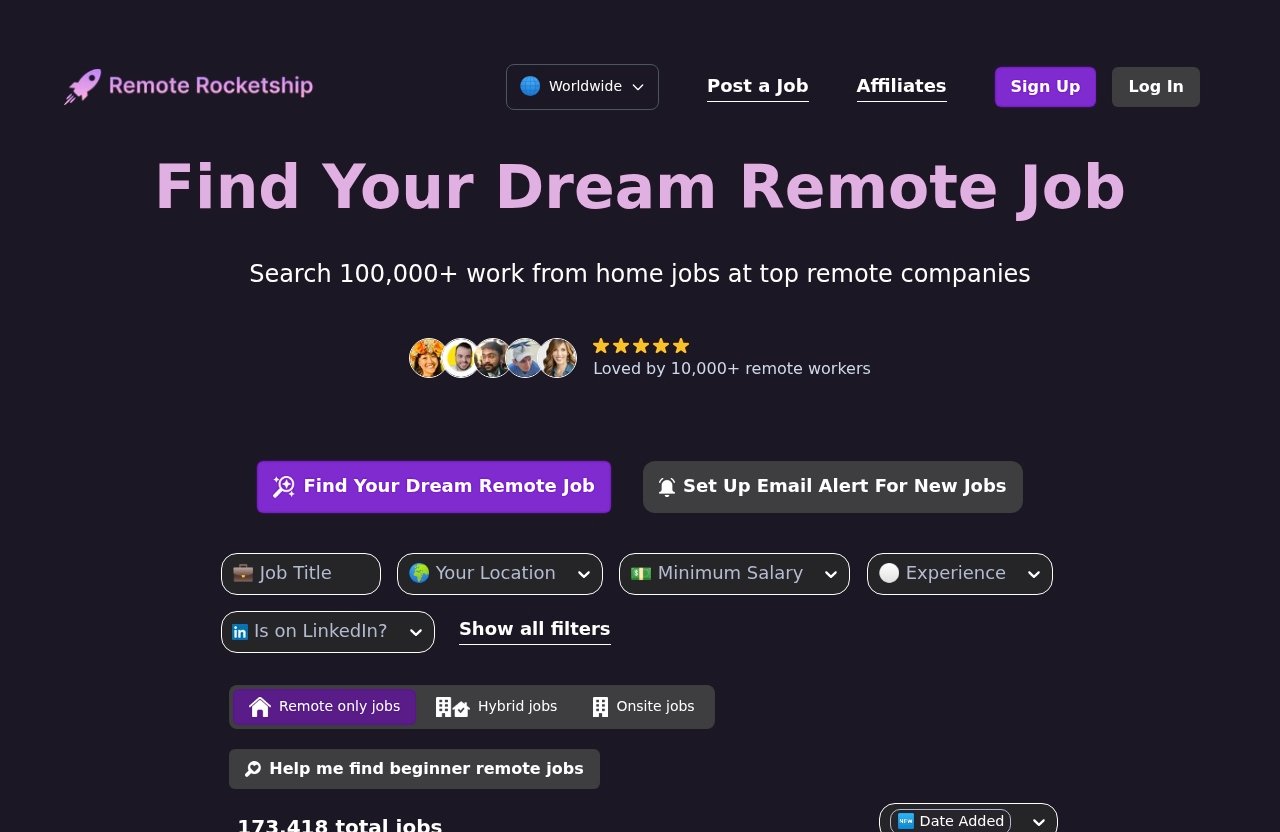
Remote Rocketship fits into the remote job board vs LinkedIn discussion as a remote-focused discovery option, not as a full replacement for LinkedIn.
Because the official Remote Rocketship homepage and pricing page returned a security verification/CAPTCHA wall at the time of writing, I will not claim specific pricing, job counts, features, free trials, or guarantees. You should verify current details directly on the official site before making any purchase decision.
Why a curated remote board can complement LinkedIn
A curated remote board can be useful because it starts from the job seeker’s main requirement: remote work. That makes it a practical complement to LinkedIn, where you may need more filtering and manual checking.
If you are actively searching for remote-first roles, it can make sense to begin your search with a focused board, then use LinkedIn for company research and outreach.
Remote Rocketship is one remote job board option we recommend considering for that focused discovery step. You can explore it here: Remote Rocketship.
Use cases for Remote Rocketship
Remote Rocketship may be worth considering if you want a more remote-focused place to look for opportunities before expanding your search elsewhere.
Good use cases include:
- You are tired of hybrid roles appearing in remote searches.
- You want to compare remote listings outside LinkedIn.
- You prefer starting with a job board instead of a social network.
- You are building a daily remote application routine.
- You want an alternative to LinkedIn for jobs while still keeping LinkedIn for networking.
Again, verify current product details on the official site, especially if pricing or access terms matter to you.
Best-fit audience for Remoterocketship
The best-fit audience for Remoterocketship is likely active remote job seekers who want a curated remote-focused option alongside LinkedIn.
It is especially relevant if you are looking for fully remote, globally remote, or location-flexible roles and want to reduce search noise. It is less of a substitute if your main need is recruiter visibility, personal branding, or referral networking.
For the best outcome, treat Remote Rocketship as part of a broader search system rather than your only channel.
How to Use Both Platforms for the Best Outcome
The smartest answer to remote job board vs LinkedIn is a workflow. Use remote job boards to identify strong-fit openings, then use LinkedIn to strengthen your chances.
This approach keeps your search focused without giving up the network effects that make LinkedIn useful.
Daily search routine
A simple daily routine works better than random browsing.
Try this:
- Spend 20–30 minutes searching remote job boards first.
- Save roles that match your title, skills, location, and work arrangement.
- Verify each role on the company website.
- Apply to the best-fit roles with a tailored resume.
- Use LinkedIn to find the recruiter, hiring manager, or team members.
- Send one thoughtful follow-up message.
- Record everything in your tracker.
If you want a remote-focused starting point, you can also review Remote Rocketship as one curated board to include in your routine.
Application tracking system
Do not rely on memory. Remote job searches become messy quickly, especially when the same company posts across multiple platforms.
Use a spreadsheet, Notion board, Airtable, or any simple tracker with these columns:
| Field | Why it matters |
|---|---|
| Company | Prevents duplicate applications. |
| Role title | Helps compare similar openings. |
| Source | Shows whether LinkedIn or a board performs better for you. |
| Remote type | Tracks fully remote, hybrid, region-specific, or global. |
| Salary range | Helps evaluate fit and negotiation. |
| Date applied | Keeps follow-up organized. |
| Contact person | Supports LinkedIn outreach. |
| Status | Prevents missed interviews and deadlines. |
After three or four weeks, review your data. If remote boards produce more interviews, lean into them. If LinkedIn outreach gets replies, increase networking.
LinkedIn profile optimization checklist
Even if you prefer remote job boards, your LinkedIn profile should support your search. Many employers will still look you up.
Improve these areas:
- Headline with target role and remote-relevant skills
- Clear “About” section with measurable outcomes
- Experience bullets focused on achievements
- Keywords matching your target roles
- Featured projects, portfolio, or case studies
- Location and work preference clarity
- Professional photo and banner
- Recommendations, if available
- Consistent resume and LinkedIn dates
A strong profile makes your applications feel more credible, no matter where the employer first finds you.
Final Recommendation by Job Seeker Type
The final remote job board vs LinkedIn recommendation is not one-size-fits-all. Your best channel depends on experience level, location flexibility, role type, and how much networking you are willing to do.
Use LinkedIn for visibility and relationships. Use curated remote job boards for remote-only efficiency. Combine both when you want the highest-quality pipeline.
Best for new grads
New grads and freshers should use LinkedIn heavily, but not exclusively. LinkedIn helps you build a professional footprint, connect with alumni, follow companies, and show projects when you do not yet have deep experience.
At the same time, remote job boards can help you find entry-level remote roles without digging through as many irrelevant listings.
Best approach:
- Build a polished LinkedIn profile.
- Post or feature projects that prove your skills.
- Search remote boards for junior-friendly openings.
- Ask alumni or community contacts for advice, not just referrals.
- Track which channel produces replies.
Best for experienced professionals
Experienced professionals often benefit most from curated remote job boards at the discovery stage. If you know your role, industry, salary expectations, and preferred work arrangement, a focused board can help you avoid low-fit listings.
LinkedIn still matters for recruiter discovery and social proof. A strong profile can validate your background after you apply elsewhere.
Best approach:
- Use remote boards for targeted applications.
- Use LinkedIn for warm introductions.
- Follow companies hiring remote teams.
- Keep your profile aligned with your resume.
- Prioritize roles where your experience clearly matches the job description.
Best for global and location-flexible candidates
Global candidates should prioritize platforms that make remote eligibility easy to evaluate. The biggest frustration is not finding “remote” jobs; it is finding remote jobs that are actually open to your country, region, or time zone.
For this group, curated remote job boards are often more efficient than broad platforms. LinkedIn remains valuable for confirming company legitimacy and finding employees who can clarify hiring restrictions.
Best approach:
- Search for globally remote or region-specific roles.
- Check country, payroll, and time zone requirements.
- Verify the company’s careers page before applying.
- Use LinkedIn to research employees in similar locations.
- Avoid roles that hide location rules until late in the process.
Bottom line: in the remote job board vs LinkedIn comparison, LinkedIn wins for networking, referrals, and visibility. Curated remote job boards win for focused remote discovery and less irrelevant search noise. If you are serious about landing remote work in 2026, use both with a clear system.
Official website · Latest pricing & offers
FAQ
Are there better job boards than LinkedIn?
Yes, depending on your goal. Curated remote job boards can be better than LinkedIn for remote-only discovery because they reduce irrelevant hybrid or on-site results.
LinkedIn is usually better for networking, recruiter visibility, and referrals. The best choice depends on whether you need cleaner listings or stronger professional reach.
Is it a red flag to not have LinkedIn?
Not always. Some people get hired through direct applications, portfolios, communities, referrals, or specialized job boards without relying heavily on LinkedIn.
That said, a polished LinkedIn profile can help with credibility in many markets. It gives recruiters and hiring managers a quick way to verify your experience, see your network, and understand your professional background.
How legit are remote jobs on LinkedIn?
Many remote jobs on LinkedIn are legitimate, but you should still verify each listing. LinkedIn is a broad platform, so some roles may be poorly labeled, outdated, hybrid, or location-restricted.
Before applying, check the company website, recruiter identity, email domain, salary details, and application process. Never pay money to get a job or share sensitive documents before a legitimate offer process.
Why are people getting rid of LinkedIn?
Common reasons include spam, privacy concerns, noisy feeds, repetitive job listings, and frustration with broad job-search results. Some job seekers prefer more focused platforms, direct applications, niche communities, or curated remote job boards.
Even if you reduce your LinkedIn use, it can still be worth keeping a clean profile as a professional credibility page.
