
Many of the best remote jobs you won’t find on LinkedIn are not secret jobs—they are simply posted somewhere else first. In 2026, companies commonly publish roles on their own career pages, applicant tracking systems (ATS), specialist remote job boards, and industry communities before a listing ever reaches LinkedIn.
I have found that treating LinkedIn as one channel rather than the entire job market produces a more realistic search strategy. This guide focuses on discovery methods for remote roles that may be less visible, less crowded, or entirely absent from mainstream feeds. It does not guarantee exclusivity, but it can help you find opportunities earlier and with more context.
Official website · Latest pricing & offers
What “remote jobs you won’t find on LinkedIn” really means in 2026
The phrase remote jobs you won’t find on LinkedIn describes roles that are unavailable on the platform, hard to surface through its filters, or posted elsewhere before they appear in LinkedIn search results. A company may share a vacancy only through its ATS page, a founder’s newsletter, a professional Slack group, or a specialized remote board.
This matters because a LinkedIn “Remote” filter does not always show the full market. It can also include roles with location restrictions, hybrid expectations, stale listings, or jobs that use broad location labels.
Why some remote roles never show up on LinkedIn
Smaller companies often keep recruiting simple: they post a job on their careers page and share it with employees, investors, or relevant communities. Some do not pay for broad distribution, while others receive enough qualified applications without it.
The remote jobs you won’t find on LinkedIn are frequently roles where a company values targeted applicants over maximum visibility. This is particularly common with early-stage startups, specialist agencies, and distributed teams hiring for a narrow skill set.
The difference between fully remote, remote-first, and hybrid-listed roles
Job labels can be misleading, so read the location and working-arrangement language carefully.
| Work arrangement | What it usually means | What to verify |
|---|---|---|
| Fully remote | No regular office requirement | Eligible countries, states, and time zones |
| Remote-first | Remote is the standard, but occasional events may occur | Retreats, quarterly meetings, travel expectations |
| Hybrid | Office attendance is expected on a recurring basis | Required office days and commuting distance |
| Work from anywhere | Broad geographic flexibility | Payroll, legal entity, and time-zone limits |
| Async | Work relies less on simultaneous hours | Core overlap hours and communication practices |
A role labeled “remote” may still require you to live near an office or work within specific US states. Conversely, a role listed under a city location may be genuinely remote-first, which is why direct career-page reading matters.
Which job types are most likely to stay off LinkedIn
The best remote jobs you won’t find on LinkedIn often sit in specialized categories: customer onboarding, implementation, revenue operations, technical writing, accessibility design, developer relations, and fractional leadership.
These roles may be shared in professional circles where hiring managers expect candidates to understand the field. Jobs with contract, part-time, international, or async terms are also more likely to be distributed through niche channels.
Why LinkedIn misses so many remote opportunities
LinkedIn remains useful, but its size creates a tradeoff: wide reach often means more noise, more duplicate listings, and more competition. Search rankings are also influenced by relevance, recency, location settings, and platform data—not solely by whether a role is a strong fit.
When researching remote jobs outside LinkedIn, I regularly see direct company listings that are more detailed and sometimes newer than their syndicated counterparts.
Company career pages beat job boards for speed
A company’s career page is usually the source of truth. When a hiring team opens or closes a role, its ATS listing is often updated before third-party platforms catch up.
For remote jobs you won’t find on LinkedIn, direct application pages can reveal critical details such as compensation ranges, country eligibility, hiring manager names, and application deadlines. They also reduce the risk of applying to an outdated repost.
Startups and distributed teams often use Greenhouse, Lever, and Ashby
Startups commonly use applicant tracking systems such as Greenhouse, Lever, and Ashby to host their hiring pages. These systems make it easy for a company to publish jobs directly, but the company may not syndicate every listing to LinkedIn.
That creates an opening for job seekers who search for:
- Greenhouse remote jobs
- Lever remote jobs
- Ashby remote jobs
- Distributed team jobs
- Remote-first startup careers
- “Work from anywhere” openings
A company can have dozens of jobs on its ATS page while maintaining only a minimal LinkedIn presence. This is one reason remote jobs you won’t find on LinkedIn are often discoverable with better search methods rather than better scrolling.
Recruiters post in niche communities before public boards
Recruiters and hiring managers frequently ask for referrals in Slack groups, Discord communities, newsletters, professional associations, and private online groups. A design lead may post in a product design community; a startup founder may share an operations vacancy in an operator network.
Searches such as “remote jobs you won’t find on LinkedIn reddit” can occasionally surface useful community discussions, but treat social posts as leads rather than verified listings. Always trace the opportunity back to a company domain or trusted application page.
The best places to find remote jobs LinkedIn often misses
A strong search uses several sources at once. The goal is not to abandon LinkedIn; it is to avoid relying on a single platform’s ranking system.
Remote job boards focused on fully remote hiring
Dedicated remote job boards can be more efficient because remote work is their core category rather than an optional filter. Well-known examples include We Work Remotely, Remote.co, Remotive, and FlexJobs, each with its own mix of roles, regions, and screening approach.
For a broader pool of remote jobs you won’t find on LinkedIn, compare listings across multiple boards instead of assuming one site is complete. Search by role family and location eligibility, not just by job title.
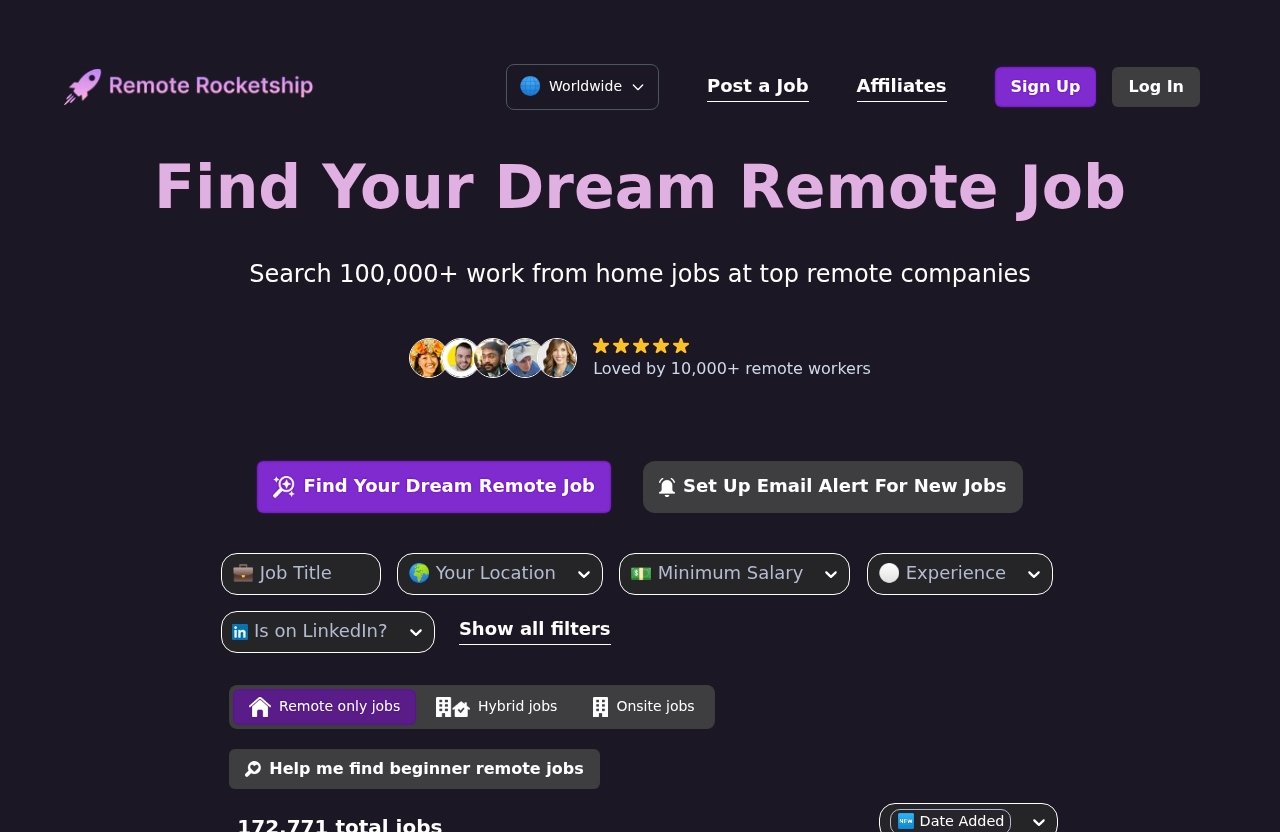
Remote Rocketship is another remote job board to consider as part of that mix. Its publicly visible search snippet describes a large volume of work-from-home jobs at remote companies in the US; you can review Remote Rocketship’s remote job listings alongside direct company openings and LinkedIn results.
Disclosure: This article includes an affiliate link to Remote Rocketship, which may earn landremotework.com a commission at no extra cost to you.
Startup career pages and ATS boards
Start with companies whose products, customers, or working styles interest you. A target list of 30 to 50 companies is more valuable than repeatedly searching generic job titles.
For each company, bookmark its careers page and note the ATS platform. If a business uses Greenhouse, Lever, or Ashby, its openings often have stable, searchable pages that can be checked quickly each week.
Useful targets include:
- Remote-first SaaS companies
- Global agencies and consultancies
- Developer-tool businesses
- Online education companies
- Digital health and fintech firms
- Open-source and infrastructure startups
- Customer experience outsourcing companies
Direct ATS pages are among the most reliable sources of hidden remote jobs because they are controlled by the employer, not copied through an aggregator.
Specialized communities, newsletters, and Slack groups
Specialist communities can surface hiring conversations before a formal listing is widely promoted. Look for groups related to your discipline, such as product operations, customer success, UX research, data analytics, technical writing, or nonprofit work.
The best remote jobs you won’t find on LinkedIn may appear in a weekly industry newsletter with a short application window. Join communities because you contribute to them, not only to ask for openings; a thoughtful profile and genuine participation improve the quality of referrals you receive.
Google x-ray search for hidden listings
An x-ray search uses Google operators to search a specific domain or type of page. It is one of the fastest ways to locate jobs hosted on ATS platforms.
Try these queries, replacing the job title or skill with your own:
text
site:boards.greenhouse.io "customer success" remote
site:jobs.lever.co "product designer" remote
site:jobs.ashbyhq.com "operations manager" remote
site:boards.greenhouse.io "technical writer" "work from anywhere"
site:jobs.lever.co "data analyst" distributed
For x-ray search remote jobs, use quotation marks around exact phrases and add exclusions when needed. For example, add -hybrid -intern if those terms are not relevant to your search.
Types of remote jobs most likely to be overlooked on LinkedIn
Not every occupation is equally likely to appear in major feeds. The remote jobs you won’t find on LinkedIn often involve specialized titles, flexible employment structures, or teams hiring internationally.
Operations and support roles
Operations roles are especially easy to miss because companies use varied titles. Search for business operations, revenue operations, people operations, implementation specialist, customer onboarding, customer success, support operations, executive assistant, and program coordinator.
Support jobs may also be organized by language, shift, product knowledge, or region. A “Customer Experience Specialist” opening might be more relevant than a standard “Customer Support Representative” search.
Design and product roles
Product and design teams increasingly hire for focused skills rather than broad titles. Search terms such as UX researcher, content designer, design systems specialist, product operations, user researcher, service designer, and growth product manager can uncover roles buried under different classifications.
For remote jobs you won’t find on LinkedIn, inspect a company’s product team page and recent product announcements. A new feature launch, funding event, or expansion into a new market can signal hiring before a role becomes widely visible.
Technical roles at smaller startups
Technical openings at smaller companies can be posted only on an ATS page, a founder’s social profile, or a developer community. Beyond software engineer, search for platform engineer, site reliability engineer, solutions engineer, QA automation, data engineer, security engineer, and developer advocate.
Smaller companies also use skill-specific language. Add tools and frameworks such as Python, React, Terraform, SQL, Kubernetes, or Salesforce to your searches rather than relying only on title keywords.
International-friendly and async roles
International-friendly jobs are frequently excluded from broad LinkedIn searches because location fields are inconsistent. Search for phrases including “global remote,” “EMEA,” “LATAM,” “anywhere,” “contractor,” “employer of record,” and “timezone-friendly.”
Async jobs can be especially attractive for people outside North American business hours. Look for phrases such as “written communication,” “documentation-first,” “low-meeting culture,” “flexible hours,” and “distributed company,” then verify whether there are mandatory overlap windows.
Official website · Latest pricing & offers
How to search smarter in 2026
Finding remote jobs you won’t find on LinkedIn requires a repeatable system, not a new search every morning. The most effective process combines targeted keywords, direct sources, saved alerts, and an application tracker.
Use Boolean search with remote-friendly keywords
Boolean search helps you include related titles and exclude poor matches. Use parentheses for alternatives, quotation marks for phrases, and NOT or minus signs to remove irrelevant terms.
Example searches:
text
("customer success" OR "implementation specialist") remote -hybrid
("product operations" OR "business operations") ("remote-first" OR distributed)
("technical writer" OR "content designer") remote (SaaS OR API)
("fractional" OR contract) "operations manager" remote
Include terms that describe working style, not just location. Useful modifiers include async, distributed, timezone-friendly, work from anywhere, contract, fractional, global remote, and remote-first.
Build a target company list and check career pages weekly
Create a simple spreadsheet with columns for company, industry, ATS link, preferred roles, location restrictions, last checked date, and notes. Start with organizations that employ people in your function, even if they have no open role today.
Checking 30 well-chosen career pages once a week is often more productive than browsing thousands of generic listings. This habit helps you spot remote jobs you won’t find on LinkedIn before they accumulate large application counts.
Set alerts on specialized boards instead of relying on LinkedIn feeds
Set role-specific alerts across remote job boards and use a separate email folder for them. Narrow alerts by role, seniority, country eligibility, and employment type where the site allows it.
Do not apply automatically to every alert. Review the job description, compare it with the company careers page, and save only roles that match your target salary, working hours, and skills.
Search by ATS platform plus title plus remote
ATS-specific searches are efficient because they remove many low-quality reposts. Rotate through Greenhouse, Lever, and Ashby searches several times per week, using your preferred titles.
| Search goal | Example query |
|---|---|
| Customer success | site:jobs.lever.co "customer success" remote |
| Product work | site:jobs.ashbyhq.com "product manager" remote |
| Operations | site:boards.greenhouse.io "operations" "remote" |
| International work | site:jobs.lever.co remote "EMEA" |
| Async-friendly work | site:boards.greenhouse.io async remote |
A practical weekly routine is 15 minutes daily for alerts and direct applications, plus 60 to 90 minutes once a week for company research, x-ray searches, and networking follow-ups.
How Remote Rocketship helps surface these jobs
Remote job boards can reduce the time spent filtering office-based roles from general job sites. They are useful when you want to search a pool built around work-from-home opportunities instead of treating remote status as an afterthought.
What kinds of listings a remote-first board can surface
Remote Rocketship is described publicly as a remote job board with a large volume of work-from-home jobs at remote companies in the US. That makes it a relevant source for readers looking beyond mainstream listings, though you should still read every employer’s location requirements carefully.
The remote jobs you won’t find on LinkedIn may be easier to discover when you compare a remote-focused board with company-owned pages. A board can help identify employers and titles; the employer’s site remains the best place to confirm current details.
Why early access and niche filtering matter
Speed matters because remote roles can attract many applicants quickly, particularly for generalist support, operations, and entry-level roles. Seeing an opening soon after publication gives you time to tailor your materials, but it does not remove the need for a strong application.
Niche filtering also matters because the phrase “remote job” covers very different arrangements. Prioritize listings with explicit details about location, time zones, employment type, reporting structure, and expected communication hours.
How to use it alongside company pages and LinkedIn
Use Remote Rocketship to expand discovery, LinkedIn to research companies and employees, and direct career pages to verify the vacancy and apply when possible. This three-part approach avoids overreliance on any one source.
For example, if you identify a company through a remote board, open its official job page, review its leadership and employee footprint on LinkedIn, and look for recent company news. That workflow is more dependable than trusting a single listing alone.
How to avoid scams and low-quality postings
A wider search for hidden remote jobs should always include a safety process. Legitimate employers can use many channels, but scammers also exploit the demand for flexible work.
Red flags in remote job listings
Be cautious when a role has vague duties, unusually high compensation for basic work, pressure to act immediately, or a request to move the conversation to encrypted messaging. Poor grammar alone is not proof of fraud, but multiple warning signs deserve attention.
Do not send money, buy “required” equipment from a recruiter, cash a check, or provide bank details before you have completed a legitimate hiring process. Genuine employers do not require payment to consider an application.
How to verify a company before applying
Check that the listing links to the organization’s official domain. Review the company website, leadership page, product or service, public business records where available, and employee profiles.
For remote jobs you won’t find on LinkedIn, verification is especially important because you may have found the lead through a less familiar source. Confirm that the same role appears on the employer’s careers page or contact the company through a publicly listed email address.
Safer application habits for remote seekers
Use a dedicated job-search email address and maintain a record of every application. Save the original listing URL, date, contact name, source, and any promised next step.
Share only the information needed for an application. A resume and portfolio are normal; government identification, financial data, and payment information should wait until a verified employer has made a legitimate offer and explained the onboarding process.
2026 remote job search checklist
The most reliable way to find remote jobs you won’t find on LinkedIn is to make discovery a consistent routine. Use this checklist to build a search process you can maintain.
Daily quick scan
- Review alerts from remote job boards and your saved searches.
- Check new openings at five to 10 priority companies.
- Apply to strong matches while the listing is fresh.
- Spend 10 minutes reviewing one niche community or newsletter.
Weekly deep search
- Run x-ray searches for Greenhouse, Lever, and Ashby listings.
- Refresh Boolean searches with new titles and skills.
- Add five relevant companies to your target list.
- Review roles marked remote for country, state, and time-zone restrictions.
- Identify one person working in a similar role for thoughtful networking.
Application tracking system
Track applications in a spreadsheet, Notion database, or simple document. Include the role, source, link, application date, status, follow-up date, compensation details, and notes on eligibility.
This makes it easier to see which sources are generating interviews. Over time, your data will reveal whether remote job boards, direct company pages, referrals, or LinkedIn are actually producing the strongest leads.
Follow-up and networking workflow
Follow up only when appropriate, typically after the timeline stated in the job post or after one to two weeks when no timeline is provided. Keep messages brief, specific, and respectful.
The best remote jobs you won’t find on LinkedIn are often found through a layered process: targeted search, direct verification, a tailored application, and patient relationship-building. In 2026, a diversified search system is more useful than chasing every heavily promoted listing.
Official website · Latest pricing & offers
FAQ
Why can’t I see remote jobs on LinkedIn?
LinkedIn shows only part of the hiring market. Companies may post first—or only—on their career pages, remote job boards, ATS platforms, newsletters, and communities. Search filters, location settings, ranking algorithms, and intense competition can also make relevant roles difficult to find.
Where to find jobs not listed on LinkedIn?
Start with company career pages, specialist remote job boards, professional communities, and newsletters. Use Google x-ray searches such as site:boards.greenhouse.io remote or site:jobs.lever.co remote with your job title to uncover listings hosted directly on employer ATS pages.
Are remote jobs on LinkedIn too competitive?
Many are highly competitive because LinkedIn gives employers broad visibility and makes applying easy. Competition alone should not stop you from applying, but searching alternative sources can help you find newer listings and less widely distributed opportunities.
What search terms help uncover hidden remote jobs?
Use terms such as remote, remote-first, distributed, async, timezone-friendly, global remote, work from anywhere, contract, fractional, and customer success. Combine these with job titles, skills, regions, and ATS operators for Greenhouse, Lever, and Ashby to uncover more targeted results.
