
If you are trying to verify remote rocketship jobs before sending your resume, you are asking the right question. Remote job listings can be real, outdated, duplicated, misrepresented, or used by scammers to collect personal information.
This guide is not a hype review or a guarantee that every listing is safe. It is a practical remote job verification process you can use before applying through Remote Rocketship or any other job board.
Official website · Latest pricing & offers
What “verify remote rocketship jobs” really means in 2026
To verify remote rocketship jobs means checking whether a listing appears to connect to a real employer, a real role, and a safe application path before you share your data.
That matters because a job board can help you discover openings, but discovery is not the same as employer verification. A listing can look polished and still lead to an expired job, a copied post, an impersonator, or a role with unclear work-from-home terms.
Why verification matters before you apply
Remote job scams have become more convincing because many real hiring processes now happen online. Email interviews, remote onboarding, digital forms, and applicant tracking systems are normal in legitimate hiring.
That makes it harder to spot the difference between a real remote opportunity and a risky one. A good remote job scam checklist helps you slow down before sending sensitive information.
Verification also saves time. If a job is not on the employer’s official careers page, has mismatched salary claims, or asks for payment upfront, you can avoid a wasted application.
What Remote Rocketship is and how it sources listings
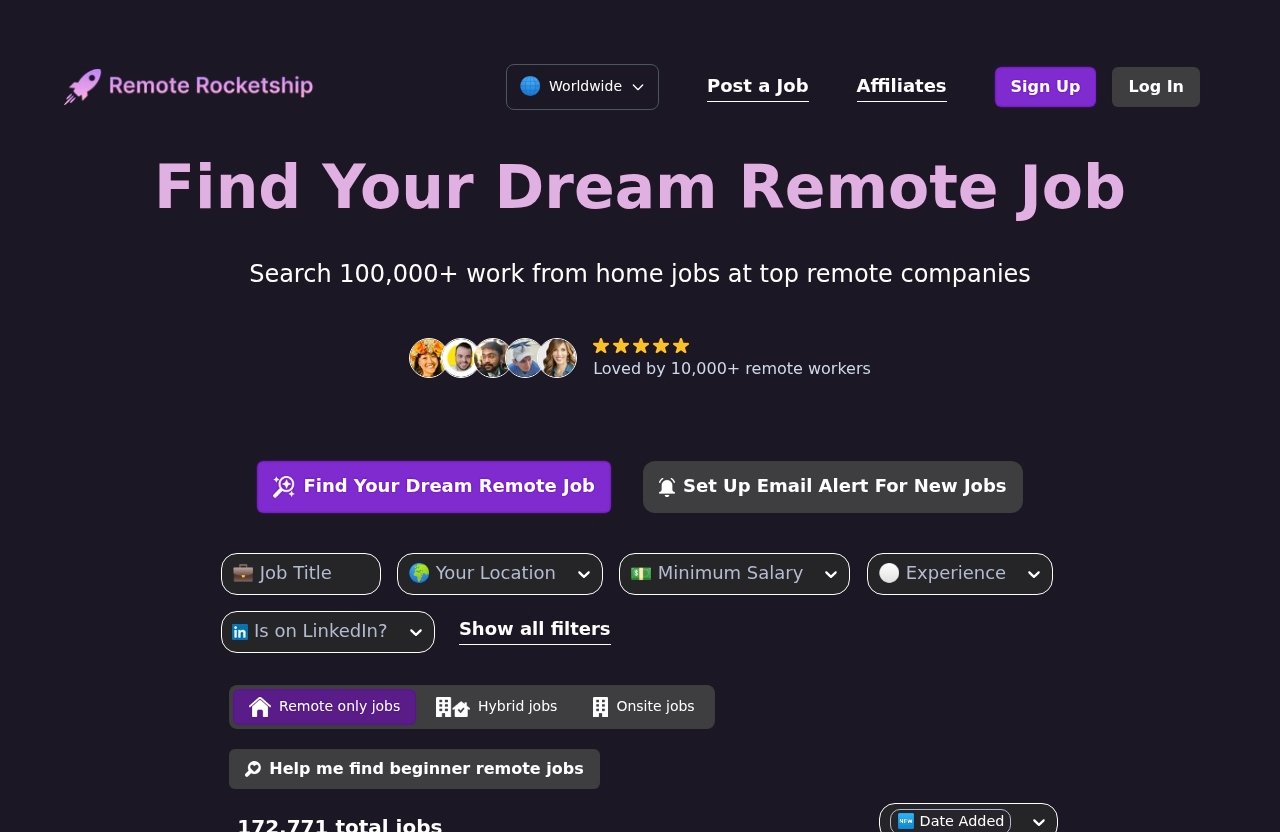
Remote Rocketship appears in search behavior as a place people use to find or inspect remote job listings. For this article, treat it as a job-discovery source: a place where you may encounter listings that need to be checked before you apply.
One important limitation: the official homepage and pricing page content available for review showed a security verification interstitial. The page text said the site was performing security verification to protect against malicious bots and that the user must be verified as not a bot. No public pricing plans, prices, or feature details were visible in that source text.
Because of that, I would not make assumptions about exact pricing, plans, listing sources, or verification features. If you use Remote Rocketship, use it as one input in your search, not as the final proof that an employer is legitimate.
The difference between discovery and vetting
Discovery means you found a role. Vetting means you confirmed the role is real enough to apply.
This distinction is central when you verify remote rocketship jobs. A listing can be discovered on a job board, shared on social media, or mentioned in a newsletter, but the strongest source of truth is usually the employer’s own website or official applicant tracking system.
Think of the process like this:
| Stage | What It Means | Trust Level |
|---|---|---|
| Discovery | You found a listing on a board or search result | Low to medium |
| Cross-check | You matched the job to the employer’s site or ATS | Medium to high |
| Safe application | You apply through an official company domain or known ATS | Higher |
| Sensitive data request | Employer asks for ID, bank info, SSN, or payment | Requires extreme caution |
Quick verdict: the 7-minute remote job verification checklist
If you only have a few minutes, use this fast checklist to verify remote rocketship jobs before clicking apply.
The goal is not to prove everything with perfect certainty. The goal is to catch obvious risks, confirm basic legitimacy, and decide whether to apply, save, or skip.
Check the employer’s official careers page
Search the company name plus “careers” in a browser. Do not rely only on the link inside the listing.
Look for the same job title, department, location, and remote status on the company’s official careers page. If the job is missing, it may still be real but expired, newly posted elsewhere, or not publicly listed; treat that as a yellow light.
Match the listing to the company domain
Check the company’s official website domain. Then compare it with the application link, recruiter email, and any forms you are asked to complete.
For example, a real company might use companyname.com or a recognized ATS subdomain. Be careful with lookalike domains, extra hyphens, misspellings, or generic email addresses.
Confirm role, salary, and location consistency
A legitimate remote job usually has consistent details across platforms. The title, salary range, seniority, department, and location restrictions should mostly match.
If one listing says “fully remote worldwide” while the company site says “remote within the U.S. only,” pause. This is one of the easiest ways to catch outdated or copied posts when you verify remote rocketship jobs work from home listings.
Search for duplicate postings and repost dates
Copy a unique sentence from the job description and search it in quotes. This can reveal whether the listing appears on the employer site, another job board, or suspicious duplicate pages.
Also check posting dates. A job reposted for months is not always fake, but it may indicate evergreen recruiting, high turnover, or an outdated scraped listing.
Look for application destination and data collection signals
Before submitting anything, check where the application goes. Safe paths usually lead to the employer’s own domain or a recognizable applicant tracking system.
Be more cautious if the application asks for sensitive data before any interview. Early requests for your Social Security number, government ID, bank details, or payment information are major remote job red flags.
Verify company presence and hiring footprint
Look up the company on LinkedIn, Google News, Crunchbase, and general search results. You are looking for a real business footprint, not perfection.
A small company may have limited press, but it should still have some coherent presence: a website, team members, product or service details, and consistent branding.
Decide whether to apply, save, or skip
Use a simple traffic-light decision:
| Signal | Meaning | Action |
|---|---|---|
| Green light | Job appears on employer site or ATS, details match, no payment or identity red flags | Apply carefully |
| Yellow light | Some details are missing or inconsistent, but no obvious scam behavior | Save and investigate |
| Red light | Payment requests, fake domains, pressure tactics, or sensitive data demands | Skip and report |
How to verify a Remote Rocketship listing step by step
This is the core process I use when checking whether a remote listing is worth an application. It works whether you are searching for rocketship remote jobs, roles on other boards, or direct company openings.
When you verify remote rocketship jobs, do the steps in order. Each step either increases confidence or gives you a reason to pause.
Step 1: Open the company website and careers page
Start with the company, not the job board. Search the employer name independently and open the official website.
Then look for pages labeled Careers, Jobs, Join Us, Work With Us, or Open Roles. If the listing appears there with matching details, that is one of the strongest positive signals.
If the job does not appear, do not assume fraud immediately. It could be closed, unlisted, or posted through a recruiting partner. But do not submit sensitive information until you confirm the application path.
Step 2: Compare job title, description, and requirements
Open the Remote Rocketship listing and the employer careers page side by side. Compare the job title, team, responsibilities, requirements, location, salary, and benefits.
Small wording differences are normal. Major differences are not.
Watch for mismatches like:
- “Entry-level” on the job board but “5+ years required” on the company site
- “Worldwide remote” on one page but “must be based in Canada” elsewhere
- A salary range that appears much higher than the employer’s own posting
- A job title that does not exist on the company careers page
This comparison is one of the fastest ways to verify remote rocketship jobs without relying on reviews or social media speculation.
Step 3: Check if the application links off-site to a real ATS
Many legitimate companies use applicant tracking systems, often called ATS platforms. These systems host application forms and candidate portals.
A real ATS path should still make sense. It may include the company name, a recognized ATS provider, or a consistent job ID. If the link redirects through multiple strange domains or opens a bare form with no employer branding, slow down.
Before entering your information, check:
- Does the application page show the employer name?
- Does the URL look professional and relevant?
- Is the page secured with HTTPS?
- Does the job ID or title match the listing?
- Does it ask only for normal application details?
A normal application usually asks for your resume, contact details, work eligibility, and optional demographic information. It should not ask you to buy equipment, pay a deposit, or provide banking details before an offer.
Step 4: Inspect the email domain and recruiter identity
If someone contacts you after you apply, inspect the email address carefully. A legitimate recruiter should usually use the company’s official domain or a clearly authorized recruiting partner domain.
Be careful with:
- Gmail, Outlook, Yahoo, or Proton addresses claiming to be corporate recruiters
- Misspelled domains
- Domains with extra words like “careers-companyname” when the official company uses something else
- Recruiters who refuse to connect through normal channels
Search the recruiter’s name on LinkedIn and compare their profile with the company’s employee list. Reviews and Reddit threads can be helpful signals, but a verified company domain and a consistent recruiter footprint matter more.
Step 5: Search the company on LinkedIn, Crunchbase, and Google News
A real company should usually leave a trail. Search the company name with terms like “careers,” “funding,” “team,” “reviews,” “LinkedIn,” and “news.”
You are not looking for universal praise. Even legitimate employers can have mixed reviews. You are looking for basic consistency.
Useful checks include:
- LinkedIn company page with employees who list the company
- A website that clearly explains the product or service
- Business registration or legal entity details where available
- Press, funding, customer, or product mentions
- Employee posts that match the company’s hiring activity
If you are researching verify remote rocketship jobs reddit discussions, treat Reddit as anecdotal. Reddit can reveal patterns, but it is not proof by itself.
Step 6: Look for wage transparency and legal employer details
Pay transparency varies by location and company policy. Still, vague or unrealistic compensation is a warning sign.
Look for salary ranges, employment type, location restrictions, and legal employer information. A legitimate listing should make it reasonably clear whether the role is full-time, part-time, contract, freelance, or commission-based.
Be cautious if a listing promises unusually high pay for very simple work, especially if it also has urgent hiring language. “No experience, $40/hour, start today” should trigger extra checks.
Red flags that a remote job may be fake or risky
Red flags do not always prove a scam. Sometimes a legitimate company writes a sloppy job ad or uses a third-party recruiter.
But when you verify remote rocketship jobs, repeated red flags should push you toward saving, investigating, or skipping the listing.
Urgent language and pressure to act immediately
Scammers often try to create urgency. They may say the role will disappear in hours, the hiring manager is waiting, or you must complete onboarding immediately.
Real employers may move quickly, but professional hiring still gives you time to review documents, ask questions, and verify who you are speaking with.
Pressure is especially concerning when paired with requests for money or personal data.
Requests for payments, deposits, or gift cards
A real employer should not require you to pay to get hired. Be extremely cautious if you are asked to buy starter kits, pay for training, send gift cards, cover background-check fees directly, or purchase equipment from a specific vendor before employment is confirmed.
This is one of the clearest red-light items in any remote job scam checklist. If money flows from the applicant to the supposed employer, stop.
Vague company names or missing legal entity info
Some fake listings use generic company names that are hard to search. Others impersonate real brands but provide no official domain, address, leadership information, or public footprint.
A legitimate startup may be small, but it should still have a coherent identity. If you cannot determine who the employer legally is, do not send sensitive information.
Too-good-to-be-true pay for low-skill work
Remote work is desirable, so scammers often use high pay to attract applicants. Be skeptical of unusually high hourly rates for simple data entry, package forwarding, check processing, or vague assistant work.
This does not mean all high-paying remote jobs are fake. It means the pay should match the skill level, market, and employer profile.
Interviewing only by chat with no real employer trail
Chat-based communication can be part of a hiring process, but a full interview process conducted only by text is risky when there is no verified company domain or recruiter identity.
A normal process often includes email from an official domain, scheduled video or phone interviews, recruiter screens, technical assessments, or conversations with hiring managers.
If the company avoids all verifiable contact, treat that as a red flag.
Requests for sensitive data too early
Do not share your Social Security number, passport scan, driver’s license, bank account, tax forms, or direct deposit details before you have verified the employer and received a legitimate offer.
Some personal information is normal after hiring. The timing matters. Early identity requests are one of the strongest reasons to pause when you verify remote rocketship jobs.
Official website · Latest pricing & offers
How to use Remote Rocketship safely before you apply
The safest mindset is simple: use Remote Rocketship to find possibilities, then verify the employer independently.
That approach keeps the process balanced. It does not assume every listing is bad, and it does not assume every listing is safe.
Treat it as a discovery tool, not a final trust signal
If you use Remote Rocketship, treat the listing as a starting point. Your next step should be checking the employer’s own careers page or official ATS.
This is especially important because the available official source text reviewed did not show public feature details, pricing, or listing-verification claims. The visible page content only showed security verification language intended to protect against malicious bots.
Save suspicious listings and cross-check elsewhere
If something feels off, do not apply immediately. Save the listing URL, employer name, job title, salary, and posting date.
Then search for the same role elsewhere. Compare it with LinkedIn, the company site, search results, and other reputable job boards.
This is useful for verify remote rocketship jobs reviews research too. Reviews may tell you what other users experienced, but they should not replace direct employer verification.
Use a separate job-search email and resume version
Create a dedicated job-search email address. This helps you spot phishing, track applications, and reduce exposure if your email ends up on spam lists.
You can also use a resume version that includes only necessary contact information. For most early applications, your name, email, city/region, LinkedIn profile, portfolio, and work history are enough.
Never share SSN, bank details, or ID upfront
This rule applies to every board, not just Remote Rocketship. Do not provide sensitive identity or banking information before you have verified the employer and reached a legitimate post-offer stage.
If a recruiter says they need that information to “reserve your spot,” “release equipment,” or “process your application,” treat it as a major red flag.
Track where each listing originally appeared
Use a simple spreadsheet or notes app. Track the board, employer, job title, application URL, date applied, recruiter name, and status.
This protects you after you apply. If someone contacts you claiming to be from the company, you can compare their message against your records.
How to spot legit remote jobs on any board, not just Remote Rocketship
The same rules apply across the remote job market. Whether you are using a niche board, a major job site, social media, or a direct company search, you still need a repeatable process for how to check if a remote job is legit.
A careful process helps you avoid both scams and low-quality applications.
Look for exact company matching across the web
Search the employer name exactly. Then compare the logo, website, domain, LinkedIn page, and job details.
Impersonators often copy real company names but use slightly different domains or unofficial emails. Exact matching helps you separate the real employer from lookalikes.
Check if the job still exists on the employer site
The employer’s own careers page is usually the strongest source of truth. If the job is not there, look for a matching ATS page connected from the official website.
If you cannot find the job anywhere except one board, use caution. It might be a legitimate third-party listing, but it needs more evidence.
Evaluate the realism of responsibilities and seniority
Legitimate job descriptions usually have a clear relationship between responsibilities, seniority, skills, and pay.
For example, a senior product role should list meaningful experience requirements. A junior support role should not promise executive-level compensation with no interview process.
Realism is a practical filter when you verify remote rocketship jobs or compare listings on multiple boards.
Verify if remote means fully remote, hybrid, or location-restricted
Many “remote” jobs are not remote from anywhere. They may require you to live in a specific country, state, time zone, or commuting distance.
Check for phrases like:
- Remote within the United States only
- Must be based in the EU
- Hybrid in New York
- Remote, but quarterly office visits required
- Work from home after training period
This matters for compliance, taxes, payroll, meetings, and your own expectations.
Confirm the hiring process has normal professional steps
Most legitimate remote hiring processes include predictable stages. There may be a recruiter screen, hiring manager interview, skills assessment, panel interview, reference check, offer letter, and onboarding.
Not every company follows the same process, but it should feel professional. If the process skips straight from chat message to “you are hired” and then asks for money or ID, stop.
When a Remote Rocketship job is probably safe enough to apply
You rarely get perfect certainty before applying. The realistic goal is to reach “safe enough to apply with normal information.”
Use this green-light framework when you verify remote rocketship jobs.
The employer has a real site and active team footprint
The company has an official website, consistent branding, clear business activity, and some public team or hiring footprint.
A small company does not need hundreds of employees or major press. But it should be possible to understand what the company does and who appears to work there.
The job is mirrored on the company careers page or ATS
This is one of the strongest signs. If the same job appears on the employer’s careers page or an ATS linked from the official site, the listing is more likely to be current and legitimate.
Still, apply through the safest route. If possible, use the employer’s official careers page rather than a copied link from an unknown source.
The recruiter uses an official company domain
A recruiter email from a verified company domain is a positive signal. A LinkedIn profile that matches the company’s employee footprint adds more confidence.
This does not guarantee everything is safe, but it reduces the risk of impersonation.
The role details, salary, and location make sense
The job description should match the role’s level, pay, and location requirements. Remote status should be clear enough that you know whether you are eligible.
If the role is listed as work-from-home, confirm whether it is fully remote, hybrid, or restricted to certain regions. This is especially important for verify remote rocketship jobs work from home searches.
There are no payment or identity-demand red flags
A job is much safer to apply for when it asks only for standard application details. Resume, contact information, portfolio, LinkedIn URL, and work history are normal.
Payment requests, bank details, SSN requests, and government ID demands should not appear at the first application stage.
What to do after you apply
Verification does not end after you submit your resume. Some scams begin after the first contact, especially when impersonators pretend to represent a real company.
Keep using your remote job verification habits until you have a signed offer and have confirmed the employer through official channels.
Monitor for phishing and impersonation emails
After applying, watch for emails that use similar but incorrect domains. Be careful with attachments, shortened links, and messages that pressure you to act quickly.
If a recruiter contacts you, compare their email domain with the company’s official website. When in doubt, contact the company through its official careers page or main contact form.
Keep application copies and screenshots
Save the job description, application URL, posting date, salary range, and recruiter details. Screenshots can help if the listing disappears or changes.
This is also useful for organizing your search. If you are applying to many remote jobs, records prevent confusion and help you identify suspicious follow-ups.
Be careful with follow-up links and attachments
Do not download files from unknown senders. Do not enter login credentials into pages reached through suspicious emails.
If you are asked to complete an assessment, verify that it comes from the employer, a known testing platform, or a link shared through an official hiring channel.
Report suspicious posts to the board and the company
If a listing looks fake or impersonates a real employer, report it to the job board. You can also alert the company being impersonated through its official website.
This helps other applicants. It also creates a record if the same scam appears again.
Official website · Latest pricing & offers
FAQ
Is Remote Rocketship legit for work-from-home?
Remote Rocketship can be used as a remote-job discovery source, but each listing still needs independent verification. A board surfacing a job is not the same as proving every employer, posting, or application link is safe.
To verify remote rocketship jobs, check the employer’s official careers page, match the job details, inspect the application domain, and avoid any early requests for money or sensitive data.
How do I check if a remote job is legit?
Start with the employer’s official website. Find the careers page, confirm the job exists, compare the title and requirements, and make sure the application link leads to the company’s domain or a credible ATS.
Then inspect the recruiter’s email domain, search for the company’s public presence, and watch for remote job red flags such as payment requests, urgent pressure, unrealistic pay, or early demands for SSN, ID, or bank details.
Is Remote Rocketship legit on Reddit?
Reddit can be useful for spotting patterns, but it is anecdotal and not proof. You may find mixed opinions, outdated comments, or experiences that do not apply to the specific employer you are checking.
Use verify remote rocketship jobs reddit searches as one signal only. Then verify the actual job through the employer’s official careers page, company domain, recruiter identity, and public hiring footprint.
What is the most legit site for remote jobs?
There is no single job site that is safest for every applicant and every role. The safest approach is to use reputable job boards for discovery and then confirm openings directly on the employer’s careers page.
For any board, including Remote Rocketship, the company’s own website or official ATS is usually the strongest source of truth. If you remember one rule, make it this: verify remote rocketship jobs by confirming the employer before you apply.
Related Reading
- Remote Rocketship Application Safety Guide 2026
- Remote Rocketship Scam Warning 2026: Is It Legit or Risky for Job Seekers?
- How Can I Tell If a Remote Job Is Legit? Best Ways to Spot Remote Job Scams in 2026
