
The best remote job boards for startups in 2026 are Wellfound, Startup Jobs, NoDesk startup jobs, Welcome to the Jungle, and Remote Rocketship. If you want startup-heavy discovery, start with Wellfound and Startup Jobs. If you want curated remote links, use NoDesk. If you care about company research, add Welcome to the Jungle. If you want to widen your search beyond startup-only platforms, use Remote Rocketship alongside those boards.
Remote startup jobs move quickly, and the “best” board depends on your role, seniority, location flexibility, and tolerance for noisy listings. The goal is not to use every site every day, but to build a repeatable workflow that surfaces fresh, relevant roles before they disappear.
Official website · Latest pricing & offers
Best Remote Job Boards for Startups in 2026: Quick Answer
Here is the short version if you are comparing the best remote job boards for startups and want a practical starting point.
| Job board | Best for | Main strength | Main tradeoff |
|---|---|---|---|
| Wellfound | Startup-heavy discovery | Strong startup orientation and company browsing | Can still require careful filtering |
| Startup Jobs | Broad startup role coverage | Wide range of startup roles and companies | Volume can feel broad or noisy |
| NoDesk startup jobs | Curated remote startup links | Hand-picked remote startup discovery | Smaller scope than larger boards |
| Welcome to the Jungle | Company research and fit | Employer context and candidate-friendly company pages | Not purely startup-only |
| Remote Rocketship | Broad remote search | Complements startup-specific boards | Verify current details directly before relying on specifics |
For most candidates, the best workflow is to use one or two startup-specific boards plus one broader remote board. That gives you enough coverage without turning the search into a full-time job.
What makes a job board startup-friendly?
A startup-friendly job board has a high concentration of early-stage or growth-stage companies, fresh listings, clear remote filters, and enough role variety to support more than just software engineering. The best remote job boards for startups also make it easy to identify whether a company is remote-first, hybrid, globally distributed, or limited to certain countries.
I also look for whether the board helps candidates evaluate fit. Startup jobs remote searches can be messy because titles vary widely, responsibilities are broad, and listings may be reposted across multiple sites.
Who this list is for: candidates seeking early-stage remote roles
This guide is for people looking for remote jobs for startups in engineering, product, design, marketing, sales, customer success, operations, finance, people operations, and founder-adjacent roles. It is also useful if you are comparing the best startup job sites and trying to avoid outdated or duplicated listings.
If you are searching for entry level startup jobs remote, you will need to be more disciplined with keywords and filters. Early-stage companies often hire generalists, but they may not always label roles as “entry-level” in the same way larger companies do.
How We Evaluated the Best Remote Job Boards for Startups
I evaluated the best remote job boards for startups using five practical criteria: startup density, listing freshness, remote filtering, role coverage, and ease of use. These are the factors that matter most when you are trying to find active remote startup jobs quickly instead of scrolling through irrelevant posts.
Startup hiring is fragmented. The same job may appear on a company website, a startup board, a remote board, and a general platform, sometimes with different wording or stale availability.
Startup density and role freshness
Startup density means the board consistently surfaces companies that feel startup-oriented rather than mostly enterprise, agency, or staffing listings. The best remote job boards for startups should make it easy to find early-stage, venture-backed, bootstrapped, or high-growth companies without excessive manual filtering.
Freshness matters because startup hiring can open and close fast. A listing that was useful three weeks ago may already be filled, paused, or deprioritized.
Remote-first filtering and location flexibility
Remote filtering is not just a checkbox. Good startup job boards help you distinguish between worldwide remote, U.S.-only remote, Europe-only remote, hybrid, and “remote but must be near headquarters.”
This is especially important if you are comparing the best remote job boards for startups in USA with the best remote job boards for startups worldwide. A role can say “remote” and still be restricted by payroll, tax, time zone, visa, or customer coverage requirements.
Role coverage across engineering, product, design, marketing, and operations
Many startup boards are strongest in engineering and product, but a useful search should also surface marketing, growth, sales, customer success, design, finance, recruiting, and operations roles. The best remote job boards for startups support multiple functions because early teams need more than developers.
When I review a board, I look for both specialist roles and generalist titles. Startups often use titles like “founding marketer,” “growth lead,” “product operations,” or “customer success generalist,” which may not appear in traditional corporate searches.
Ease of search, alerts, and application flow
A board can have strong listings but still waste time if search is clunky. Useful boards let you search by keyword, role type, remote status, location, and company stage or category when available.
Application flow also matters. If every listing sends you into a confusing external process, you need a system for tracking where you applied, when you followed up, and which version of your resume you used.
The Best Remote Job Boards for Startups in 2026
The best remote job boards for startups each solve a different problem. Some are better for startup discovery, some are better for broad volume, and others are better as supporting tools in a weekly search routine.
I would not treat any single board as complete. In practice, the strongest candidates usually combine startup job boards with broader remote boards and direct company research.
Wellfound
Wellfound is one of the most recognizable names for startup-focused job searching. Many candidates still associate it with the AngelList job board era, and it remains a natural first stop for people who want to browse startup companies and roles in one place.
It is best for candidates who want to explore early-stage companies, compare startup profiles, and find roles across technical and business functions. If your priority is startup density, Wellfound belongs high on your shortlist of the best remote job boards for startups.
The tradeoff is that you still need to filter carefully. Not every role will match your location, seniority, compensation expectations, or preferred company stage.
Startup Jobs
Startup Jobs, available at startup.jobs, is a broad startup employment marketplace with wide role coverage. It is useful when you want to see a large range of startup jobs remote candidates may not find on smaller curated lists.
This board is especially helpful for candidates who want volume across functions. Engineering, product, design, go-to-market, operations, and business roles can all appear, depending on current hiring demand.
The limitation is breadth. A high-volume board can surface more opportunities, but it can also require more sorting to separate ideal roles from poor-fit listings.
NoDesk startup jobs
NoDesk startup jobs, found at nodesk.co/remote-work/startups/, is useful for candidates who prefer curated remote discovery over a large search engine. It points remote-first candidates toward startup-related opportunities and resources without requiring them to sift through as much general job-board noise.
This is a good option if you want a leaner workflow. Instead of treating it as your only source, use it as a curated checkpoint during your weekly search.
The tradeoff is scope. Smaller curated resources may not cover every company, function, or geography represented on larger startup job boards.
Welcome to the Jungle
Welcome to the Jungle, at us.welcometothejungle.com, is useful when you want more company context before applying. Welcome to the Jungle jobs are not limited only to startups, but the platform can help candidates evaluate culture, teams, and role fit more thoughtfully.
This is valuable because startup fit matters. A great title at the wrong company stage, pace, or working style can become a frustrating experience.
The limitation is that it may not be the fastest pure startup search engine. It is strongest when used for research and shortlisting, not just raw listing volume.
Remote Rocketship
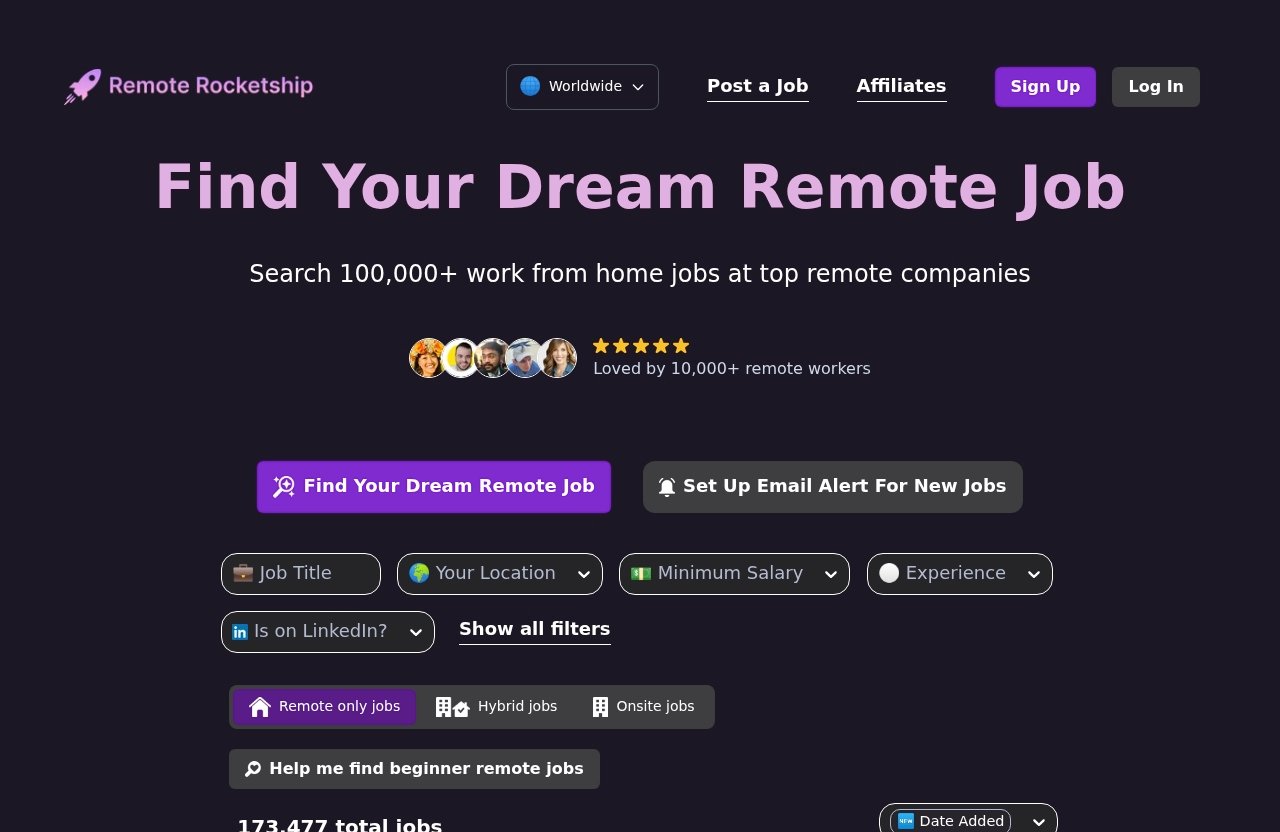
Remote Rocketship fits into this comparison as a broader remote job board that can complement startup-specific platforms. If you are already checking Wellfound, Startup Jobs, NoDesk, and Welcome to the Jungle, adding Remote Rocketship can help widen your remote search beyond boards that are strictly startup-branded.
Because accessible official pricing and feature details were limited at the time of writing, I would verify current specifics directly before making decisions based on plans, alerts, or other product details. That said, as part of a practical workflow, a broader remote board can be useful for catching roles that startup-only boards may miss.
For candidates comparing the best remote job boards for startups, Remote Rocketship is best viewed as a complementary source rather than a replacement for startup-specific discovery.
How to choose the right board for your stage and function
If you are a software engineer, product manager, or designer, start with Wellfound and Startup Jobs, then add Remote Rocketship for broader remote coverage. If you are in marketing, sales, customer success, or operations, use Startup Jobs for volume and Welcome to the Jungle for company research.
If you are early-career, use multiple keyword variations. Search for “junior,” “associate,” “coordinator,” “internship,” “founding,” “generalist,” and “remote” rather than relying only on entry-level filters.
Wellfound: Best for Startup-Heavy Discovery
Wellfound earns its place among the best remote job boards for startups because it is closely associated with startup hiring and company discovery. It is often one of the first places candidates check when they want to work at an early-stage or venture-backed company.
It is particularly useful when you want to browse companies, not just job titles. That matters because startup roles can vary dramatically depending on team size, funding stage, customer base, and founder expectations.
Why startup job seekers use it
Job seekers use Wellfound because it concentrates startup opportunities in a way general job boards often do not. For remote startup jobs, that can reduce the number of irrelevant corporate listings you need to scan.
It also helps candidates think in terms of company-stage fit. If you prefer a small team where responsibilities are broad, startup-heavy browsing is more useful than searching only by title.
Best for early-stage company browsing
Wellfound is especially strong for people who want to discover companies they may not already know. That is valuable because many startup companies hiring remote worldwide are not household names.
When I use startup boards, I do not only apply to visible roles. I also save promising companies, check their career pages, and return later when new roles open.
Potential drawbacks
The main drawback is that startup density does not automatically mean every listing is relevant. You still need to check remote restrictions, role seniority, salary transparency when available, and whether the company is actively hiring.
Also, candidates in non-technical functions may need broader searches. Wellfound can still be useful, but pairing it with Startup Jobs and broader remote boards usually creates better coverage.
Startup Jobs: Best for Broad Startup Role Coverage
Startup Jobs belongs on any list of the best remote job boards for startups because it offers broad exposure to startup roles across many functions. If you want one board that feels expansive rather than narrowly curated, this is a strong place to look.
The platform is best for candidates who do not want to miss opportunities just because they were posted outside a niche community. It can be especially useful during active search weeks when you want to build a larger application pipeline.
Who should use it
Use Startup Jobs if you want broad access to startup job boards without limiting yourself too early. It is useful for candidates across engineering, product, design, marketing, sales, operations, and support roles.
It also works well if you are still exploring which type of startup role fits you. Searching across multiple functions can reveal patterns in titles, skill expectations, and remote availability.
Strengths for tech and non-tech roles
Some startup boards lean heavily technical, but broad startup sites can be useful for non-tech candidates too. Growth, content, partnerships, customer success, sales, operations, and finance roles often appear in startup ecosystems.
For remote jobs for startups, role naming can be inconsistent. A “growth associate” role at one company may overlap with marketing, sales operations, analytics, or partnerships at another.
When it may be too broad
The same breadth that makes Startup Jobs useful can also create noise. You may need to use tighter keyword combinations, location filters, and date sorting to avoid wasting time.
If your search is very specific, such as “remote seed-stage product designer in North America,” a broad board may require more manual review than a curated source.
Official website · Latest pricing & offers
NoDesk Startup Jobs: Best for Curated Remote Startup Links
NoDesk startup jobs is a helpful option for candidates who prefer curation over volume. It deserves consideration among the best remote job boards for startups because it focuses on remote work discovery and startup-related links rather than trying to be the largest possible database.
For busy job seekers, this can be a real advantage. A curated page may surface fewer listings, but the time spent reviewing them can feel more focused.
Why curation matters
Curation matters because remote job search results often include stale listings, duplicate posts, staffing roles, and hybrid jobs mislabeled as remote. A curated resource can reduce some of that noise.
This does not mean curated lists are always complete. It means they are useful as a high-signal part of your workflow.
Best use case for remote-first candidates
NoDesk is best for candidates who are serious about remote-first work and want startup-related opportunities without searching a giant database. It can be especially helpful for people who already know they do not want hybrid or office-first companies.
I would use it as a weekly review source. Check it alongside Wellfound, Startup Jobs, and a broader remote board rather than expecting it to cover the entire market.
Limitations compared with larger boards
The limitation is coverage. Curated resources usually cannot match the volume of larger job boards, especially across every role type and geography.
If you need a large application pipeline, NoDesk should be one source among several. It is strong for discovery, but not enough by itself for most serious searches.
Welcome to the Jungle: Best for Company Research and Fit
Welcome to the Jungle is useful because startup candidates need more than a list of openings. Among the best remote job boards for startups, it stands out most for company context and fit research rather than pure startup volume.
This matters because joining a startup is a high-context decision. The same role title can mean very different day-to-day work depending on company culture, team maturity, and management style.
Why it helps with startup evaluation
Welcome to the Jungle can help candidates look beyond the job description. Company pages, team information, and employer storytelling can give useful signals before you spend time applying.
For startups, those signals matter. A vague job description may still be worth exploring if the company context is strong, while a polished title may not be enough if the team setup looks misaligned with your goals.
How it reduces noise
Company research reduces noise by helping you eliminate poor-fit opportunities earlier. Instead of applying to every remote role with a startup label, you can prioritize companies that match your working style.
This is especially helpful when comparing Welcome to the Jungle jobs with listings found on broader boards. You may find the role elsewhere, then use company context to decide whether it deserves an application.
Best for candidates who value company context
Welcome to the Jungle is best for candidates who care about culture, team structure, and employer positioning. It is also useful if you are choosing between several similar remote startup jobs and need more context before applying.
It may not replace Wellfound or Startup Jobs for raw startup discovery. But it can make your shortlist better.
Where Remote Rocketship Fits for Startup Job Seekers
Remote Rocketship fits into the best remote job boards for startups conversation as a broader remote search companion. It is not best understood as a startup-only platform; it is more useful as an additional source when you want to catch remote opportunities that may not appear on startup-specific boards.
In a real job search, this matters. Startup roles are scattered, and companies do not always post every opening on every niche platform.
Why it belongs in the comparison
Remote Rocketship belongs here because candidates searching for remote startup jobs often need both depth and breadth. Startup-specific boards give you depth in early-stage ecosystems, while broader remote boards can expose roles from startups, scaleups, and remote-first companies that may not label themselves clearly.
I would not rely on unverified claims about pricing, counts, or exclusive features. The practical reason to include Remote Rocketship is simpler: it can be part of a broader remote job search workflow.
How to use it alongside startup-specific boards
Use startup-specific boards first when you want early-stage discovery. Then use Remote Rocketship to widen your search for related remote roles, especially if your title or function appears across both startups and remote-first companies.
For example, a product marketer might search Startup Jobs for “founding product marketing” and then search a broader remote board for “remote product marketing,” “growth marketing,” or “B2B SaaS marketing.” That combination usually finds more relevant leads than either approach alone.
Best candidate profiles for Remote Rocketship
Remote Rocketship is most useful for candidates who are open to startup-like remote roles but do not want to limit themselves only to startup-branded job boards. It may fit engineers, marketers, designers, operators, and customer-facing candidates who want a wider remote pipeline.
It is also useful if you are comparing the best remote job boards for startups worldwide and want a broader view of remote hiring. Just confirm location requirements carefully because remote does not always mean globally available.
Best Remote Job Boards by Use Case
The best remote job boards for startups depend on what you need most: startup concentration, curated discovery, company research, or broad remote coverage. Choosing by use case is usually more effective than trying to rank every board as universally “best.”
Here is the practical breakdown I would use.
Best for the most startup listings
For the most startup-oriented discovery, start with Wellfound and Startup Jobs. Wellfound is strong for startup-heavy browsing, while Startup Jobs is useful when you want broader role volume.
This combination is especially good if you are exploring multiple startup stages or functions. It gives you a wider view of how startups are hiring in 2026.
Best for curated remote opportunities
NoDesk startup jobs is the strongest fit if you want curated remote startup links. It is not the largest source, but it can save time when you want a cleaner review process.
Use it as a signal source. If a company appears there and also appears on another board, that may be a prompt to research it more seriously.
Best for research before applying
Welcome to the Jungle is the best option in this list for company research and fit evaluation. It can help you understand employer positioning before you invest time in a tailored application.
This is useful when you are deciding between similar startup jobs remote candidates often see across multiple boards. Better context can lead to better application choices.
Best for broad remote search
Remote Rocketship is best used for broad remote search alongside startup-specific platforms. It can help expand your pipeline when startup-only sources feel too narrow.
For most candidates, the strongest setup is not one board. It is a stack: Wellfound or Startup Jobs for startup density, NoDesk for curation, Welcome to the Jungle for research, and Remote Rocketship for broader remote coverage.
Tips for Finding Remote Startup Jobs Faster in 2026
Even the best remote job boards for startups will not help much if your search process is too broad. Startup hiring rewards speed, specificity, and follow-through.
A good workflow is simple: search the right keywords, save promising companies, apply quickly to fresh roles, and track every application.
Use keyword combinations that match startup stages
Search beyond “remote startup jobs.” Try combinations like “seed-stage remote,” “Series A remote,” “founding designer,” “founding engineer,” “early-stage operations,” “remote growth lead,” and “startup customer success.”
If you want entry level startup jobs remote, use “junior,” “associate,” “coordinator,” “intern,” “apprentice,” and “new grad.” Also test function-specific phrases like “junior product analyst remote startup” or “associate growth marketer remote.”
Set alerts and save searches
Set alerts where the board supports them, and save searches manually when it does not. Startup hiring moves fast, and checking once a month is usually not enough.
I recommend checking your highest-signal boards several times per week during an active search. For lower-priority sources, a weekly review may be enough.
Look for role signals that indicate startup velocity
Strong startup listings often mention ownership, ambiguity, cross-functional work, customer proximity, experimentation, or building from zero to one. These signals can indicate that the company needs someone comfortable with fast-moving environments.
But read carefully. Sometimes “wear many hats” means meaningful ownership, and sometimes it means unclear priorities or under-resourcing.
Avoid outdated or duplicate listings
Outdated and duplicate listings are common across remote job boards. Before applying, check the company careers page when possible and compare posting dates across sources.
You can also search for community feedback, including terms like “remote job boards for startups reddit,” but treat anecdotal comments cautiously. Reddit can reveal patterns, yet it should not replace direct research.
Official website · Latest pricing & offers
FAQ
Which job board is best for remote startup jobs?
For startup-heavy discovery, Wellfound and Startup Jobs are strong starting points. They are among the best remote job boards for startups because they focus heavily on startup roles and company discovery.
To widen your search, add a broader remote board such as Remote Rocketship. This helps you find remote roles that may not appear on startup-specific platforms.
Are startup job boards better than LinkedIn for remote roles?
Startup job boards are often better for finding relevant early-stage roles with less general-market noise. They can surface companies and titles that are harder to identify on broad professional networks.
LinkedIn is still useful because it has enormous reach, but filtering for true startup quality can take more time. For remote jobs for startups, I would use startup boards first and LinkedIn as a secondary research and networking tool.
How do I find entry-level startup jobs remotely?
Use keywords like “entry-level,” “junior,” “associate,” “coordinator,” “internship,” and “new grad” with remote filters. Then add startup-specific terms such as “startup,” “early-stage,” “seed-stage,” “Series A,” and “founding team.”
Entry-level startup jobs remote candidates should also look for generalist roles. Smaller companies may hire for potential and adaptability, even when the title does not say “entry-level.”
What keywords should I use when searching for startup remote jobs?
Use combinations such as “remote startup jobs,” “early-stage remote jobs,” “startup jobs remote,” “seed-stage remote,” “Series A remote,” “junior remote,” and function-specific terms like “remote product designer startup” or “remote growth marketer startup.”
Also search by company type. Terms like “B2B SaaS,” “AI startup,” “fintech startup,” “developer tools,” and “climate tech” can uncover better-fit roles.
Final Recommendation
The best remote job boards for startups in 2026 are not interchangeable. Wellfound is the strongest starting point for startup-heavy discovery, Startup Jobs is best for broad startup role coverage, NoDesk is best for curated remote startup links, Welcome to the Jungle is best for company research, and Remote Rocketship is useful for broader remote search.
If you want the most efficient workflow, combine two startup-specific boards with one broader remote board. That gives you startup density, fresh discovery, and wider remote coverage without depending on a single source.
Best overall for startup discovery
Start with Wellfound if you want to browse startup companies and roles in a startup-heavy environment. Add Startup Jobs if you want more volume across functions and company types.
Together, they provide a strong foundation for finding remote startup jobs in 2026.
Best for broader remote search
Use Remote Rocketship when you want to expand beyond startup-only platforms. It can complement your search by surfacing remote roles that may still fit a startup-oriented candidate profile.
Just avoid assuming any board is complete. Always verify role details, location restrictions, and application status before investing time.
Best for candidates who want to compare multiple sources
The best setup is a comparison stack: Wellfound for startup discovery, Startup Jobs for breadth, NoDesk startup jobs for curation, Welcome to the Jungle for research, and Remote Rocketship for broader remote coverage.
That balanced approach gives you the best chance of finding relevant remote startup roles quickly while avoiding outdated, duplicated, or poor-fit listings.
Related Reading
- Remote Job Board vs LinkedIn: Which Finds Better Remote Roles in 2026?
- Best Sites for Remote Software Engineer Jobs in 2026: Remote Rocketship vs Major Job Boards
- Best Remote Job Boards for Tech Jobs in 2026: Remote Rocketship vs Broader Boards
