
Searching for remote jobs better than LinkedIn does not mean abandoning LinkedIn. It means using the right source for each part of the job hunt: specialized boards for discovery, company sites for direct applications, and LinkedIn for research and relationships.
In 2026, the best remote openings are often scattered across niche job boards, startup communities, curated newsletters, and remote-first company career pages. A broader platform can still be useful, but targeted sources usually make it easier to filter out hybrid roles, irrelevant locations, and heavily recycled listings.
Official website · Latest pricing & offers
Why remote jobs can be easier to find outside LinkedIn
LinkedIn is a large professional network first and a job board second. That combination is valuable, but it can make focused remote searching slower than it needs to be—especially when you want a specific schedule, timezone, seniority level, or employment type.
For many applicants, remote jobs better than LinkedIn are simply jobs found through sources built around remote work from the start.
Less noise, fewer social distractions
A LinkedIn search can mix job posts with networking content, promoted posts, recruiter updates, and “easy apply” listings that already have a large applicant pool. The platform’s scale is its strength, but that scale can make it hard to stay focused.
Niche remote job boards typically have a narrower purpose: helping candidates browse roles. If you know you want a fully remote product-management role, a part-time writing role, or a global customer-support position, a focused board can reduce the number of irrelevant results.
Curated boards vs giant aggregators
The best remote jobs better than LinkedIn often appear on boards that organize listings around remote-specific criteria. Those criteria may include worldwide eligibility, async work, role category, contract type, experience level, or compensation information where employers provide it.
This does not automatically make every small board high quality. It does mean the board’s filters and editorial standards matter more than its raw number of listings. A smaller source with relevant jobs can outperform a massive feed that requires constant cleanup.
Why hidden opportunities appear on niche boards first
Some employers publish openings directly to a remote-focused board, their own careers page, or a specialized community before creating a formal LinkedIn post. Startup teams, distributed agencies, and companies hiring internationally may prefer channels that reach people already looking for remote-first work.
These hidden remote jobs are not necessarily secret. They are simply less likely to surface if you rely on one platform, one saved search, and one application method.
What makes a remote job board better than LinkedIn
A better platform is not the one with the most listings. It is the one that helps you identify legitimate, relevant roles quickly enough to submit a strong application before the position becomes crowded.
When comparing remote jobs better than LinkedIn, use the same criteria you would use to evaluate the role itself: clarity, fit, transparency, and efficiency.
Filtering by salary, role, and seniority
Good filters help you avoid wasting time. Search for role families rather than only job titles—for example, “content,” “customer success,” “operations,” “data,” or “product”—then narrow by seniority, employment type, and region.
Salary information is also useful when it is available, but treat it as one signal rather than the only one. A role without a posted salary may still be worth pursuing if the company, scope, and level are a strong match.
Remote-first vs hybrid confusion
“Remote” is often used loosely. Some listings mean fully remote within a country, while others require regular office visits, relocation, specific work hours, or residency in a particular state or timezone.
The strongest fully remote jobs better than LinkedIn are usually described with clear language: remote-first, distributed, work from anywhere, worldwide, or a specific list of eligible locations. Read the location section before tailoring your résumé, not after.
Manual curation and scam reduction
Curation is valuable when it removes expired, duplicated, vague, or clearly suspicious listings. It cannot guarantee that every employer is legitimate, but it can improve the starting point.
Look for job boards that make it easy to see the employer name, job description, application destination, and posting date. Vetted remote job boards are helpful, but personal verification should always remain part of your process.
Application friction and time saved
The best remote jobs better than LinkedIn are not always the easiest to apply for. In fact, a direct company application can be more work than a one-click form, but it often gives you more room to show fit.
A useful board saves time before you apply. It should help you find roles that match your work authorization, schedule, skills, and compensation expectations—so you can spend more effort on fewer, better applications.
| Evaluation factor | LinkedIn can be strong for | Specialized remote boards can be strong for |
|---|---|---|
| Company research | Employee profiles, hiring activity, employer pages | Initial role discovery |
| Remote-work filters | Broad searches across many industries | Remote-first, global, contract, or async-focused searches |
| Networking | Recruiters, alumni, hiring managers | Smaller communities connected to a niche |
| Applicant competition | Large visibility can mean more applicants | Earlier discovery of specialized roles |
| Direct applications | Company links are often available | Frequently directs candidates to employer sites |
Best remote jobs better than LinkedIn by use case
There is no universal winner among remote job boards. The right source depends on whether you are pursuing executive-level work, startup roles, global opportunities, flexible contracts, or non-technical careers.
The practical approach is to build a short list of platforms based on your use case, rather than treating every board as another feed to scroll.
Best for senior and high-paying roles
Senior candidates should prioritize clarity over volume. Look for roles that define scope, leadership expectations, reporting lines, and compensation ranges where provided. A vague “head of growth” post with no company context is usually less useful than a detailed role at a company you can research.
For senior remote jobs better than LinkedIn, remote-focused boards such as Remote100K, We Work Remotely, Remotive, Himalayas, and Built In can be worthwhile sources to monitor alongside direct company career pages. The goal is not to assume every listing will be highly paid; it is to find roles where the scope matches your experience.
High-paying remote roles tend to reward a focused search. Use terms such as “director,” “principal,” “staff,” “head of,” “enterprise,” “strategic,” or “lead,” but also search adjacent titles. Many companies use nonstandard job titles for senior positions.
Best for startup and early-stage roles
Startup hiring is often relationship-driven and fast-moving. A company may post a role on its careers page, a startup-focused platform, or in a founder community long before it appears in a broad job search.
Wellfound and Startup Jobs are examples of sources job seekers may consider when targeting startup opportunities. The best remote jobs better than LinkedIn in this category usually come from candidates who also research funding stage, product maturity, leadership team, and hiring needs before applying.
Do not romanticize startups. A remote startup role can offer ownership and speed, but it can also mean ambiguity, shifting priorities, and less formal support. Ask about runway, management structure, meeting expectations, timezone overlap, and how performance is evaluated.
Best for fully remote global roles
Global roles require more than a “remote” label. You need to know whether the employer can hire in your country, whether the work is employee or contractor-based, and whether the expected workday overlaps with a particular timezone.
Remote OK, Dynamite Jobs, Working Nomads, Remote.co, and similar remote job boards may be useful places to look for distributed opportunities. For work from anywhere jobs, read every location note carefully; “worldwide” can still include payroll, tax, compliance, or scheduling limitations.
Global searches benefit from location keywords. Try combinations such as “worldwide marketing,” “EMEA customer support,” “Europe async,” “LATAM sales,” or “US overlap product designer.” This is more effective than assuming a global label means every applicant is eligible.
Best for non-tech remote roles
Remote work is not limited to engineering, design, and product. Non-tech functions include recruiting, education, healthcare administration, customer support, bookkeeping, sales, writing, marketing, operations, human resources, and project coordination.
For non-tech remote jobs better than LinkedIn, use role-specific searches across FlexJobs, PowerToFly, Remote.co, Working Nomads, and company career pages. These sources can help you widen discovery, but always confirm the actual employer and work arrangement before applying.
Candidates seeking part-time remote jobs should search specifically for “part-time,” “flexible,” “contract,” “temporary,” or “fractional.” Part-time remote jobs better than LinkedIn searches are especially effective when you combine a job board with direct outreach to agencies, consultancies, and small remote-first businesses.
Best for contract and freelance work
Contract work can be an efficient route to remote income, portfolio growth, and long-term relationships. It is not automatically less stable than full-time work, but you should assess rate, payment terms, duration, ownership of work, and client expectations before accepting.
The strongest remote jobs better than LinkedIn for freelancers are often found through niche communities, referrals, agency networks, and boards that clearly label contract engagements. Search for “consultant,” “freelance,” “fractional,” “project-based,” or “independent contractor” alongside your core skill.
For contract roles, a targeted portfolio matters more than a generic résumé. Show one or two relevant outcomes, explain your availability, and make it easy for the client to understand what you can deliver in the first 30 to 90 days.
Remote jobs you won’t find on LinkedIn: where they usually show up
The phrase “hidden remote jobs” can sound overly dramatic. In reality, these opportunities are often public—they are just posted in places that do not receive the same visibility as LinkedIn.
To find remote jobs better than LinkedIn, expand your search beyond job aggregators and build direct discovery habits.
Company career pages and remote-first startups
Start with companies you would genuinely want to work for. Create a list of 30 to 50 remote-first companies in your field, then check their career pages weekly or set alerts where available.
Company sites are especially useful because they offer the original job description. You can verify role details, find the official application process, and avoid applying through copied listings that may be outdated.
Curated niche boards
Curated remote listings can be a practical middle ground between a company career page and a giant job aggregator. They give you broader discovery while maintaining a remote-work focus.
Your shortlist might include a mix of general remote job boards, startup sources, and role-specific communities. The best remote jobs better than LinkedIn may be on a board you check twice a week rather than one you browse for hours every day.
Communities, Slack groups, and newsletters
Professional communities can surface roles before they are widely promoted. This is common in writing, design, marketing, operations, no-code, customer success, open source, and founder-led companies.
Join communities because you can contribute, learn, and make useful connections—not only because you want job leads. When a role does appear, a thoughtful response from a recognized member is stronger than a cold, generic application.
Founder and recruiter posts outside LinkedIn
Founders and hiring teams also share jobs through newsletters, industry publications, podcasts, online events, and professional social channels. Follow people in your niche, not every recruiter who posts “remote hiring” content.
The most useful remote jobs better than LinkedIn leads are specific: they name the company, role, requirements, location constraints, and application path. Avoid posts that push applicants into a chat app, request upfront payment, or refuse to identify the employer.
Official website · Latest pricing & offers
How to search remote boards faster than browsing LinkedIn
Searching efficiently is a competitive advantage. A repeatable system prevents the familiar cycle of opening dozens of tabs, applying to weak matches, and losing track of where you applied.
Use your remote job boards as a pipeline, not as entertainment.
Set alerts and weekly search routines
Set alerts for a limited set of role titles and skill combinations. Check high-priority sources daily or every other day, and review broader sources once or twice per week.
For remote jobs better than LinkedIn, a 30-minute focused search routine is usually more productive than several hours of unfocused browsing. Apply first to new roles where your fit is clear, then research deeply before submitting.
Use keywords like async, distributed, worldwide, remote-first
Remote terminology reveals how a company works. “Async” may signal written communication and fewer meetings; “distributed” may indicate a team across multiple locations; “remote-first” can suggest that remote work is central rather than an exception.
Search these terms with your function: “async content strategist,” “distributed operations manager,” or “remote-first account executive.” These queries often uncover companies with a more deliberate remote culture.
Search by role family and timezone fit
Job titles vary widely. A “customer success manager” might also be listed as “client partner,” “implementation manager,” “customer experience lead,” or “account manager.”
The best remote jobs better than LinkedIn searches combine role family with practical constraints. Add terms such as “US,” “UK,” “Europe,” “Americas,” “GMT,” “EST,” “PST,” or “overlap” to avoid spending time on roles you cannot realistically accept.
Save filters for salary and location
Create separate saved searches for your primary role, stretch role, and flexible backup role. For example, a marketer could track “content strategist,” “demand generation,” and “freelance B2B writer.”
Use salary filters when a platform provides them, but do not over-filter too early. You may miss a strong role where the employer discusses compensation later but offers a compelling scope, benefits package, or advancement path.
When LinkedIn is still useful for remote job seekers
LinkedIn remains an important tool, especially once you have found a role elsewhere. It is not an either-or decision between LinkedIn and specialized boards.
The smartest job seekers use remote jobs better than LinkedIn sources for discovery and LinkedIn for context.
Recruiter discovery
Recruiters often search LinkedIn profiles using titles, skills, locations, keywords, and work history. Keep your profile current, make your remote preferences clear, and describe results rather than responsibilities alone.
You do not need to post daily to be discoverable. A complete headline, well-written About section, relevant skills, and visible portfolio links usually matter more than constant activity.
Company research and employee validation
Before applying, review the company’s LinkedIn page and the profiles of people who work there. Look for a real team, consistent company information, recent activity, and employees whose backgrounds align with the business.
This step makes remote jobs better than LinkedIn searches safer because it adds an independent validation layer. If a company has no credible digital footprint, inconsistent employee information, or an unclear business model, proceed carefully.
Networking with hiring managers
A thoughtful message can help when it is relevant and brief. Refer to the role, explain your specific fit, and ask one intelligent question rather than immediately requesting a referral.
Networking works best after you have done your homework. Mention a product, customer, team challenge, or recent company update that shows you understand the business.
Cross-checking legitimacy
LinkedIn is useful for confirming whether recruiters and employees appear connected to the company. It is not a perfect verification tool, but it can reveal obvious inconsistencies.
Compare the job description across the official careers page, LinkedIn post, and any third-party board. If details conflict, apply only through the employer’s official site or contact the company through a verified channel.
How to avoid scams and low-quality remote listings
Remote work attracts legitimate employers and opportunistic scammers alike. A good search strategy includes a safety process from the first click to the final offer.
Use trusted sources, but remember that remote jobs better than LinkedIn still require the same due diligence as any other job lead.
Red flags to watch for
Be cautious when a listing promises unusually high pay for vague work, skips an interview, uses a personal email address instead of a company domain, or asks you to pay for equipment, training, background checks, or software.
The U.S. Federal Trade Commission’s guidance on job scams is a useful reference: legitimate employers do not require applicants to send money to get hired. Be especially wary of checks sent for “equipment purchases” or instructions to communicate only through encrypted messaging apps.
Verify company footprint and team signals
Visit the employer’s official website, read its careers page, and look for a real product, service, customer base, or leadership team. Search the company name with terms such as “reviews,” “scam,” “lawsuit,” or “careers” to identify concerns worth investigating.
For remote jobs better than LinkedIn, confirm that the recruiter’s email domain matches the official company website. If you receive a message from a different domain, contact the company directly using details published on its site.
Check salary transparency and application flow
A clear salary range is a positive signal when it is available, but a missing range does not automatically indicate a scam. More important is whether the job description explains responsibilities, reporting relationships, qualifications, location eligibility, and a normal interview process.
Avoid applications that demand highly sensitive information before an offer. You should not need to provide banking information, government identification, or payment details during an initial application.
Use trusted boards and official career pages
Job boards can help with discovery, but direct applications through an official career page are often the safest route. Save a copy of the job description and note the date you applied in case the listing is later removed.
If something feels rushed, secretive, or financially unusual, pause. A legitimate opportunity can withstand a candidate asking reasonable questions about the company, role, contract, and hiring process.
Best workflow for finding remote jobs in 2026
A strong job search is a system, not a single platform. The goal is to discover relevant roles early, apply with intention, follow up professionally, and learn from your response rate.
Start With Niche Boards for Remote Jobs Better Than LinkedIn
Choose three to five sources that fit your target work: one general remote board, one startup source, one role-specific community, and a list of direct company career pages. This gives you variety without creating an unmanageable daily routine.
Search each source using saved role, location, and contract filters. The best remote jobs better than LinkedIn approach favors relevance over quantity, so do not apply to every role that contains the word “remote.”
Shortlist target companies
Build a tracker with company name, role, source, application date, location requirement, contact, and next step. Add a short note explaining why the role fits your experience.
This tracker helps you identify patterns. If you repeatedly find strong roles at remote-first companies in one industry, you can refine your portfolio, résumé, and outreach around that market.
Apply early and track responses
Apply quickly when you are a strong fit, ideally after tailoring the top third of your résumé and writing a concise, specific note. Early applications can help, but quality still matters more than speed.
Review your results every two weeks. If applications generate no interviews, improve your targeting and evidence of impact before increasing volume. The best best remote jobs better than LinkedIn strategy is iterative, not frantic.
Use LinkedIn for follow-up and research
After applying directly, use LinkedIn to identify the hiring manager, recruiter, or possible teammates. Follow the company, engage naturally with relevant updates, and send a short message only when you have a clear reason to do so.
This combined workflow is more effective than relying on platforms like LinkedIn for jobs alone. Remote boards help you discover openings; LinkedIn helps you understand the people and business behind them.
Why Remoterocketship fits this strategy
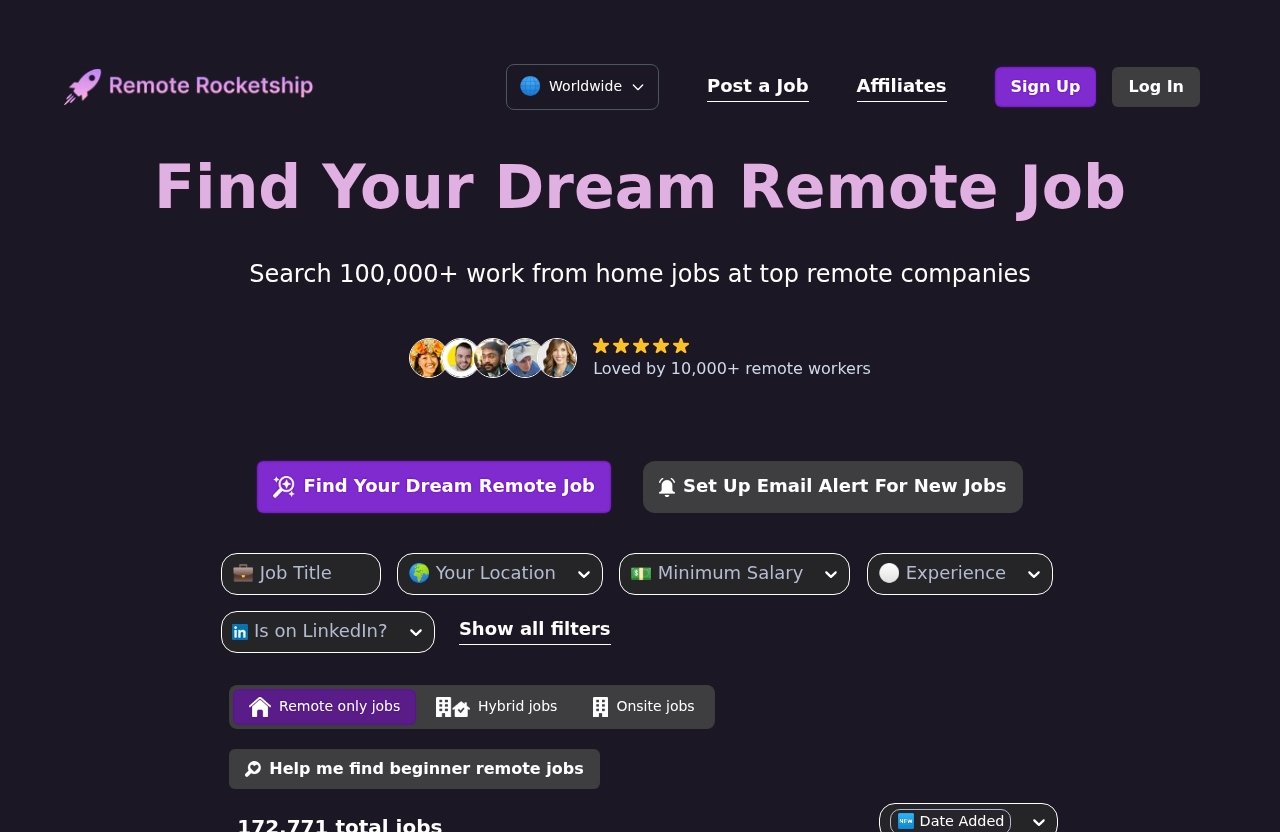
Remoterocketship can be considered as one option in a broader remote job discovery stack. It may suit job seekers who want another focused place to explore remote opportunities alongside company career pages, startup boards, and curated listings.
Use it as a focused remote job discovery tool
Rather than relying on any one source, add tools selectively and evaluate whether they surface roles relevant to your skills, location, and work preferences. For people comparing job boards other than LinkedIn and Indeed, Remoterocketship is one remote-focused option worth reviewing.
Before subscribing or relying on it, check the official site directly for the latest verified pricing, features, and availability. Those details can change, and they should be confirmed before making a decision.
Affiliate context and reader benefit
Land Remote Work may earn a commission if you choose to use the linked service, at no additional cost to you. That relationship does not change the core recommendation: use multiple sources and judge each one by listing relevance, transparency, and the quality of opportunities it helps you uncover.
The most useful remote jobs better than LinkedIn tools are the ones that improve your search process, not the ones that encourage endless browsing.
Who should consider it most
Consider adding Remoterocketship to your workflow if you are actively searching for remote work and want to compare another specialized discovery source with the boards and company career pages already in your routine.
It may be particularly relevant for candidates who have outgrown generic searches and want to explore curated remote listings. Still, always verify each employer independently and apply through official channels whenever possible.
Official website · Latest pricing & offers
FAQ
Is there a better job site than LinkedIn?
It depends on your goal. Niche remote job boards can be better for focused remote searches, while LinkedIn remains valuable for networking, recruiter visibility, and company research. The strongest approach uses both.
Where can I find remote jobs besides LinkedIn?
Look at curated remote boards, startup-focused sources such as Wellfound, company career pages, industry newsletters, and professional communities. Remote-first companies often publish roles through multiple channels, so direct career-page searches are essential.
What is a better alternative to LinkedIn?
The best alternative depends on the role type. Startup boards may be better for early-stage companies, specialized boards may be better for global or contract roles, and niche communities may uncover freelance work before it is widely advertised.
How do I find legitimate remote jobs?
Use reputable job sources, verify the employer through its official website and employee profiles, apply through the company’s careers page when possible, and never pay money to get a job. Be wary of rushed hiring, vague descriptions, and requests for financial or identity information too early.
The most reliable path to remote jobs better than LinkedIn is not replacing LinkedIn entirely. Use niche remote boards for discovery, company sites for direct applications, LinkedIn for validation and networking, and a safety-first process for every listing you pursue.
Related Reading
- Remote Rocketship pricing features 2026
- Remote Rocketship customer reviews in 2026
- Verify Remote Rocketship jobs
