
A remote rocketship warning does not automatically mean that Remote Rocketship is a fake service. In most cases, people searching this phrase are trying to understand two separate issues: whether the job board itself appears legitimate and whether the remote jobs they find through it are safe to pursue.
Those questions deserve different answers. A remote job board can be a real paid product while individual listings still carry risks such as impersonated employers, copied job descriptions, stale posts, or misleading recruiter outreach. The safest approach is to treat any board as a discovery tool—not as final proof that a role or employer is genuine.
Official website · Latest pricing & offers
What a “Remote Rocketship warning” really means in 2026
Why people search this phrase
A remote rocketship warning search usually reflects understandable caution. Remote work scams remain common because online hiring allows bad actors to hide behind convincing company names, fake recruiter profiles, and professional-looking application pages.
Job seekers may also be wary of paid job boards. Paying for access can create concern about whether listings are exclusive, whether the platform delivers enough value, or whether job seekers will encounter the same roles available elsewhere for free. Those are fair questions, but they are not automatic evidence of a scam.
In practical terms, a remote rocketship scam warning often relates to one of three things:
- Concern about paying for a remote-job search tool
- Concern that a listing could be fake or outdated
- Concern about sharing a resume or personal details online
Platform risk vs. employer/listing risk
The most useful distinction is between platform risk and listing risk. Platform risk concerns the business behind the job board: its pricing, cancellation process, stated policies, and whether it is transparent about what subscribers receive.
Listing risk concerns the actual employer and role. Even if a job board has real operations and a clear subscription model, a specific job can still be copied, stale, poorly described, or potentially used by an impersonator outside the board’s intended process.
This distinction matters because “is remote rocketship legit” is not exactly the same question as “is this particular remote role legitimate?” A careful applicant should evaluate both.
When a caution is justified
A remote rocketship warning is justified when an application process starts to look inconsistent with normal hiring practices. For example, be cautious if a recruiter contacts you from a free email account, asks you to move immediately to Telegram or text messaging, or requests money for equipment, training, or a background check.
Caution is also warranted when a job link sends you to a domain that does not match the employer’s official website. A real company may use an applicant-tracking system, but the connection should be clear and verifiable from the company’s own careers page.
The goal is not to assume fraud. It is to slow down long enough to verify the details before sharing sensitive information.
Is Remote Rocketship legit or risky?
What the official site claims
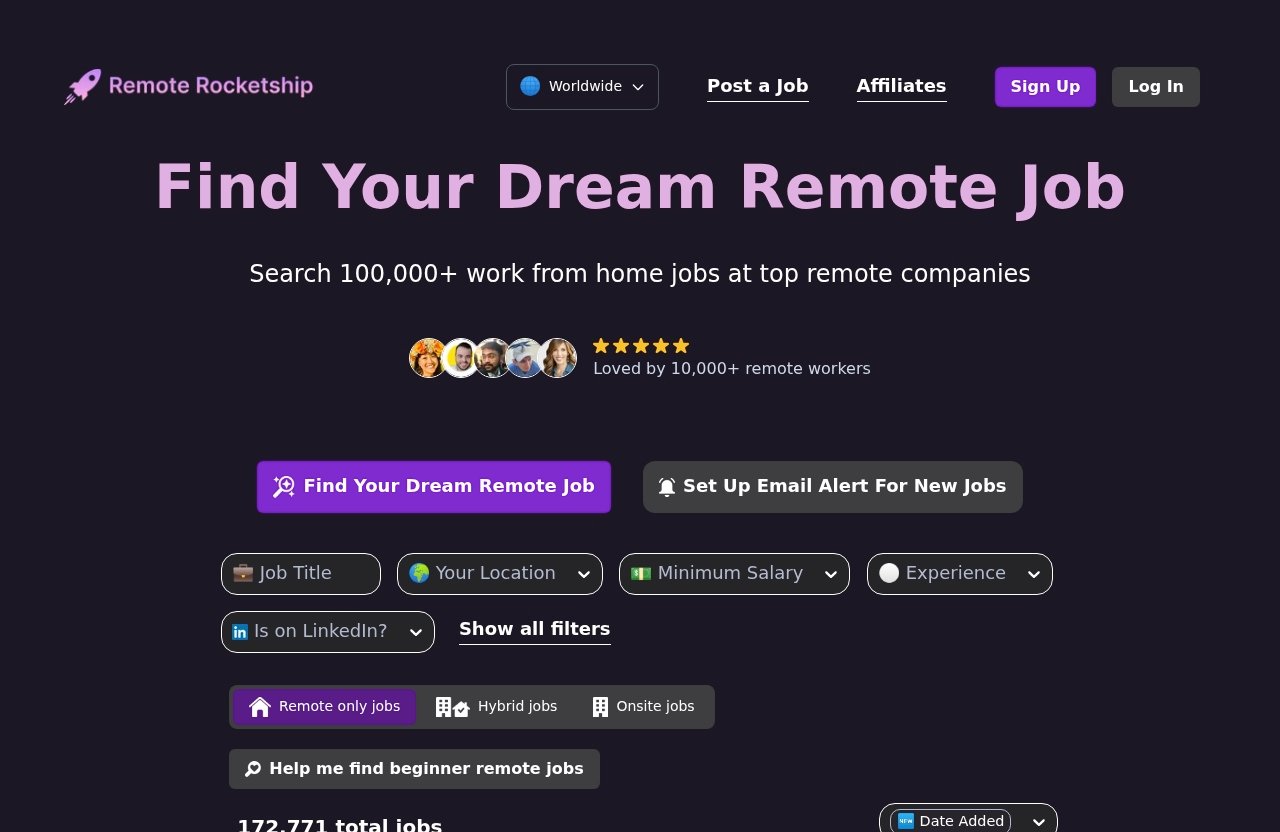
When assessing a remote rocketship warning, start with what the company officially represents. Remote Rocketship says it finds new remote jobs minutes after companies post them, allowing users to apply before the crowd.
Its homepage also states that it provides “100% remote” opportunities, “verified jobs only,” and “no scams, no junk.” According to those official claims, jobs are pulled directly from company career pages, scanned around the clock, and checked or verified.
Those statements describe the platform’s intended process and value proposition. They should not be interpreted as a guarantee that every application outcome, recruiter interaction, or external job page will always be safe.
What the pricing page reveals
Remote Rocketship has a visible paid subscription model rather than hiding access terms. The pricing page states a monthly option at $29 per month, a quarterly plan billed every three months at $59 total, and an annual plan billed once yearly at $99 total.
It also states that users can browse remote jobs for free before deciding whether to subscribe. The published policy information includes no commitment, cancellation at any time, cancellation in a few clicks, a 14-day money-back guarantee, and payment processing through Stripe.
Every plan is stated to include job discovery tools, salary, visa sponsorship, and seniority filters, hourly or daily email alerts, resume and cover-letter tools, resume-match insights, the Remote Job Search MasterClass, and API, CLI, and MCP access through an API key.
Why legitimacy and safety are not the same thing
The answer to “is Remote Rocketship legit” should be balanced. The official information describes a structured subscription product with defined pricing, cancellation terms, and features. That is different from an anonymous website that asks for money without explaining what it offers.
Still, platform legitimacy does not remove the need for independent review of each job. Listings can change after they are indexed. A company may close a role, alter its hiring process, or become the subject of impersonation attempts on unrelated channels.
In my view, the sensible standard for remote job seekers is simple: consider a board’s transparency, but verify the employer yourself. That is the foundation of responsible remote rocketship safety.
The biggest warning signs to check before applying
Remote Rocketship warning signs in recruiter behavior
Recruiter behavior often reveals more than a polished job description. A legitimate recruiter should be able to identify the employer, explain the role, and communicate through a traceable professional channel.
Watch for these remote job red flags:
- A recruiter uses a Gmail, Outlook, or unusual address instead of a company domain
- They insist on Telegram, Signal, WhatsApp, or text-only interviews immediately
- They refuse to schedule a video or phone conversation
- Their messages contain major spelling errors, inconsistent names, or copied text
- They pressure you to accept an offer before a meaningful interview
- They ask for bank details, government ID, or tax information too early
A recruiter using a third-party recruiting firm is not automatically suspicious. But you should be able to confirm that the staffing firm exists and that it is authorized to represent the employer.
Job post red flags
One remote rocketship warning sign is a role that sounds impressive but says very little. A real posting normally explains the company, team, responsibilities, qualifications, employment type, and location or work-authorization expectations.
Be cautious with jobs that promise unusually high pay for basic data entry, virtual assistant work, package forwarding, or “optimization” tasks. Scammers frequently use low-barrier roles because they attract applicants quickly.
Other signs include vague job titles, no named department, recycled language from unrelated companies, and requests to purchase equipment from a specific vendor. A legitimate employer may provide equipment, but it should not require you to deposit a check, buy gift cards, or send funds to a supplier.
Domain and email mismatches
A reliable way to verify remote jobs is to inspect the web address carefully. Copycat domains may differ from the real company domain by one letter, a hyphen, a country extension, or an extra word such as “careers,” “remote,” or “jobs.”
If the listing says you are applying to a well-known company, visit that company’s official website independently. Use the career link from its main navigation, then search for the same title, location, and requisition number.
A mismatch does not always prove fraud. Some employers use third-party applicant tracking systems. The key question is whether the official company site links to that same application system or confirms the role.
Too-good-to-be-true compensation or urgency
A credible remote job can offer strong compensation. The warning sign is not high pay by itself; it is high pay combined with no experience requirements, almost no interview process, and urgent pressure to act.
Treat “hiring today,” “start in one hour,” or “send your ID now to secure your spot” as a remote job scam warning. Legitimate employers can move fast, but they do not need applicants to make financial decisions or disclose highly sensitive data under pressure.
Before applying, use this quick checklist:
| Check | Safer sign | Warning sign |
|---|---|---|
| Employer identity | Official website and active company presence | No verifiable website or inconsistent name |
| Job location | Clear hiring location and work rules | “Worldwide” with no legal or payroll details |
| Application link | Matches official careers page | Unrelated or misspelled domain |
| Interview | Structured call with identifiable staff | Chat-only interview and instant offer |
| Payment | Employer pays you through normal payroll | You must pay, deposit, or purchase something |
Official website · Latest pricing & offers
How to use Remote Rocketship safely
Verify the employer outside the board
The best remote rocketship safety habit is independent confirmation. Do not rely only on the title, company logo, or description shown in a listing.
Search for the employer’s official website, business contact information, leadership team, and careers page. Then look for evidence that the company actually operates in the industry described by the job post.
If a listing is for a smaller company with limited public information, that does not make it fraudulent. It simply means you should require stronger confirmation before providing your resume, work samples, or personal data.
Cross-check the role on the company career page
A remote rocketship warning should prompt a simple cross-check: locate the role on the company’s official job board. Compare the title, location, responsibilities, salary information, and application destination.
If the role appears on the official company site, apply through that official route when possible. You can still use Remote Rocketship to discover opportunities early, but applying through the employer’s verified page reduces the chance of landing on a spoofed form.
If the posting is missing, it may have been filled or removed. Contact the company through contact details found on its official site rather than replying to an unexpected message.
Research the recruiter and domain
Before continuing with any recruiter, search their name alongside the company name. Review their professional profile carefully, looking for a work history that matches the role and an established network—not merely a newly created account with copied branding.
Also inspect email domains character by character. A message from companycareers.com may look close to company.com, but it is not the same thing.
This step is especially important after you receive a response. Many scams begin with a real-looking job post and shift into fraud during the supposed interview, onboarding, or equipment-purchase stage.
Protect your resume, email, and personal data
Safe remote job applications do not require you to reveal everything at once. Your initial resume should include your skills, work history, and professional contact information, but it should not include your Social Security number, full date of birth, banking information, or copies of identification documents.
Use a dedicated professional email address for job hunting. This makes it easier to track applications and reduces the damage if one email address begins receiving spam or suspicious outreach.
When you are ready to explore the service, you can browse Remote Rocketship’s job-search options and then apply the same verification process to every opportunity you consider. This site may earn a commission from qualifying referrals, but that does not change the need to assess each employer independently.
What the paid model means for job seekers
Why the platform charges
The paid model appears designed around speed, filtering, and job-search tools. Remote Rocketship says it identifies jobs soon after companies post them, and its plans include filters for salary, visa sponsorship, and seniority as well as hourly or daily alerts.
The subscription also includes resume-related tools, customized resume and cover-letter support, resume-match insights, educational material through the Remote Job Search MasterClass, and technical access through an API key. For active applicants, those features may be useful if they save time and help organize a broad search.
However, paying for access does not buy an offer, guarantee interviews, or eliminate the need to verify remote jobs. Consider the subscription a productivity expense, not an employment guarantee.
Who may benefit most
A paid board may suit job seekers who are applying consistently and want to see new openings quickly. It may be particularly relevant for experienced candidates with clear salary, seniority, or visa-sponsorship requirements who value focused filtering.
It can also help applicants who have already built a strong resume and know how to evaluate job quality. Earlier discovery only helps when you can respond with a tailored, credible application.
Remote Rocketship reviews and personal opinions can be useful context, but evaluate them carefully. Look for specifics about search workflow, support, cancellation, and job relevance rather than relying on vague praise or criticism.
Who should probably skip it
A remote rocketship scam warning mindset is especially useful for casual browsers. If you are not ready to apply actively, do not yet have a targeted role in mind, or only want to browse occasional openings, free company career pages may be enough.
You may also want to skip a paid plan if the advertised filters and alerts do not solve a real problem in your search. The site says users can browse jobs for free, which gives you a chance to evaluate whether its listings fit your goals before committing.
Read the billing terms before subscribing, keep proof of your purchase, and set a reminder to reassess whether you are using the service.
Safer alternatives and backup options
Free remote job boards
No single board should control your job search. Free sources can include official company career pages, professional networks, nonprofit or government employment resources, and established general job sites with remote filters.
The strongest defense against a remote job board scam is comparison. If the same position appears consistently on the employer’s official site and reputable job channels, that is more reassuring than seeing it in only one unfamiliar location.
Be equally cautious everywhere. A free board is not inherently safer than a paid one, and a paid board is not inherently safer than a free one.
Broader job search strategy
Build a search process that does not depend on a single listing source. Create a spreadsheet or tracker with the job title, company, application URL, date posted, recruiter name, follow-up date, and verification notes.
This makes duplicate listings easier to spot. It also helps you identify when a “new” role is actually an old posting that has been repeatedly republished.
A balanced approach includes direct applications, referrals, networking, carefully selected boards, and alerts from companies you genuinely want to join. That reduces urgency and makes it harder for scammers to exploit desperation.
When to combine boards with LinkedIn and company sites
For cautious applicants, the best pattern is: discover on a board, confirm on the company site, then research the people involved through professional channels. LinkedIn can help you identify employees and recruiters, but a profile alone is not proof of identity.
Use company websites to validate roles and official domains. Use professional networks to understand whether the team, recruiter, and organization appear consistent. Use job boards for reach and discovery.
This layered method is more dependable than trusting any individual source, including a platform that advertises verified listings.
Final verdict: should you trust Remote Rocketship in 2026?
Best-case use case
In the best case, Remote Rocketship functions as a fast discovery tool for people who want to find remote roles soon after they are posted. Its official site describes transparent paid plans, browsing access before subscribing, cancellation flexibility, a 14-day money-back guarantee, and job-search features aimed at active applicants.
For someone who values early alerts, filters, and application tools, it may be worth evaluating based on their search volume and budget.
Main risks to remember
The main remote rocketship warning is not that every listing should be presumed fraudulent. The more realistic risk is over-trusting the presence of a job on any board.
Jobs can be stale, duplicated, misleading, or targeted by impersonators after publication. Recruiter behavior, domain mismatches, urgent payment requests, and inconsistent details remain important remote job red flags regardless of where you first found the role.
Bottom line for cautious applicants
My conclusion is balanced: Remote Rocketship may be legitimate as a platform, based on its official claims and published subscription terms, but no job board can replace your own due diligence.
Use it to discover opportunities, then verify the employer, confirm the role on the official careers page, inspect domains, and protect your personal information. A thoughtful remote rocketship warning approach is not fear—it is smart job-search hygiene.
Official website · Latest pricing & offers
FAQ
Is Remote Rocketship a scam?
The official site presents Remote Rocketship as a paid remote job board with published pricing, stated features, cancellation terms, and a 14-day money-back guarantee. The more important caution is that applicants should independently verify every employer and job listing before applying or sharing sensitive information.
How can I tell if a remote job listing is fake?
Look for vague company details, mismatched email or website domains, rushed chat-only interviews, unusually high pay for little experience, and any request for money. Confirm the role through the employer’s official career page before proceeding.
Does Remote Rocketship verify every job?
Remote Rocketship’s official site says listings are checked and verified and that jobs are pulled from company career pages. Even so, applicants should confirm the employer and role themselves because listings can change and outside impersonation attempts can occur.
Is it safe to upload my resume?
It can be reasonable to share a standard professional resume through a verified application process. Do not include banking information, government ID numbers, your full date of birth, or other unnecessary sensitive details, and confirm the employer and application domain first.
What should I do if a recruiter asks for money?
Treat it as a major warning sign. Stop the process, do not send money or gift cards, do not deposit checks for equipment purchases, and report the listing or contact attempt to the platform and the company being impersonated.
